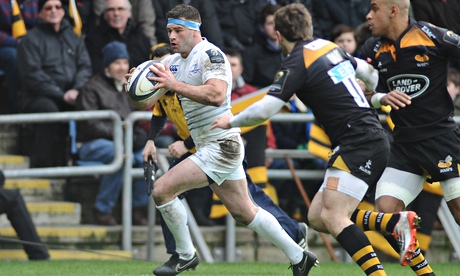
To the relief, no doubt, of the winners of European rugby’s political battle of the past few years, matters on the field have gone the same way. The quarter-finalists of the Champions Cup are resoundingly French and English. Leinster are a proud exception, and at times they played on Saturday like a side that believed they could become champions of Europe for the fourth time. At other times – and perhaps when it mattered, at the end of their last pool game against Wasps – they looked slightly bemused by the size of the task, by the brutal contact that must be endured in the new Europe. The lack of an all-round-Europe presence in the last eight may come as nothing more than confirmation of business as usual to the four regions of Wales, the two districts of Scotland and the one club of Italy. Wales have missed out on qualification five times in the past 10 years, and have been in the quarter‑finals once in the past four. That was in 2012 when Cardiff Blues, who had lost an epic place-kick decider after their 2009 semi-final against Leicester ended 26-26 after extra-time, suffered horribly in Dublin, going down 34-3 to Leinster. As a high point to stir the memory and give Wales a little muscle at the negotiating table, it lacked a little clout.
From Scotland, only once has a team qualified from the pool stages in the past decade, although to be fair to Edinburgh in 2011-12, they beat Toulouse 19-14 in the quarter-finals at Murrayfield and put up stern resistance against Ulster in Dublin in the semi, before losing 22-19. To have Glasgow in contention in this inaugural season of the Champions Cup, designed by French and English architects for the benefit of clubs from France and England – they kick off against Bath away on Sunday at 1.00pm – is in a way a triumph. And confirmation of a general reawakening in Scottish rugby.
Italy have never qualified. The political reshaping of qualification and the number of participating teams in the Champions Cup coincided with an internal upheaval. Treviso, the nearest Italy have ever had to a competitive club at this level, had a clear-out of players in anticipation of an exit from the Pro 12 League. When there was an about-turn in Italian plans, Treviso were left in no shape to be a force among the Celts, let alone in the company of the great rugby houses of Europe.
If this season’s quarter-final lineup does not have an altogether unfamiliar look to it, there is something missing – namely an Irish team to accompany Leinster through the trials ahead. In the course of the past 10 seasons, there have been at least two provinces in the knock-out stages on all occasions bar one. That was in 2008, when Munster went on to beat Toulouse in the final in Cardiff and become champions for the second time. One that year was enough.
In 2012 and 2014, Ireland had all three of Munster, Leinster and Ulster in the last eight. Munster and Leinster were champions five times between them in nine seasons. That they ruled Europe irked the French and English, who accused them of coasting in the Celtic league, of protecting their star material in order to be able to unleash them fully fresh in the Heineken Cup. The accusers also blamed the entire Celtic-Italian league for the ease with which it waved its participating teams into the elite European tournament. Qualification? The Pro 12 didn’t know the meaning of the word.
There was one last Irish target in their sights. Dublin, home of the old ERC, the governing body. In the original power-brokering, horse-trading and exchanging of favour for favour that went into the construction of a cross-border professional structure, the Irish were the cutest by far at garnering a good deal for themselves while apparently keeping everybody else sweet.
There was a tax deal that could be done to make Dublin the headquarters of the new order. And who could argue with that in a rugby world still not entirely sure how money would change the game? And surely the central powers of the English and the French would be able to accommodate the little old fringes on the field, wouldn’t they now? Otherwise there would be no European element to their plan to lord it over everyone.
The Irish got away with it. In fact, they were too good at the art of smiling and winning. The victories of Munster and Leinster stopped being quaint and lovable; they were proof that the system was skewed not the way of those that had the money, the playing numbers and the viewing numbers, but towards Ireland.
It was good while it lasted, but England and France rule now. Look at the last eight and cry, you Celts. It is perhaps how it should be, a truer reflection of how rugby is in post-crash Europe. But perhaps it sort of makes a neutral raise a little cheer for Glasgow on Sunday, or wish Leinster all the best in their lonely furrow in the knock-out rounds ahead.