
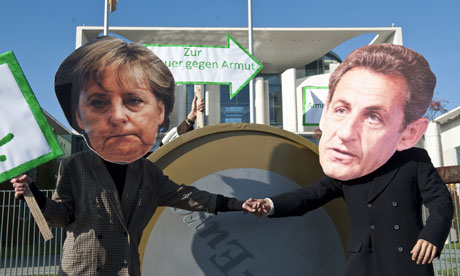
A deadline is a line and, if you step over it, you're dead. Or so a former boss used to say. In the case of the Franco-German talks on a grand plan, however, the Sunday deadline for agreement has been abandoned and yet nothing has happened. Markets this morning are calm. Why?
Investors' thinking seems to be that the adoption of a new deadline - "Wednesday, at the latest," according to last night's communiqué - could be construed as good news, or at least neutral from the point of view of share prices and bond prices. This theory says that more time to reach agreement makes a watertight plan more likely to happen.
Really? The notion sounds like a triumph of hope over experience. Okay, last night's statement still promised "a global, ambitious response to the crisis currently facing the eurozone" but it seems just as likely that more time will simply entrench disagreements between Germany and France. As the clock ticks, the definition of "ambitious" could simply be watered down.
After all, if we've learned anything of the past two years of crisis in euroland, it's that delay tends to strengthen Germany's negotiating hand. That's why haircuts of greater than 21% for holders of Greek bonds can be contemplated. Since the July agreement was struck, Greek bonds have fallen further in value, allowing Germany to point to market prices are say "look, the market has already got there".
In the case of the European Financial Stability Facility (EFSF) - the rescue fund that seems to the source of most of the disagreement - Germany's position seems clear. It doesn't want to increase its guarantees to the €440bn (£383bn) fund and it doesn't want to oblige the European Central Bank to provide a financial backstop to the EFSF. That still leaves room for the EFSF's firepower to be leveraged up. But Germany's stance doesn't seem likely to yield any windfalls for private-sector investors. Don't expect the calm to last.











