Europe has seen a “dramatic resurgence” of measles, with more cases reported in the first half of 2019 than the whole of last year, according to the World Health Organisation (WHO).
Almost 90,000 people in Europe were reported to have the disease between January and June this year compared to 84,462 cases in 2018.
The figures came as the UK, Albania, Greece and the Czech Republic lost their measles-free status for the first time since records began in 2012.
By the end of 2018, 35 countries had achieved or sustained measles elimination, the European Regional Verification Commission for Measles and Rubella Elimination (RVC) said.
The UK had been declared measles free in 2017.
Tedros Adhanom Ghebreyesus, WHO director-general, said misinformation about vaccines, particularly that shared on social media, is “as contagious and dangerous as the diseases it helps to spread”.
Dr Gunter Pfaff, chair of the RVC, added: “Re-establishment of measles transmission is concerning.
“If high immunisation coverage is not achieved and sustained in every community, both children and adults will suffer unnecessarily and some will tragically die.”
Professor Martin Marshall, vice-chairman of the Royal College of GPs, said the findings were “disheartening”.
He added: “While take-up of the MMR vaccination across the UK is still high, it is not high enough, and we have actually seen a small decline in recent years.
“It is clear that we are still suffering from entirely debunked claims around MMR that were perpetuated in the nineties – and are now resurgent on social media and other online platforms.”
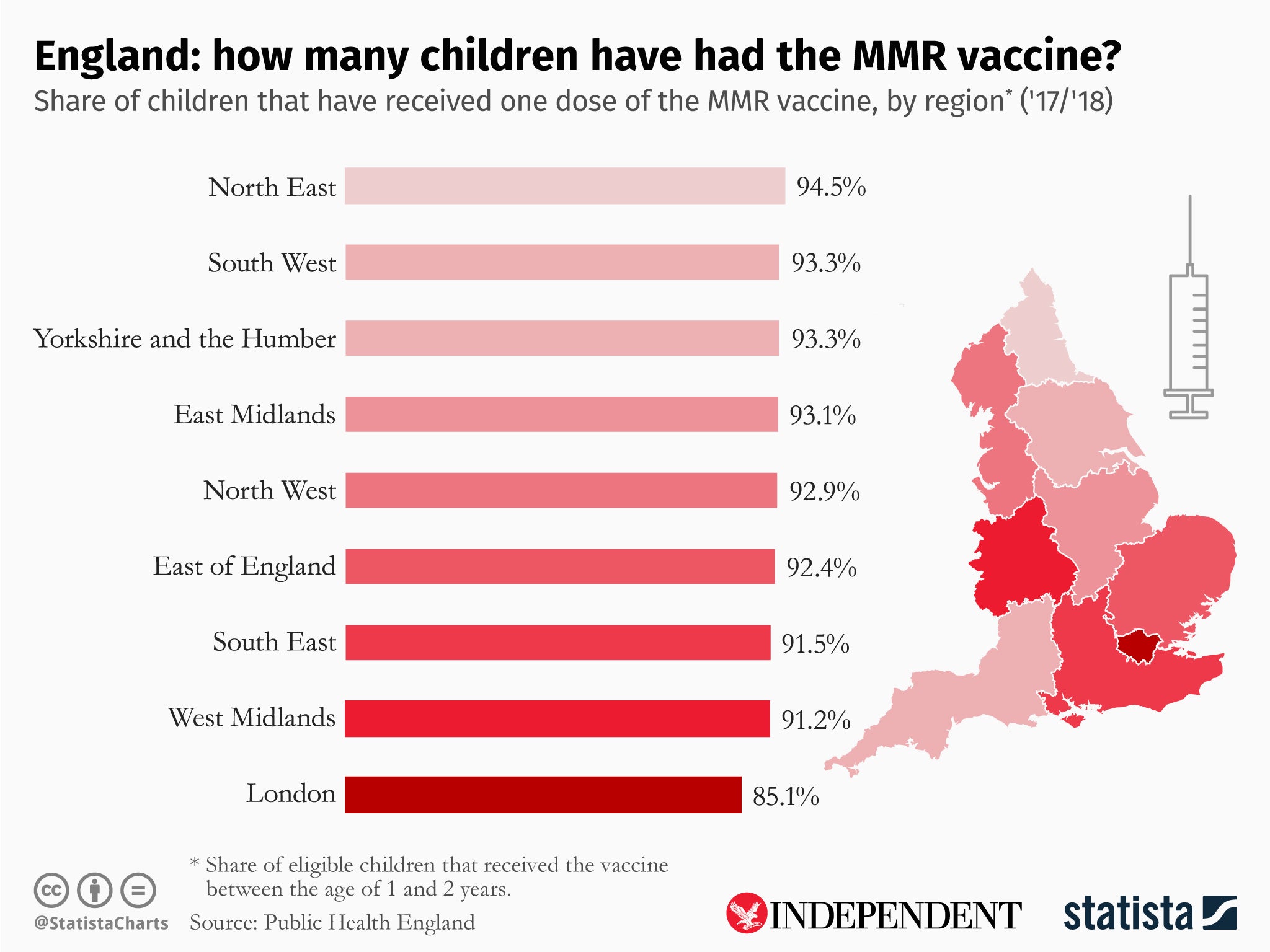
It comes as WHO welcomed a decision by social media company Pinterest to only provide evidence-based information from leading health experts to its users in a bid to tackle health misinformation.
The company will give users resources from WHO, the Centres for Disease Control and Prevention (CDC), the American Academy of Pediatrics (AAP), and the WHO-established Vaccine Safety Net (VSN) when they search for a related term.
WHO said in a statement: “Social media platforms are the way many people get their information and they will likely be major sources of information for the next generations of parents.
“We see this as a critical issue and one that needs our collective effort to protect people’s health and lives.”
Press Association contributed to this report.