
The EU's woodland is marginally growing, with a reported 0.1% year-on-year increase, according to Eurostat.
Taking into account both forest expansion and losses, whether from logging or natural events like fires, droughts and pests, Ireland leads, way above the EU average, with a net 1.2% annual growth in wooded area.
Next are Estonia (+0.33%), Bulgaria (+0.26%) and France (+0.25%). Only a few countries reported (minimal) drops — all between -0.06% and -0.01% — namely Denmark, the Netherlands, Slovenia, Sweden, and Poland.
What's the controversy behind Portugal's forest growth?
Woodland losses aside, however, Portugal's growth rate is unmatched anywhere in Europe.
In just a year, its wooded area rose by an impressive 11%, according to Eurostat, but why is this the case?
The country's boom comes after years of reforestation efforts, but it is also owed to its forests' relatively young age and especially the widespread use of eucalyptus.
This exceptionally fast-growing tree, native to Oceania, has made Portugal one of Europe's leading paper producers, but has also brought with it massive environmental threats.
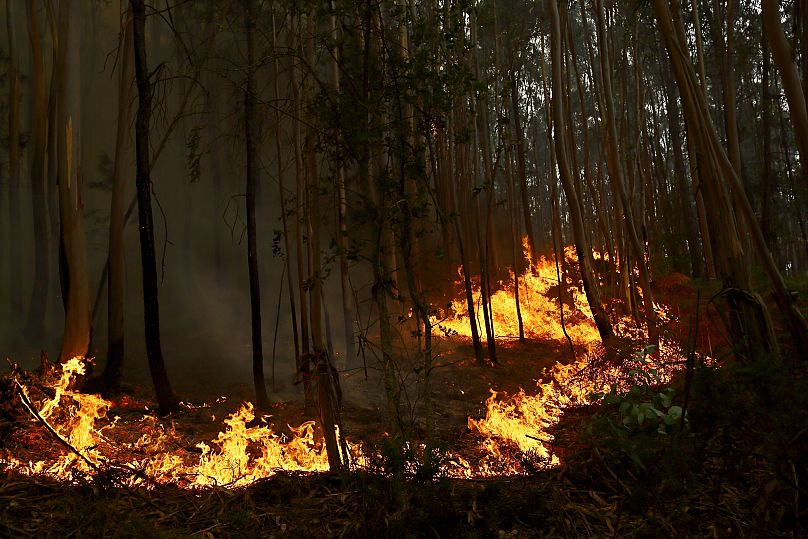
Its leaves, rich in highly flammable oils, have multiplied wildfire risks exponentially. On top of that, eucalyptus requires enormous amounts of water, drying up the soil beneath.
How is Portugal trying to change its green areas for good?
In 2025 alone, the country lost 263,000 hectares to fires, the highest share in the EU relative to its size, roughly eight times the size of Malta, according to Copernicus.
Now the country is trying to turn the tide by improving forest mapping and — crucially — incentivising the planting of native species like holm and cork oak.
In November, Portugal's nature conservation institute ICNF distributed more than 100,000 trees and shrubs across the country, including maritime pines, ash trees and rosemary.
Urban and regional parks can also join the project by submitting their applications to the Floresta Comun Project.
Furthermore, the EU, as well as Portugal's national organisation, like the Foundation for Science and Technology, have been rolling out hundreds of thousands of euros in schemes aimed at oak protection and regeneration.