Europe is spending more on its military than at any point since the 1950s. Defense budgets are climbing across the continent. New targets have been set, new factories are being built, and the political will to rearm — absent for decades — has finally arrived.
The problem is the bill.
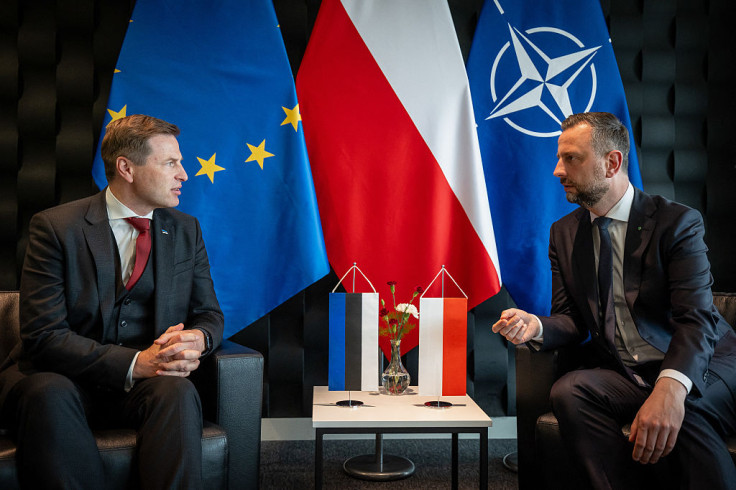
European nations are seeing prices for defense supplies that have climbed in some cases by more than 50% in the last two years, Estonian Defense Minister Hanno Pevkur warned Saturday at the Lennart Meri Conference in Tallinn — one of northern Europe's most prominent annual gatherings on security policy.
"Prices are going up," Pevkur told an audience at the three-day conference. "I have discussions with my national armament director constantly."
The remark was brief but pointed — a candid admission from the defense minister of one of NATO's most defense-serious nations that the alliance's long-overdue rearmament push is colliding with a hard economic reality: when every country in Europe tries to buy weapons and ammunition at the same time, defense manufacturers raise their prices.
The Paradox of Rearmament: The More Europe Spends, the More It Costs
The backdrop to Pevkur's warning is one of the most dramatic military spending surges in modern European history.
Global defense spending reached a record $2.63 trillion in 2025, driven heavily by Europe. Across European NATO members, military budgets jumped 14% in 2025 alone — the steepest single-year increase since 1953. The rise has been fueled by Russia's war in Ukraine, growing alarm about long-term U.S. security commitments under Trump, and a new NATO target — agreed at the Hague Summit in 2025 — requiring all members to reach 5% of GDP in defense spending by 2035.
All 23 EU member states that are also NATO members now meet or exceed the previous 2% of GDP benchmark. Germany, long the alliance's most conspicuous under-spender, increased defense spending by 24% to $114 billion in 2025 — surpassing the U.K. to become Europe's largest defense investor and the world's fourth largest. Berlin has committed to further increases, with funding projected to reach €162 billion by 2029. For the first time in NATO history, a European ally — Norway — has surpassed the United States in defense spending per capita.
Estonia itself has raised its defense spending to 5% of GDP — the highest in Europe as a share of national income, excluding Ukraine. Poland allocates 4.48% of GDP, Lithuania 4%, Latvia 3.73%.
But all of that new money is chasing a limited supply of weapons, ammunition, and military hardware — and sellers know it.
Why Prices Are Surging: Supply Chains Built for Peace
The 50% price increase Pevkur flagged is not an accident. It is the predictable result of a European defense industrial base that spent three decades optimizing for peacetime — cutting costs, consolidating suppliers, and abandoning the redundant production capacity that made sense during the Cold War but seemed wasteful in an era of low threats and tighter budgets.
Decades of underinvestment, offshoring, and dependence on "just-in-time" logistics left the alliance ill-prepared for sustained warfare. Russia's invasion of Ukraine in 2022 revealed the gap in brutal terms: within months, Ukraine was firing artillery shells faster than NATO's entire industrial base could replace them. Western stockpiles were drawn down to provide Ukraine with ammunition that manufacturers could not replace at speed.
The ammunition problem remains severe. Russia is producing roughly 250,000 artillery shells per month. NATO's 2026 production target of 267,000 rounds monthly would reach only bare parity — not the surplus needed for both stockpiling and Ukrainian resupply. Europe's single major TNT producer is in Poland. Key explosives like RDX face persistent bottlenecks. Patriot air defense systems carry delivery delays of up to ten years.
The same dynamic that inflated consumer goods prices during pandemic-era supply chain crises is now inflating defense prices: too much money, not enough production capacity, and a seller's market where manufacturers — knowing governments have no choice but to buy — can charge what the market will bear. According to sources familiar with procurement negotiations cited in Bloomberg's reporting, some defense contractors are offering the same equipment to different government buyers at dramatically different prices.
Estonia: Small Country, Loudest Warning
The fact that this warning came from Estonia is not incidental.
Estonia is the canary in the coal mine of European defense. It borders Russia directly, spends more on defense as a share of GDP than almost any other NATO member, and has been one of the most vocal voices demanding that the rest of the alliance take the Russian threat seriously long before it became fashionable to do so. When Estonia's defense minister talks about procurement prices, he is not speaking from a comfortable distance — he is speaking as the chief buyer for a country that lives with the threat next door.
Estonia is also putting its money where its mouth is on domestic production. A Swedish defense company — widely believed to be BAE Systems' Bofors subsidiary — has agreed to invest at least €300 million in a major 155mm artillery shell factory in northeastern Estonia, with production of short-, medium- and long-range munitions expected to begin in 2027. Estonia's state-owned company Hexest AS is building an RDX explosives facility expected to be operational by 2028. A broader defense industry park in Ermistu is already hosting four companies.
The logic is straightforward: if defense manufacturers are going to charge a 50% premium to sell you weapons, build the capacity to produce your own.
McKinsey: Equipment Stocks Still Below 2021 Levels Despite Record Spending
A February 2026 report by McKinsey underscored the depth of the problem. Even though investment has increased sharply, total equipment stocks in European NATO countries remain below their 2021 levels, reflecting military donations to Ukraine, the retirement of legacy systems, and long delivery timelines for new equipment.
In other words: European countries are spending record amounts of money and still falling behind on actual hardware in inventory. Equipment is becoming more modern — more platforms from recent generations are appearing across all major categories — but deliveries are lagging the spending. McKinsey projects that equipment availability and military capabilities are expected to improve more visibly only as deliveries from recent orders begin to accelerate in 2026 and 2027.
Meanwhile, European NATO forces continue to operate a highly fragmented set of platforms, with fragmentation levels more than four times higher than in the United States — a structural inefficiency that raises maintenance costs, complicates logistics, and makes interoperability across national forces far more difficult than the alliance's political statements imply.
The Ankara Summit and What Comes Next
The pricing crisis Pevkur described will be front and center when NATO leaders gather in Ankara, Turkey in July 2026 for the alliance's annual summit. The meeting is expected to focus heavily on the gap between spending pledges and actual military readiness — and on whether the new 5% of GDP target agreed at The Hague is achievable without either inflating defense industry profits or triggering a broader realignment of how the alliance procures equipment.
Ahead of the Ankara summit, all NATO allies now exceed the previous 2% of GDP defense spending target — a milestone that would have seemed impossible as recently as 2021. In 2025 alone, European allies and Canada increased defense spending by 20% from the prior year. The political will is there. The money is arriving.
The problem Pevkur identified — politely, briefly, at a security conference in Tallinn — is that the industrial capacity to absorb all that money at reasonable prices does not yet exist. Defense manufacturers are rational actors: when demand surges and supply is constrained, prices rise. The 50% increase in two years is not a scandal. It is Economics 101.
The question Europe now faces is whether it can build enough new domestic production capacity, coordinate procurement efficiently enough across 30-plus allied nations, and move fast enough that the next two years of record spending actually translates into weapons on the ground — rather than profits on defense contractors' balance sheets.
For now, Hanno Pevkur is still having those conversations with his national armament director. Constantly.