For all the concern over trade flows and balances nowadays, the largest deficit the world must confront is one of leadership. With the United States retreating from its global role, someone needs to step up. But who?
Henry Kissinger once said, "Peace can be achieved only by hegemony or by balance of power." The same could perhaps be said of trade, or even of globalisation itself. It is no accident that the two great eras of globalisation -- the decades leading up to World War I and the last 75 years -- were characterised by balance of power and hegemony, respectively.
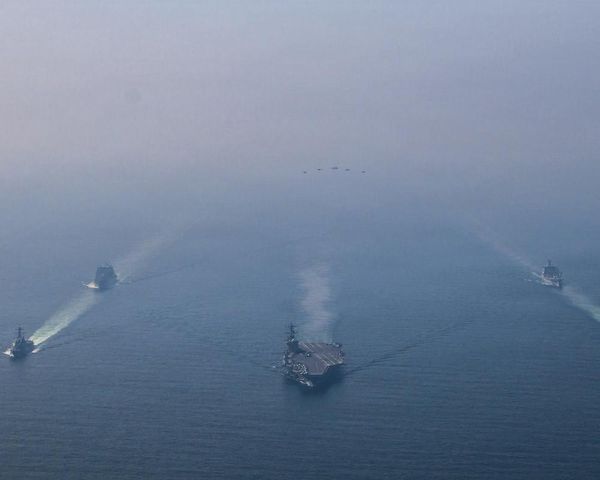
Of course, trade requires more than the absence of conflict. Like all economic activity, it flourishes when property rights are respected, taxation is efficient and purposeful, letters of credit are honoured, tariffs and other barriers are removed, and so forth. In short, effective trade demands clear rules, typically enforced by a hegemon. In the age of the British Empire, the Royal Navy combatted piracy; for the last 75 years, the US Navy has been responsible for keeping sea-lanes open.
International institutions have also played an essential role. But here, too, the hegemon's support is crucial. Without US backing, it is unlikely that the General Agreement on Tariffs and Trade and its successor, the World Trade Organisation, could have gained sufficient authority to deepen and safeguard the post-war trading system. That is why US President Donald Trump's embrace of protectionism is so dangerous.
The Trump administration wants the benefits of hegemony, but is unwilling to bear the costs. Those costs extend well beyond military spending and include, for example, issuance of the world's main reserve currency. This position confers considerable advantages on the US, but it also requires the US to run persistent trade deficits, in order to supply the rest of the world with sufficient dollar liquidity.
Mr Trump's mercantilist approach is simply inconsistent with hegemony. But even if US protectionism proves to be a short-run aberration, and Mr Trump's successor reverses his damaging trade policies, America's global status is in relative decline, particularly vis-à-vis a rising China. In other words, US dominance is likely to come to an end, regardless of who succeeds Mr Trump.
To ensure that US hegemony can give way to a peaceful and prosperous balance of power, more varied and visionary leadership will be required. Here, the European Union -- one of the world's largest economies and a key defender of liberal values -- has a vital role to play. But it first must get its own house in order, assuming responsibility for its own security -- military, cyber, economic and financial.
The challenge ahead for the EU is daunting. It must address its democratic deficit, implement sensible border and immigration policies, and shore up its financial foundations -- tasks that will ultimately take decades. To achieve these goals, Europe's leaders must make clear that the days of relying on the US to carry out the heavy lifting of global leadership are over. German Chancellor Angela Merkel opened that discussion in a Munich beer hall during her election campaign last year. Now that the election is over, the topic must not be allowed to fade into the background.
Europe must also strengthen its financial footing. A single European financial market without a credible banking resolution mechanism will always be prone to crisis. That, in turn, requires the sharing of obligations -- for example, through common deposit insurance or an emergency backstop for systemically important financial institutions. Debt mutualisation is anathema to many in Europe. But, as the eurozone crisis clearly demonstrated, countries cannot enjoy the advantages of a common market unless they fulfill the necessary common obligations.
Finally, if the US is unwilling to play its role as the world's leading champion of free trade, Europe must take over. Trade leadership should come easy to a continent that excels at free and open economic ties. It will require a balance of toughness, pragmatism, and diplomatic skill. Above all, the EU needs to lead by example. Eliminating its remaining external tariffs, even if largely symbolic, could reinforce the simple truth that trade is not a zero-sum game, but a mutually beneficial endeavour.
With the US in retreat and China's ascendant, the transition from a hegemonic global order to one characterised by a balance of power is underway. But the transition cannot be left to chance, with countries assuming that everything will work out naturally. Leadership is essential, and the outcome for the world depends crucially on whether, and when, the EU recognises its responsibility. - PROJECT SYNDICATE
Larry Hatheway is Chief Economist at GAM Holding.