Summary
That’s it from me. Here’s a reminder of the draw in full.
Ukraine v Slovenia
Sweden v Denmark
Bosnia and Herzegovina v Republic of Ireland
Hungary v Norway
The first legs will be played as above on the 12-14 November, with the return legs on 15-17 November. The away goals rule applies.
See you next time. Bye!
Olexandr Zavarov, Ukraine coach:
It is a fine draw for us, we can be happy with that. It would be important to get some advantage in the home leg before heading to Slovenia. And it is also important to avoid any underestimation of Slovenia, which was probably the case in the past. Our players have to approach these games with the utmost responsibility.
The “past” that Zavarov is specifically talking about is their Euro 2000 qualifying play-off against Slovenia, when Ukraine threw away a 2-1 first leg advantage to lose 3-2 on aggregate. That was Slovenia first and only Euro finals appearance to date.
“We’ll be speaking to Martin O’Neill, a very excitable man.” Sky Sports News are really trying to liven up your Sunday.
Updated
Sweden have played Denmark 104 times. 104! Sweden have won 45 occasions, Denmark 40 times, whilst there have been 19 draws. There is a goal difference of just 12 (to the Swedes) between the two teams in all those matches. Even Steven.
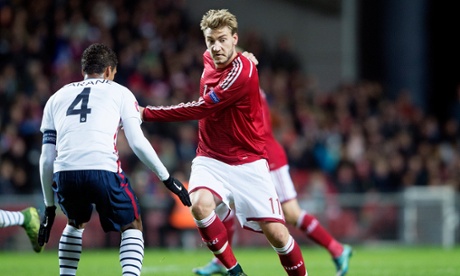
Denmark’s top scorer in qualifying? Nicklas Bendtner, with … er … two goals.
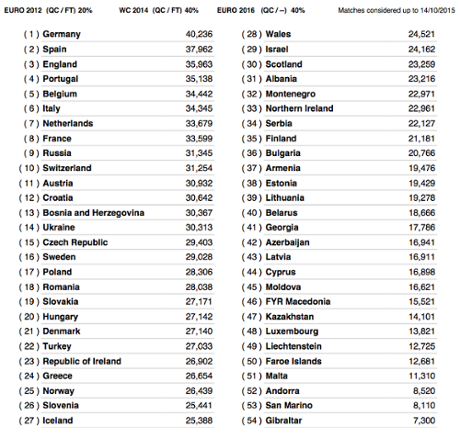
In case you were wondering, the seedings were based on Uefa coefficient ranking. Denmark were just two points from being drawn as the final seeds instead of Hungary!
Updated
Ireland have played Bosnia just once in their history, back in 2012, when Shane Long (who else?) got the winner for the Republic in a friendly.
The draw in full
Ukraine v Slovenia
Sweden v Denmark
Bosnia and Herzegovina v Republic of Ireland
Hungary v Norway
The first legs will be played as above on the 12-14 November, with the return legs on 15-17 November.
Updated
Final draw: Hungary v Norway
A touch for the Norwegians.
Third draw: Bosnia and Herzegovina v Republic of Ireland
Not bad, lads. Not bad.
Second draw: Sweden v Denmark
The Scandinavians collide!
First draw: Ukraine v Slovenia
Martin O’Neill breathes a sigh of relief!
There is some considerable waffle being spouted on stage. We’re still a few miunites away I reckon. Former French striker Dominique Rocheteau is helping to recount some of the highlights from their successful 1984 Euro tournament.
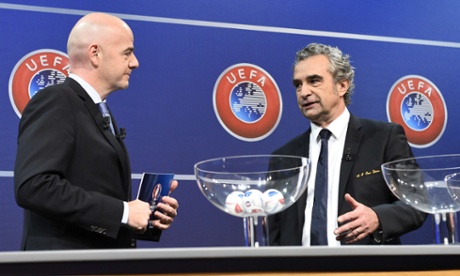
Michel Platini, star of that team and Uefa president, unfortunately couldn’t make it down today. He’s got a suspension or something.
Updated
Here we go then! Keys in the bowl!
SEEDED
Bosnia and Herzegovina (third in Group B)
Top scorer: Edin Džeko (7 goals)
Qualifying record: P10 W5 D2 L3 F17 A12 Pts17
EURO best: never qualified
Last EURO: N/A
EURO appearances: 0
Ukraine (third in Group C)
Top scorer: Andriy Yarmolenko (4 goals)
Qualifying record: P10 W6 D1 L3 F14 A4 Pts19
EURO best: group stage 2012
Last EURO: 2012 (group stage)
EURO appearances: 1 (2012)
Sweden (third in Group G)
Top scorer: Zlatan Ibrahimović (8 goals)
Qualifying record: P10 W5 D3 L2 F15 A9 Pts18
EURO best: semi-finals 1992
Last EURO: 2012 (group stage)
EURO appearances: 5 (1992, 2000, 2004, 2008, 2012)
Hungary (third in Group F)
Top scorer: Dániel Böde, Krisztián Németh (2 goals)
Qualifying record: P10 W4 D4 L2 F11 A9 Pts16
EURO best: third place 1964
Last EURO: 1972 (fourth place)
EURO appearances: 2 (1964, 1972)
UNSEEDED
Denmark (third in Group I)
Top scorer: Nicklas Bendtner (2 goals)
Qualifying record: P8 W3 D3 L2 F8 A5 Pts12
EURO best: winners 1992
Last EURO: 2012 (group stage)
EURO appearances: 8 (1964, 1984, 1988, 1992, 1996, 2000, 2004, 2012)
Republic of Ireland (third in Group D)
Top scorer: Robbie Keane (5 goals)
Qualifying record: P10 W5 D3 L2 F19 A7 Pts18
EURO best: group stage 1988, 2012
Last EURO: 2012 (group stage)
EURO appearances: 2 (1988, 2012)
Norway (third in Group H)
Top scorer: Alexander Tettey (3 goals)
Qualifying record: P10 W6 D1 L3 F13 A10 Pts19
EURO best: group stage 2000
Last EURO: 2000
EURO appearances: 1 (2000)
Slovenia (third in Group E)
Top scorer: Milivoje Novakovič (6 goals)
Qualifying record: P10 W5 D1 L4 F18 A11 Pts16
EURO best: group stage 2000
Last EURO: 2000
EURO appearances: 1 (2000)
We’re five minutes away from the draw in Uefa’s HQ in Nyon.
The first legs of the four fixtures will take place during the next international break on 12, 13 and 14 of November. The return legs will be played on 15, 16 and 17 November.
Hello all. So here we have it, it’s simple enough: eight teams, four places left at Euro 2016.
Seeded: Bosnia and Herzegovina, Ukraine, Sweden, Hungary
Unseeded: Denmark, Republic of Ireland, Norway, Slovenia
On paper, there isn’t all that much between the two pots. Ukraine are arguably the strongest seeded team, and the one that the Republic of Ireland would most like to avoid. Hungary probably the weakest.
Bosnia and Herzegovina have Eden Dzeko and Miralem Pjanic.
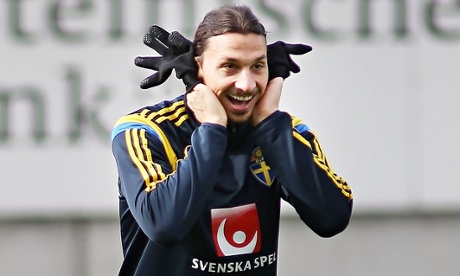
Sweden have Zlatan. As I said … simple.
Michael will be here soon. In the meantime, here’s what Martin O’Neill said following the Republic of Ireland’s defeat against Poland.
Rather than dwell on Sunday’s anticlimatic 2-1 defeat in Poland, the Republic of Ireland manager, Martin O’Neill, emphasised the positive aspects of a Euro 2016 campaign that will still finish on a high if his team emerge triumphant from a two-leg play-off in November.
On the back of a thrilling win over Germany in Dublin, Ireland went to Warsaw confident of gaining at least the high-scoring draw they needed to qualify for France but Poland prevailed and progressed to the finals instead. O’Neill says finishing third in a group that also included Scotland and the world champions Germany was a laudable feat and has convinced him that his team are good enough to come through next month.
“I said to the players in the dressing room that I would have taken this situation,” O’Neill said. “When we saw the group in the first place, I may well have taken it before we even kicked a ball in Georgia in the very first game. What I said has come to fruition: teams have taken points off each other. I heard Gordon Strachan saying that they’re out despite us and Poland not beating them, but we’ve takenfour points off the world champions. Scotland didn’t do that. So we should put this into perspective. I’m disappointed by the Poland defeat but we’re still here, still fighting. We’re not out of this, not by a long shot.”
Ireland will find out the identity of their play-off opponents when the draw is made in Nyon on Sunday. The Irish are unlikely to be seeded for the draw and their most probable opponents include Sweden, Bosnia-Herzogovina and Croatia. “I’ll take on any of them,” O’Neill said.
The red card for John O’Shea in Warsaw, and the yellow for Jon Walters, deprives Ireland of two of their most trusted players for the first play-off game and O’Neill’s disappointment at their losses was evident in his post-match call for Uefa to reform the system so that suspensions picked up in the group phase are not carried over into play-offs. He said the system was particularly unfair in view of the fact that Group I had only five countries, meaning they played fewer matches than those in other groups and thus ran less risk of incurring costly bans. Denmark will be in the play-off after finishing third in that group.
The sense of injustice was all the more acute in the case of Walters, as the manager believes the Stoke City forward was booked because of Robert Lewandowski’s reaction to an innocent challenge. “That is a real blow,” O’Neill said of the ban of a player whose strength and dynamism have epitomised much of what Ireland have done well in the campaign. “Having seen the replay, I think he’s harshly done by. Lewandowski has played for the foul and carried on rolling.”
O’Neill has been accustomed to improvising throughout the campaign, even making alterations when not obliged to do so. It has been difficult to discern an overall team identity. In different matches – and often within the same match – performances have fluctuated between the disjointed and the fluently adventurous. There was the dreary route one approach when losing to Scotland last year, and then vibrant and coherent displays such as in the second half against Poland in March and in last week’s win over Germany. That victory looked like a coming of age for the team but the display in Poland was an uninspiring sequel. That was partly because Wes Hoolahan, the creative pivot against Germany, felt unable to start in Poland.
“Wes had a chat with me and he felt that not only was his heel causing him a problem, which he picked up while playing for Norwich, but also his side was pretty sore,” O’Neill said. “He felt that rather than starting a game and not lasting that long, he’d have been better to come on if needed for 20 or 25 minutes, and that was the case.”
The influence of Hoolahan, who was often overlooked by previous managers, has been an undoubted plus point in Ireland’s campaign and O’Neill also highlighted the rise of the Derby County midfielder Jeff Hendrick, who made decisive contributions at key points and generally looks at home in an international midfield. It was noticeable how Ireland improved on Sunday after Hendrick shifted from right midfield to the centre following Glenn Whelan’s departure in the second half.
O’Neill also praised Darren Randolph, who played well in Poland days after being thrust into his competitive debut against Germany following Shay Given’s knee injury. O’Neill said there may be a chance Given will be fit for the play-off but he would have no qualms about turning to the inexperienced Randolph again.
“We’ll find out from Stoke exactly [what Given’s injury is],” O’Neill said. “I don’t think it’s as bad as first feared. But Darren’s done really well for us. That was his first game when he came on against Germany and I thought he dealt with that situation really brilliantly. He gave us a nice command, which you wouldn’t expect from someone making his debut, and against Poland I thought he did really fine.”
Updated