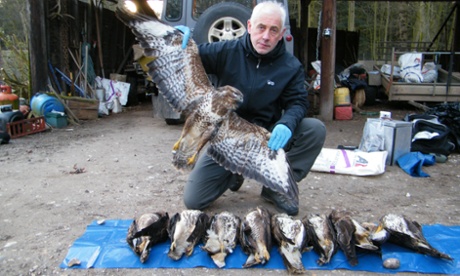
Lenient penalties for environment crimes, such as the suspended sentence handed down to a former gamekeeper who poisoned buzzards, hamper law enforcement and obstruct police efforts to get authorisation for vital wiretaps, the head of an EU environmental crimes unit has told the Guardian.
Leif Gorts, who leads a team at Eurojust, was speaking as the cross-border crime-fighting agency launched its first environmental crimes report, showing a dearth of prosecutions in Europe with low penalties, under-reporting, poor cross-border cooperation and corruption all hobbling enforcement efforts.
“We need stronger penalties so we can get wiretapping and other investigative measures authorised to fight organised crime,” Gorts said. “In my country, Sweden, we have four years as a maximum penalty, so we can wiretap people who are conspiring to kill wolves, for example.”
“A one year maximum sentence is considered enough for the UK, but a man was convicted of killing 10 endangered species just to protect pheasants, and he got away with a 10-week conditional sentence. That is not dissuasive. It is such a harmful thing to do.”
A court found that Allen Lambert, a former gamekeeper at the Stody estate near Holt in Norfolk, had killed 10 buzzards and a sparrowhawk, in what the RSPB called the worst case of bird poisoning ever detected in Britain. But he received no custodial sentence or fine.
A wiretap may not have prevented his crime, but intelligence gathering is considered essential by officers struggling to get to grips with what Interpol says is an environmental crime wave.
“The interception of communications is very seldom used in cases of trafficking in endangered species,” the Eurojust report says. “As penalties are in most cases low, standard investigative tools used for other serious crimes cannot be used.”

A recentl Europol threat assessment stressed the growing links between organised criminal gangs and wildlife trafficking – and evidence of such links can enable wiretaps in many EU countries. But the Eurojust report says it is difficult to obtain this evidence without monitoring communications in the first place.
Currently, links between crime gangs and wildlife crimes “are often not investigated,” the report finds.
The EU’s justice commissioner, Vera Jourova, said that a balance had to be struck between prosecuting serious crime in the public interest and safeguarding citizens’ rights.
“That is why it is crucial that prosecutors are involved from the start when fighting cross-border crimes,” she said in a statement. “Environmental crime is threatening human life, health and natural resources. It must therefore be targeted with the same seriousness as other criminal offences.”
The UK, the Netherlands and Sweden are the only EU member states to have dedicated public prosecutors for environmental crime. MPs in 2012 concluded UK wildlife protection laws, to stop crimes such as bird poisoning, are a “mess”.
Overall, the Eurojust report finds that EU authorities are not investigating environmental offences thoroughly because of a lack of coordination between states’ internal agencies, and poor cross-border cooperation with neighbouring countries.
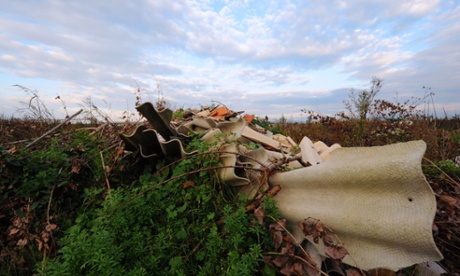
Michele Coninsx, the president of Eurojust, told a Brussels press conference: “The illicit trafficking of waste needs facilitators, transporters and brokers operating in different countries. If you don’t put all pieces of the puzzle together, you might tackle a problem in one country only to have a secondary effect in another.”
Some 7.4m tonnes of waste are illegally transported out of the EU each year, according to a 2009 estimate, often to be dumped in developing countries, particularly in West Africa.
Coninsx said that there was “a huge need” for EU states to harmonise their legislation to close off loopholes currently being exploited.
The commission has also taken steps to crack down on illegal logging, one of the most profitable of environmental crimes with a turnover valued at between $30-$100bn by Interpol.
But research by the environmental group Client Earth earlier this summer showed that eight EU states had done nothing to transpose the law, while 10 had only produced draft legislation. Most bloc countries had no penalties in place to deal with illegally-logged timber entering the EU market.