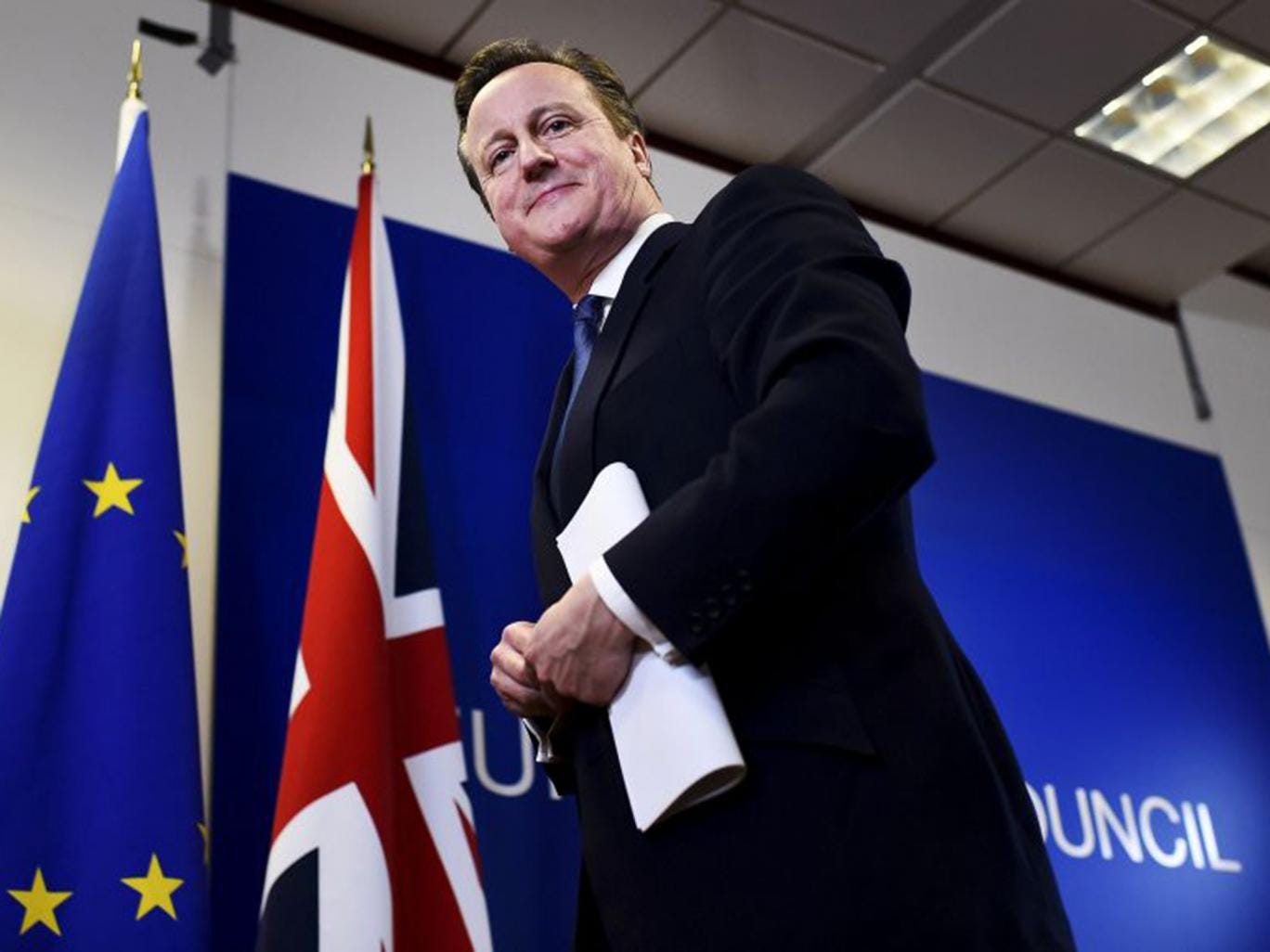
David Cameron’s attempts to choreograph a triumphant renegotiation deal in Brussels fell after more than 24 hours of talks failed to reach agreement on a new deal for Britain’s membership.
The Prime Minister was forced to cancel a Cabinet meeting in London that would have rubber stamped the settlement and fired the starting gun on the referendum campaign.
He spent the day instead locked in meetings behind closed doors with other European leaders attempting to prevent a significant watering down of his original renegotiation proposals that have already faced criticism in the UK for being too weak.
Senior British Government sources said that they feared they could still be “ambushed” by other countries at a full Council meeting over dinner.
“It has been pretty hard-going but we are preparing to defend our line,” they said. “We have no idea how it will turn out at the moment.”
At the centre of the dispute were plans, put forward earlier this month by the European Council President Donald Tusk, which would allow Britain and other European countries to only pay child benefit to the children of migrant workers at the rate they would get in their home countries.
In a series of meeting the Poles and the Czechs demanded that this be phased in over 16 years and only apply to new workers.
However Britain, with support from Holland and Denmark, said the indexation must come in immediately and include the children of workers already in Britain.
Another source of controversy was the length of the so-called emergency break on in-work benefits.
Poland, Hungary, Slovakia and the Czech Republic said the break should only last for an initial period of two years – with the possibility of two one-year extensions – but only if agreed by a majority of other council members.
Mr Cameron has been pushing for a five-year immediate break with the possibility of two further one-year extensions.
France also objected to protections in the original draft that would have allowed the British Government to set different regulations for the City of London to those in other European financial centres.
“I will do what it takes for the UK to stay in Europe, but it is also necessary for Europe to be able to advance,” the French president François Hollande said.
“There can be no special status for the UK and the City of London
By early evening, Mr Tusk announced that he would reconvene a meeting of all 28 members – despite no agreement having been reached in a series of bilateral meeting during the day.
Mr Tusk had intended only to reconvene the Council if there was broad agreement on a draft text that could then be rubber stamped.
British officials expressed concern that the new plan could allow Mr Cameron to be ambushed and come under pressure to compromise.
“We’ve had some progress and things have been moving our way,” said a source.
“It may be now a question of defending what we have.”
The delay in reaching a deal is a blow to Mr Cameron, who had hoped to use a successful Brussels summit to set the agenda and fire the starting gun in the referendum before the weekend. Instead, the delay hands the initiative to “leave” campaigners, who are planning to roll out a series of high-profile Cabinet “outers” over the weekend.
It is still possible that Mr Cameron could return from Brussels empty handed – although the Prime Minister knows this would be deeply unpopular with fellow EU leaders who are determined to settle the “British problem” and not let it drag onto another summit.
Some other EU leaders expressed dismay at Mr Cameron’s negotiating stance.
The Czech Europe minister Tomas Prouza suggested that the UK side was not really engaging in the talks, writing on Twitter: “As the time passes, I am more and more perplexed by the British approach of non-negotiation. Quite unorthodox, to say the least.”
Mr Prouza joked that he was “not looking forward to cold British breakfast served seven hours late”.
But the Polish Europe minister Konrad Szymanski said a deal was “close”, telling reporters: “We managed to have a compromise on many, many issues ... but we still need more clarification, more guarantees to get the compromise which would be satisfactory for both sides.
“There’s still some way to go, we need some hours.”