Closing summary
So, in summary, Greece has promised to speed up the implementation of its extended bailout agreement and will send a full list of detailed reform proposals to its euro zone partners very soon.
Not a big breakthough, but perhaps all Alexis Tsipras could hope for. It means Greece could yet unlock some of its bailout money, if it can satisfy its creditors with a credibly reform plan.
Here’s our latest story:
And with that, leaders are heading off for some sleep before day 2 of the summit. The last word goes to Ian Traynor:
2 summits in row @tsipras_eu sounds banal. hot air. maybe works back home. merkel much more specific. he wanted meeting. she wasn't bothered
— Ian Traynor (@traynorbrussels) March 20, 2015
I’ll be back in a few hours with a new liveblog to cover the second day of the summit, and other developments. Good night. GW
Tsipras: We're back on track
Greek PM Alexis Tsipras has told reporters that he’s more optimistic after tonight’s meeting, even though European leaders don’t appear to have budged.
TSIPRAS: "Process back on track" #Greece not obliged to take recessionary measures pic.twitter.com/TdRUsPLTsK
— Derek Gatopoulos (@dgatopoulos) March 20, 2015
#Tsipras : negotiation process back on track" pic.twitter.com/MxxVdWrjTX
— Konstantinos Pappas (@kpappas1955) March 20, 2015
French president Francois Hollande is briefing the press now (lifefeed here).
He confirms that Greece must present new reform plans ASAP; there’s no time to lose. And he also suggests that some aid could be forthcoming once Greece’s progress has been evaluated.
Merkel and Hollande have different interpretations of Greek agreement. Merkel: No money without review. Hollande: Money after evaluation.
— David Carretta (@davcarretta) March 20, 2015
At a brief press conference, Angela Merkel has told reporters that there was “disappointment” that more progress hasn’t been made since Greece secured its bailout extension a month ago.
#Merkel: The #Greek gov will show full responsibility of the reforms and next days will send us a list of specific reforms
— Maria Aroni (@aronimar) March 20, 2015
More Merkel: "There was disappointment that that what we expected didn't happen after Feb 20" #Greece
— Derek Gatopoulos (@dgatopoulos) March 20, 2015
Updated
Statement released
And finally, the meeting is over. In a short statement, the European Council say that attendees at tonight’s (last night’s) meeting are sticking to the agreement made last month.
Greece must present a “full and adequate” list of reforms, fast, and all sides have agreed to work faster to make progress.
Our europe editor Ian Traynor explains:
Following three hours of talks that ended after 2 in the morning, German chancellor Angela Merkel made it plain that there would be no quick disbursement of emergency aid to Greece unless Tsipras delivered on unfulfilled pledges to supply a full menu of proposed structural reforms to the Greek economy.
The credibility of Tsipras’ proposals would need to be supported by eurozone governments before Greece, on the brink of insolvency, could obtain the financial support.
"@Mina_Andreeva: .@JunckerEU @J_Dijsselbloem @eucopresident statement after meeting on #Greece pic.twitter.com/mz7vz7VbWl"
— Konstantinos Pappas (@kpappas1955) March 20, 2015
1:39am and still in #EU summit building. Seems like old times #Greece pic.twitter.com/RPQgN7U4f1
— Peter Spiegel (@SpiegelPeter) March 20, 2015
You have to admire these leaders’ stamina...
#EUCO heading towards 2a.m bxl, 3 hrs of @tsipras_eu mini-summit. he must be doing ok.but merkel can outsit any male. did 17 hours in minsk
— Ian Traynor (@traynorbrussels) March 20, 2015
If there are any press briefings in Brussels, they should be streamed online here....
Reporters in Brussels are hearing that Greece is being urged to implement some reforms immediately, to unlock the first slice of its outstanding bailout payment of over 7 billion euros.
#Greece asked to change attitude towards technical teams, also suggest a plan of immediate reforms, via @doleross #EUCO
— Janine Louloudi (@janinel83) March 20, 2015
Greece has apparently been told to be more welcoming to officials representing its creditors in Athens:
#Greece, Eu sources: until now Eu technicians in Athens could not work safely, we said to @tsipras_eu that that needs to change
— Giovanna Pancheri (@giopank) March 20, 2015
Those officials returned to Greece a week ago, but have been keeping a low profile.
The Greek meeting hasn’t finished yet - Suzanne Lynch of the Irish Times has heard that some common ground is emerging between the leaders:
#tsipras + EU leaders 'Identifying areas that can be tackled quickly' for reform says EU source on ongoing #Greece mini-summit
— Suzanne Lynch (@suzannelynch1) March 19, 2015
Another date for the diary, possibly....
Extra #Eurogroup meeting possibly next week ~Greek official
— Yannis Koutsomitis (@YanniKouts) March 19, 2015
Updated
An EU official has also suggested that another (!) meeting of eurogroup finance ministers may take place soon....
More details on the wires...
Juncker 'annoyed' over Greek govt's attitude toward 'technical staff' /via @tsigouriX #GreeceMiniEuCo
— Yannis Koutsomitis (@YanniKouts) March 19, 2015
Details of tonight’s meeting are starting to emerge.
An EU official has told Bloomberg that talks between Greece and its creditors were “frank” at times (euphemism alert!) and that the Greek government has enough funds to last until next month.
Exchanges at Greece meeting were "often frank", EU official says...
— Rebecca Christie (@rebeccawire) March 19, 2015
#EU official says #Greek cash should last until April
— RANsquawk (@RANsquawk) March 19, 2015
Tonight’s meeting will set the scene for Monday, when Greece’s prime minister visits Berlin.
The Wall Street Journal reports tonight that Angela Merkel is poised to “intervene directly in a deepening rift between Greece and its international creditors”.
However, she may not soften her line on austerity:
The chancellor’s message for Mr. Tsipras—that Greece has no alternative to cooperating with finance officials’ demands—is likely to disappoint the Greek leader’s hope for a lenient funding deal.
Here’s the story: Germany’s Merkel Set to Intervene in Greek Rift With Creditors
Reminder; we’re not expecting much from this meeting.
Hours ago, Angela Merkel said it would not deliver a breakthrough, and several other leaders have emphasised that they want to see Greece delivering on its commitments before bailout cash is handed over.
But the gathering is overshadowed by fears that Greece could run out of money to meet debt repayments., which could spur leaders to find some common ground.
Photos: Inside the meeting
Alexis Tsipras looked rather more cheerful than Mario Draghi at the start of tonight’s mini-summit meeting on Greece:

Heads-up: we might hear from Angela Merkel tonight:
The meeting on #Greece in a small group format just started. Afterwards press conf. by Chllr #Merkel. pic.twitter.com/13XIlWd51K MT @RegSprecher
— GermanForeignOffice (@GermanyDiplo) March 19, 2015
Update from Ian - that £20m fund announced by David Cameron tonight is a UK-only affair:
#EUCO cameron unveils very small fund for eastern europe. it's uk only. eu not invited. why go to brussels to do that?
— Ian Traynor (@traynorbrussels) March 19, 2015
Ahha! European officials have just released a short video of the start of the meeting on Greece tonight:
It’s online here - unfortunately everyone is on their best behaviour, but you can see Alexis Tsipras, Angela Merkel, Francois Hollande, Donald Tusk, Mario Draghi, Jean-Claude Juncker and Jeroen Dijsselbloem all in attendance.
Update: the 8th member is the Secretary General of EU council Uwe Corsepius.
Αρχίσαμε...ο Θεός να βάλει το χέρι του!!! pic.twitter.com/Z4770hyLgF
— Giannis Tsakiris (@GiannisTsakiris) March 19, 2015
Updated
Back in Greece, Mega TV’s political analyst Nikos Evangelatos, citing senior government officials, has told the station’s flagship news programme that the Greek side was attending the talks “with a goal, hope and fear.”
“The goal is to get a deal,” he said, adding:
“The fear is that a new card will be put on the table and that creditors demand Greece completes [the last] programme with an evaluation of public finances [a red line for a government that wants nothing to do with the previous bailout accord], and the hope is that more money is released because the 400 million euros in ELA funds disbursed [last night] from the European Central Bank are only enough to keep the country going for a couple of days.”
Europe editor Ian Traynor tweets news from the UK PM:
#EUCO cameron announces £20m good governance fund for post-soviet, post-yugo places. modelled on thatcher's 89 knowhow fund for poland
— Ian Traynor (@traynorbrussels) March 19, 2015
Small #Greece kerfuffle in main #EU summit session. @MartinSchulz defended @atsipras, who said he wants 2 clear confusion on Feb 20 agreemnt
— Peter Spiegel (@SpiegelPeter) March 19, 2015
The most important thing is Tsipras’s intentions, not ours, Tusk adds.....
#EUCO @eucopresident going in to chair @tsipras_eu mini-summit: 'he requested it. most important thing is his intentions, not ours.'
— Ian Traynor (@traynorbrussels) March 19, 2015
Updated
European Council president Donald Tusk appears to have downplayed hopes of a breakthrough, by reminding reporters that the meeting tonight was Tsipras’s idea....
The mini-summit about Greece is now underway, reporters on the ground in Brussels say.
Updated
Summary
Hello again. Greek government sources say that Alexis Tsipras has been briefing fellow leaders about the humanitarian crisis in Greece tonight.
He hopes to establish common ground during tonight’s talks, and is unhappy that officials from Greece’s creditors have drawn “red lines”, preventing Athens making progress on implementing last month’s the bailout extension deal, adds our Helena Smith.
Updated
Ian Traynor: Greek crisis returns to centre stage

Looks like Brussels is going to be quiet for some hours <tempting fate>.
So here’s Ian Traynor’s latest dispatch from the summit:
Europe’s long-running drama over whether Greece will stay in the single currency returned to the centre of EU politics on Thursday evening when Alexis Tsipras, the country’s prime minister, used his second Brussels summit for emergency talks with the political leaders of his key creditors.
Despite the reluctance of other EU leaders to prioritise Greece in a summit scheduled to deal with issues including Ukraine and the Libya crisis, the prime minister was granted a special meeting with Germany’s chancellor, Angela Merkel, Mario Draghi, the president of the European Central Bank, the French president, François Hollande, Donald Tusk of Poland, who chairs the summits, and Jeroen Dijsselbloem, the Dutch finance minister who heads the Eurogroup of finance ministers.
Both sides, Merkel and Draghi on the one hand and Tsipras on the other, went into the talks with little sign of a shift in their respective stances. A rapid breakthrough was not expected despite the sense that time is not on Athens’ side and that it is running out of money, possibly within weeks.
If there is to be any breakthrough, it is more likely to come on Monday when Tsipras goes to Berlin to see Merkel again, diplomats and officials said.
Following an agreement to extend until June Greece’s €240bn (£173bn) bailout – brokered by the EU, the ECB and the International Monetary Fund – on condition that Athens delivers on promised fiscal and structural reforms to it economy, things have gone from bad to worse in the relationship.
Unsuccessful and bad-tempered meetings this week between the two sides in Athens have left Greece looking isolated. Tsipras pushed two bills through parliament on Wednesday granting relief in the form of food stamps and free electricity to those hardest hit by the savage austerity of the past five years.
Eurozone officials complained that this should not have happened without their blessing, accusing Tsipras of “unilateral” action. He responded robustly, arguing that the days of Greece taking orders from its creditors were over and that he was asserting Greece’s economic and political sovereignty.
The decision to interrupt the summit to enable a smaller-format negotiation with Tsipras also ruffled feathers among eurozone creditors not taking part in the talks. “I’m angry,” said Charles Michel, the Belgian prime minister. He was joined by the Dutch and Luxembourg leaders who held up the beginning of the summit by almost an hour because of an “exchange of information” on the row with Tusk. They also insisted that the rest of the summit be briefed on the Tsipras talks, probably on Friday......
I’ll try to update the blog if there are major developments tonight..... Otherwise, back early tomorrow to catch-up. GW
Here’s tonight’s official seating plan:
Oh @alexstubb: #EUCO seating arrangement. No new colleagues. Order of rotating Presidency. pic.twitter.com/0VoXt7LBJ8
— Eva Peña (@evaeuropa) March 19, 2015
Alas we don’t get one for the informal meeting about Greece later -- will it be Tsipras on one side, and the other six on the other?
Tonight’s meeting on the Greek crisis will start after leaders have had dinner -- and Marco Zatterin of La Stampa suggests it could be a late one:
Pino the Eu Octopus foresees the beginning of the Eu Greek meeting in bxl "around 11 pm" @la_stampa #EUCO
— Marco Zatterin (@straneuropa) March 19, 2015
Updated
European leaders got down to business tonight after holding the traditional family photo - once everyone turned up, that is...


Updated
FTSE 100 hits new closing high
Britain’s FTSE 100 index has set a new record closing high tonight, by a whisker, on expectations that central banks will leave interest rates at record lows for longer.
The blue-chip index finished the day up 17 points at 6962.32, up 0.25%, beating the previous record of 6961 set on March 5th.
#FTSE 100 closed at 6962, +0.25% All time high
— LondonStockExchange (@LSEplc) March 19, 2015
Andy Haldane’s suggestion today that UK interest rates are as likely to be cut as raised helped keep shares higher.
Haldane’s comments also pushed the pound down; it lost over two cents against the US dollar today, back down to $1.474.
Back at the summit our Europe editor, Ian Traynor, is hearing that several smaller EU nations are unhappy about tonight’s mini-summit on Greece.
#EUCO at least another 2 countries joined belgium complaining about small format tsipras talks, demand to be briefed - eu diplomats
— Ian Traynor (@traynorbrussels) March 19, 2015
#EUCO benelux annoyed about @tsipras_eu special talks, summit delayed bc of complaints - eu dips
— Ian Traynor (@traynorbrussels) March 19, 2015
If you’re just tuning in, that mini summit starts tonight, and will involve Alexis Tsipras, Angela Merkel, Francois Hollande, Jean-Claude Juncker, Donald Tusk, Mario Draghi and Jeroen Dijsselbloem
(that’s the leaders of Greece, France and Germany, plus the head of the European Commission, the European Council, the European Central Bank and the Eurogroup of finance ministers)
Greek government insider: liquidity is a huge problem
So why has the Greek prime minister pressed for today’s mini-summit on the sidelines of the Summit tonight?
Insiders in his Syriza party are saying it is not only because he wants to get a lay of the land ahead of Monday’s meeting with the German chancellor. Liquidity – or the lack of it – is the main reason.
Helena Smith, our Athens correspondent, reports:
Greek sources say they are not surprised that Angela Merkel is not promising any breakthrough today.
“We always expected her to take an uncompromising stance given [the views] of her constituency,” said one referring to the frustration growing numbers of Germans have increasingly expressed with Greece.
“What we are doing is seizing the moment to press for a political solution before the four-month [bailout extension] period runs out. Liquidity has become a huge problem and if we don’t resolve that how on earth will we be able to proceed with anything else?”
Athens faces €1.7bn euro in debt repayments this month alone. The lack of liquidity has begun to affect the real economy with officials blaming the Dutch finance minister and president of the Euro group Jeroen Dijsselbloem for massive withdrawals from banks yesterday.
“His statements about a Cyprus-style bail-in were totally irresponsible,” said one. “They are the sort of thing that could spark the accident everyone is talking about,” he added.
“If anything, an accident would take the form of a run on banks.”
The “honourable compromise” [see earlier report] that Greece’s leftist- led government is said to be seeking could take the form of Athens promising to enact immediate privatisations and maintain unpopular property taxes, insiders said, in return for rescue funds being unlocked.
Greece has yet to drawn down €7.2bn from its original bailout program.
Updated
Greek 10-year bond yields hit two-year high
The selloff in Greek government bonds is accelerating this afternoon as the summit begins, as markets are gripped by fresh worries over its bailout.
The yield on Greek 10-year debt has jumped to 12.2%, up from 11.2% last night. That’s the highest level since April 2013, and suggests a higher risk of default.
#Greece 10-year bond yield climbs above 12%; first time since April 2013 /via @advdesk
— Yannis Koutsomitis (@YanniKouts) March 19, 2015
Greece’s two-year debt has suffered a dramatic slide, pushing its yield up to almost 25%, from 21.8% yesterday.
This follows the news that €300bn was withdrawn from banks yesterday after Eurogroup president Jeroen Dijsselbloem suggested capital controls could be imposed.
An FT report that the European Central Bank is considering banning Greek lenders from adding to their holdings of government debt has also alarmed traders. That would cut off an important potential source of funding.
A sombre start to the summit:
One minute of silence. The European Council pays tribute to the victims of the terrorist attack in #Tunisia. #EUCO pic.twitter.com/wwLuQ51Ltd
— Donald Tusk (@eucopresident) March 19, 2015
More signs of discord in Brussels:
Enda Kenny attacks language used by Greek govt: "There's a difference btwn political argument + threats of releasing jihadists into Europe."
— Tony Connelly (@tconnellyRTE) March 19, 2015
That’s a reference to Panos Kammenos, the Greek defence minister, who warned this month that the Greek government might issue travel papers to illegal immigrants if its creditors didn’t help it.
Ireland’s prime minister, Enda Kenny, has predicted it could be “quite a difficult meeting’, and that Greece must face its responsibilities:
“The feeling among the political leaders is that Greece and Greek politicians have to live up to their responsibilities here. The ball is in their court.
The prime minister asked for time and space and he has been given that to come forward with sustainable and workable proposals. Greece needs to reflect on that very quickly because time is running out.”
Tsipras: EU must be brave
Here’s what Alexis Tsipras told Brussels reporters as he arrived for the summit:
“The European Union needs brave political initiatives, which respect both democracy and the treaties.
“Let us leave the crisis behind us and be led toward growth”.
Denmark’s prime minister, Helle Thorning-Schmidt, told reporters outside the summit that the rhetoric between Athens and Berlin does not belong in the EU.
Greece’s PM has urged his fellow leaders to be bold today:
#TSIPRAS: The European Union needs bold political initiatives #Greece #EUCO pic.twitter.com/e5vHqyROwB
— Derek Gatopoulos (@dgatopoulos) March 19, 2015
There must be an election soon:
UK PM Cameron: When I came to my first #EUCO in 2010, Britain and Greece were virtually in the same boat.
— Open Europe (@OpenEurope) March 19, 2015
This is clearly ridiculous. The UK was not on the brink of losing access to the international money markets five years ago.
It’s true that Britain was running an alarmingly high deficit in 2010, at 11% of GDP (compared to 10% for Greece).
But one crucial difference is that the Bank of England was able to rapidly adjust monetary policy and print electronic money to address the worst financial crisis in decades. That helped Britain to get away with deficits that would have been the envy of Keynesian politicians across the eurozone (a chunky 5% of GDP this year).
Cameron can argue that his 2010 austerity programme calmed the markets and helped cut borrowing costs [although that’s also due to global disinflation and weaker growth]. But, really, the same boat? Not even the same ocean.
Cameron: Reason why UK is now in different situation from Greece is we took difficult long-term decisions. #EUCO
— Open Europe (@OpenEurope) March 19, 2015
Oh dear: Cameron says UK and Greece were in the same position five years ago. The reason why UK growing now is his "difficult" decisions.
— Matthew Dalton (@DJMatthewDalton) March 19, 2015
Updated
Greece must get its wealthiest citizens to pay their taxes, declares French president Francois Hollande as he arrives in Brussels.
#Hollande "Ce qu'on demande a la #Grèce c'est qu'elle demande aux plus riches de payer des impôts" #EUCO
— lida bola (@lidabola) March 19, 2015
MT @lidabola #HOLLANDE "We want Greece to get its rich to pay their taxes" #Greece pic.twitter.com/xlFa5XhXWx
— Derek Gatopoulos (@dgatopoulos) March 19, 2015
Merkel: Don't expect any solutions today
Angela Merkel has dashed any lingering hopes of a breakthrough -- telling reporters outside the summit that they shouldn’t expect a solution to the Greek crisis tonight.
That’s a blow to Alexis Tsipras’s hopes of a political deal to resolve the crisis, rather than through the technical talks with eurozone officials.
Merkel kills it again on arrival at #EUCO: 'Do not expect any solution, do not expect a breakthrough' #Greece
— Danny Kemp (@dannyctkemp) March 19, 2015
Green party MEP Ska Keller isn’t impressed:
so Merkel doesn't expect any solutions on #Greece today. Why is it left to the #Eurogroup to hold #Europe together?
— Ska Keller (@SkaKeller) March 19, 2015
Updated
Finland's @alexstubb has 'full confidence' in France and Germany handling Greece at summit sideline meeting #EUCO
— Alex Pigman (@parisnewsroom) March 19, 2015
There’s open rancour in Brussels before the summit even starts.
Belgium’s prime minister, Charles Michel, has blasted tonight’s meeting between Greece, its creditors, and the leaders of Germany and France.
Arriving at the summit, Michel told reporters:
“It’s a bad method.”
Any decision on Greece must also include smaller nations, Michel adds. And he’s planning to voice his criticism of the procedure during the summit.
Andy Haldane: UK interest rates could be cut
UK interest rates are as likely to be cut to fresh record lows as they are to be raised.
So says Andy Haldane, the Bank of England’s chief economist, in a speech in Rutland right now [online here].
Haldane is warning that Britain faces significant disinflationary pressure. He cites the relative strength of the pound, and lingering spare capacity in the labour market which may be responsible for poor wage growth.
As such, the BoE’s monetary policy committee (which Haldane serves on) may well cut borrowing costs rather than raise them:
Given the asymmetry of inflation risks, I think the chances of a rate rise or cut are broadly evenly balanced.
And here’s Haldane’s conclusion:
Inflation has dropped like a stone over the past year, to close to zero. This largely, but not wholly, reflects external forces. On the MPC’s central view, inflation will remain close to zero in the near-term, before rising to reach the inflation target over a two-year horizon. The risks to inflation at that horizon are plainly two-sided. But my personal view is that these risks are skewed to the downside. In my view, that means policy needs to stand ready to move off either foot in the period ahead to meet the symmetric inflation target.
Andrew G Haldane, as @bankofengland now style him, is concerned about "drag" from labour market slack; inflation expectations; sterling.
— Heather Stewart (@heatherstewart3) March 19, 2015
Andy Haldane, the Bank of England's chief economist, has just outed himself as the secret dove on the MPC. pic.twitter.com/rn9injhuVa
— Ferdinando Giugliano (@FerdiGiugliano) March 19, 2015
Good to see Greek prime minister Alexis Tsipras showing some thrift; he and his team were spotted in economy class heading to today’s Summit. Hat-tip to Enikos.
Alexis Tsipras travels economy class to crucial EU Summit – PHOTOS - http://t.co/qgavCo1Hrs pic.twitter.com/X42mdBjrZJ
— enikos_en (@enikos_en) March 19, 2015
And he’s now arrived in Brussels:
Σήμερα βρισκόμαστε στις Βρυξέλλες, στη Σύνοδο Κορυφής. #EUCO #Greece pic.twitter.com/0Ir5113f1r
— PrimeMinisterGR (@PrimeministerGR) March 19, 2015
Both the FT and Reuters are reporting that depositors withdrew at least €300m from Greek banks yesterday.
That would be the biggest daily outflow since last month’s bailout extension was agreed in February.
The trigger, I fear, was Eurogroup president Jeroen Dijsselbloem’s not-so-helpful suggestion that that capital controls might be needed in Greece if it doesn’t reach agreement with its creditors.
Memories of the Cyprus crisis, when banks were shut for days, are still raw in Greece. One banker told the FT’s Kerin Hope that:
“Depositors are nervous already and the suggestion that Greece could follow the example of Cyprus two years ago made them react.”
And here’s a video clip of Donald Tusk talking about Greece:
EU's Tusk: Meeting is not 'last chance' for #Greece http://t.co/tAOIO6wMXO
— Derek Gatopoulos (@dgatopoulos) March 19, 2015
Donald Tusk: Nobody wants a Grexit

Here are European Council president Donald Tusk’s comments on Greece at a news conference ahead of today’s summit, via Reuters.
On Greece’s bailout.
“Nobody wants a so-called Grexit. And everybody wants to avoid a so-called Grexident.”
On tonight’s meeting between Alexis Tsipras, Angela Merkel, Mario Draghi et al.
“This informal meeting will not be a decisive meeting, because we have a formal format to take decisions [ie the, Eurogroup of finance minister]”.
So why are they meeting at all?
“This is something like consultations. (They are) needed because we try to avoid confrontational political discussions and my intuition is that today at the level of the European Council the discussion could be a little bit too hot.”
My remarks following the #TripartiteSocialSummit & ahead of the European Council #EUCO http://t.co/PSHI8j9z2Q pic.twitter.com/Wgw8o3HR3q
— Donald Tusk (@eucopresident) March 19, 2015
Tusk also explained that the two-day meeting will consider Europe’s Energy Union, the Russia/Ukraine conflict, Libya, and economic growth.
And he argued that the European economy is recovering, although obviously not yet fixed:
Unemployment is still unacceptably high in some countries, and there is an urgent need for labour market reforms in the eurozone. However, the economic tide is turning. And by continuing with structural reforms, we are ensuring that this will be a long-term improvement, not a brief crack of light.
Back to important issues, and the draft conclusions of the EU Summit have leaked, showing that leaders are planning a fightback against Russian ‘disinformation’ over Ukraine.
HUGE: @donaldtusk to launch programme countering Russian propaganda by June - #EUCO draft conclusions (@tineurope) pic.twitter.com/g9vka5n1rH
— Exen (@Exen) March 19, 2015
Lord, give me strength....
Surprise: SATIRIST who admitted to faking Varoufakis middle-finger video wasn't being serious! New @OpenEurope blog: http://t.co/dW3PuHDn1C
— Vincenzo Scarpetta (@LondonerVince) March 19, 2015
European Council president Donald Tusk has played down the importance of tonight’s talks, saying that it’s not the last opportunity to resolve the Greek crisis.
- EU’S TUSK SAYS: THURSDAY MEETING WITH TSIPRAS IS NOT LAST CHANCE FOR GREECE
- EU’S TUSK SAYS: NOBODY WANTS A GREXIT OR A GREXIDENT
- EU’S TUSK SAYS: INFORMAL MEETING WILL NOT BE A DECISIVE MEETING, WILL NOT TAKE DECISIONS
Finland’s prime minister, Alex Stubb, has warned that Athens can’t expect another bailout extension.
#Greece Has Four Months And Not More, Finland's Stubb Says. #Grexit AB
— IGSquawk (@IGSquawk) March 19, 2015
This is encouraging... European banks borrowed €97.8bn of cheap loans from the ECB, through its latest liquidity scheme.
That’s more than economists expected, and suggests that demand for credit from businesses and consumers is rising.
Today’s targeted loans, or TLTROs, were made at a lower rate than previous offers, making them particularly attractive to banks. In return, they have to use the funds to help the eurozone’s ‘real economy’.
Credit Agricole’s Frederik Ducrozet believes the TLTRO programme should help the eurozone recovery, particularly in peripheral countries.
The take-up at today’s TLTRO exceeded expectations, with 143 banks borrowing an extra €97.8bn from the ECB.
TLTRO will help expand the ECB’s balance sheet at the margin but, more importantly, they will contribute towards improving monetary policy transmission and to lower borrowing costs even further.
WOW #TLTRO. EUR98bn and 143 bidders (vs. 255 and 306 in the previous two). Should provide a boost to bank lending in the periphery.
— Frederik Ducrozet (@fwred) March 19, 2015
My TLTRO reaction piece – More important than you think. http://t.co/cA2Es4hzfM
— Frederik Ducrozet (@fwred) March 19, 2015
Updated
Greek bond yields are continuing to climb this morning, on fears that the deadlock won’t be broken in time.
#Greece 10Y govt bond yields up 23 bps ahead of EU summit. Poised for highest close since July 2013. pic.twitter.com/BLNuGtTbpt
— Richard Bravo (@richbravo2) March 19, 2015
Greek government hopes for 'honourable compromise' tonight

Over in Athens, our correspondent says there is are hopes that an “honourable” deal could be being hammered out at tonight’s mini-summit between the Greek PM and other leaders.
Helena Smith writes:
Greece will seek to strike an “honourable compromise” with creditors at tonight’s euro summit.
Dimitris Papadimoulis, an MEP with the governing Syriza party told Skai news:
“An honourable compromise is what we want.”
Insiders said Athens’ recent apparent hardening of its stance should be seen within the context of bargaining ahead of tonight’s talks and Monday’s make-or-break meeting between the Greek prime minister Alexis Tsipras and his German counterpart Angela Merkel.
The rhetoric is being ratcheted up on both sides.
While the EU commission president Jean-Claude Juncker insisted this morning that progress could only be made if Greece implemented reforms, the Greek defence minister Panos Kammenos vowed the leftist-led administration would continue enacting legislation no matter what creditors said.
Kammenos who also heads the governing coalition’s junior partner, the nationalist ANEL party, said:
“We will go ahead with legislation and after we will tell them why we are doing it.”
At a time when the Greek people “were going hungry” the government’s moral obligation was to enact its anti-austerity agenda, Kammenos said.
“From the very first we have had an honourable approach [with creditors and voters] that we will change the policies of the memorandum,” he said referring to the €240bn bailout accord propping up the debt-stricken Greek economy.
“This country takes orders only from the people, we are a country that has regained its national sovereignty.”
Updated

European Commission President Jean-Claude Juncker has echoed Angela Merkel this morning, saying Athens must stick to its promises.
Juncker told France’s Europe 1 radio that he’ll make this point to Tsipras in Brussels today:
“I will repeat to him what I’ve already told him twice: Greece must undertake the necessary reforms, Greece must ensure that the commitments it made to the Eurogroup in 2012 and more recently are followed up on.”
Updated
A new opinion poll this morning shows a majority of Greeks still favour sticking with the euro rather than returning to the drachma:
Keep € and memorandum or return to drachma? 61.2% of Greeks would vote to keep € (Marc/@ALPHA_TV poll). #Greece pic.twitter.com/7Hp4zD69Ed
— Vincenzo Scarpetta (@LondonerVince) March 19, 2015
The poll, by Marc for Alpha TV, also shows that Alexis Tsipras’s Syriza party holds a strong lead in the opinion polls:
#Greece Marc poll: Syriza 40.2, ND 21, KKE 4.9, GolDawn 4.8, IndGreeks 4.5, Potami 4.3, Pasok 2.5, GPap 1.8, other party 3.3
— Efthimia Efthimiou (@EfiEfthimiou) March 19, 2015
The government’s early rush of popularity has faded a little, though:
New Marc/@ALPHA_TV poll: Greek gov't approval rating down to 59.8% from 83.1% last month. Still high, but... #Greece pic.twitter.com/B7pSnNqy70
— Vincenzo Scarpetta (@LondonerVince) March 19, 2015
There’s a good preview of today’s European Council meeting on the BBC, explaining how leaders will try to resolve the Greek crisis on the margins of the summit.
The aim is to break the deadlock that has developed between Greece and its creditors about the terms agreed last month for an extension of its huge financial bailout.
As time has dragged on, concern has risen that Greece could soon run out of money. There is only a matter of weeks left before another “crunch” comes.
“Things now need to move at pace,” the EU diplomat said. “The risk of an accident has risen.”
More here: EU aims to solve its Greek ‘elephant’
My colleague Julia Kollewe has written about the FTSE 100 index hitting a fresh record high this morning:
Fears that Greece might default are pushing down the value of its sovereign debt this morning.
The yield (or interest rate) on its two-year Greek bonds has jumped to 23%, up from 21.6% last night. That’s the highest since the bonds was issued in the middle of 2014.
The 10-year bond yield has risen to a one-month high of 11.6%, up from 11.3%.
Yields rise when prices fall, and these yields suggests a high danger of Greece’s not repaying these loans in full.
The cost of insuring Greek bonds against default has also risen this morning.
- GREECE 5-YEAR CREDIT DEFAULT SWAPS RISE TO 1,919 BPS, UP FROM 1,806 BPS ON WEDNESDAY - MARKIT
My day started with a working breakfast with Prime Minister of #Ukraine @Yatsenyuk_AP pic.twitter.com/X3q00zJiqH
— Donald Tusk (@eucopresident) March 19, 2015
Greece isn’t officially on the agenda for today’s EUCO Summit, but it will obviously be on the minds of leaders.
One EU official has said the Greek bailout is the “elephant in the room”, according to the AFP newswire.
It’s not Europe’s only problem; leaders will also debate whether to extend economic sanctions against Russia over the Ukraine conflict.
Merkel: Eurozone crisis not yet resolved

Angela Merkel has warned that Greece’s debt crisis will only be resolved if it sticks to its agreements and remains on its “tough path”.
Speaking in the German parliament this morning before heading to Brussels, the chancellor said that the eurozone debt crisis had not been completely overcome yet.
So, no sign of Berlin giving ground ahead of tonight’s crunch meeting with other eurozone figures.
Merkel also amused MPs by joking that her meeting with Greece’s prime minister on Monday could be combative.
“I have invited the Greek Prime Minister Alexis Tsipras to Berlin on Monday and I’m looking forward to his visit. We will have time to talk to each other in detail and perhaps also to argue.”
I’m sure they’ll get on like a house on fire.
Laughter in #Bundestag when #Merkel said she's looking forward to debating with Greece's Prime Minister Alexis Tsipras when he visits Berlin
— Harriet Torry (@HarrietTorry) March 19, 2015
It really has been a dramatic 15 hours in the international markets, since the Federal Reserve’s monthly meeting.
The dramatic selloff in the dollar is now unwinding this morning, as investors conclude that the reaction to the Fed’s cautiousness was perhaps overdone.
Look what #Yellen did to the #dollar http://t.co/vmCpw1KJMV #BartChart #Fed pic.twitter.com/kZQDhxB8UO
— Mark Barton (@markbartontv) March 19, 2015
#Euro back now to where we were before FOMC last night as senamigams around Greece trigger another sell-off. pic.twitter.com/3OUA6rK65w
— Holger Zschaepitz (@Schuldensuehner) March 19, 2015
everyone is very sweary this morning. And them that aren't swearing are just looking at charts and shaking their heads..
— Lorcan Roche Kelly (@LorcanRK) March 19, 2015
Martin Schulz: Time is running out for Greece

European Parliament President Martin Schulz has raised the stakes ahead of today’s European Council Summit, warning that Greece desperately needs funds.
Schlulz told German radio that Greece’s financial situation was “dangerous”, with debt payments looming [including €300m of IMF repayments on Friday].
Reuters has the details:
Time is short,” Schulz told Deutschlandfunk radio just hours before European Union leaders discuss Greece’s bailout at their summit. “In the short term, two to three billion (euros) are needed to keep to the existing obligations,” he said.
Schulz said Greece had to make further payments by the end of the month, its banks needed money and its central bank’s ability to supply funds was almost exhausted.
“So it would be good if Greece fulfils the obligations that it has agreed to - then further money will flow,” said Schulz.
“The willingness of the Greek government to cooperate must improve,” he said, when asked about reports that Greece was holding back information from its euro zone peers on its progress with reforms.
The row over Greek finance minister Yanis Varoufakis’s infamous ‘finger’ gesture has taken another twist overnight; a German humorist has now claimed to have faked the footage.
Any apology in the offing @GuentherJauch65? For having used a doctored video to silence a conciliatory Greek voice? http://t.co/7SP6OcLIIv
— Yanis Varoufakis (@yanisvaroufakis) March 19, 2015
UPDATE: Apparently it’s all an elaborate joke. Lucky there’s not a debt crisis to fix.....
#Varoufake explained: Varoufakis claims finger was faked - a satire faker said he faked it - but his claim that it's fake was faked. Follow?
— Nina Schick (@NinaDSchick) March 19, 2015
Updated
The euro is sliding back towards its recent lows this morning, after soaring against the US dollar last night following the Federal Reserve’s cautious performance.
The euro is plunging again after yesterday's surge against the dollar. http://t.co/qmqxEkefzV pic.twitter.com/qZx7hJTevs
— BI UK Finance (@BIUK_Finance) March 19, 2015
Fed caution drives FTSE 100 to record high
The FTSE 100 has just hit a fresh record high this morning, as City traders begin the morning in an optimistic mood.
London’s blue chip index is up 32 points in early trading at 6977, led by mining companies.
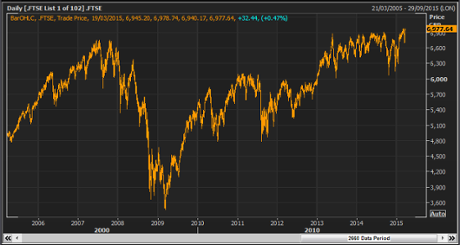
That follows yesterday’s 107-point jump on the back of George Osborne’s budget, which included tax relief for oil companies and new help for home buyers.
Today’s rally comes after the US Federal Reserve dampened expectations of an early rise in American interest rates.
Cautious Fed policymakers want to see further improvement in the US employment market, and clear signs of inflation pressure, before hiking rates. And that means monetary policy could stay extremely loose for longer.
That sent the dollar tumbling dramatically in the FX markets, but it’s clawing its way back this morning.
Updated
The Agenda: EU leaders to hold Greece debt talks
Good morning, and welcome to our rolling coverage of the world economy, the financial markets, the eurozone and business.
With tensions rising over Greece’s bailout, European leaders are heading to Brussels for another summit dominated by Athens’s financial problems.
Greek PM Alexis Tsipras has secured a meeting tonight, on the sidelines of the European Council meeting, to try to break the deadlock with its creditors over its financial programme.
The meeting will be convened by European council president Donald Tusk, and involve German chancellor Angela Merkel, French President Francois Hollande, European Central Bank chief Mario Draghi, European Commission president Jean-Claude Juncker, and eurogroup chief Jeroen Dijsselbloem.
Tsipras’s ambition is to persuade these key players to support his reform plans, and unlock bailout loans. Negotiations between the two sides seem to have floundered since Greece secured a four-month extension to its loans last month, and it faces new loan repayments on Friday.
Last night, Tsipras told the Greek parliament he is committed to the anti-austerity programme which swept his Syria party to power two months ago.
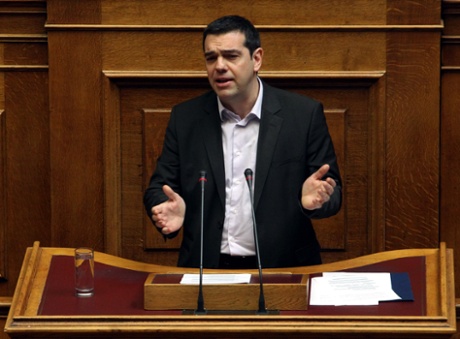
He declared:
“We are not going back on what we have promised.
We are not asking for special treatment but equal treatment.”
And MPs subsequently approved the first piece of humanitarian legislation brought forwards by the new government, giving free electricity and food stamps for thousands of poor Greek families.
I’ll be tracking all the main events through the day. Oh, and I’m sorry we couldn’t run a eurozone liveblog yesterday; the UK Budget had my full attention.....