The European Union has delayed the signing of a trade deal with the South American Mercosur bloc, as protests by farmers and push back from key member states France and Italy expose the political fault lines running through Europe’s agricultural policy.
The signing of the agreement between the EU and Mercosur, 25 years in the making, has been pushed back until January.
The European Commission informed the Mercosur countries of the delay on Friday, after opposition from France and Italy ended hopes of sealing the pact on the margins of Thursday's EU leaders’ summit.
The agreement would create the world’s largest free-trade area and boost EU exports of cars, machinery, wines and spirits to Latin America at a time of mounting global trade tensions.
But the backlash from Europe’s farming community – already simmering over subsidies, imports and disease controls – proved decisive.
Farmers descend on Brussels to protest EU Mercosur trade deal
Tractors and tear gas
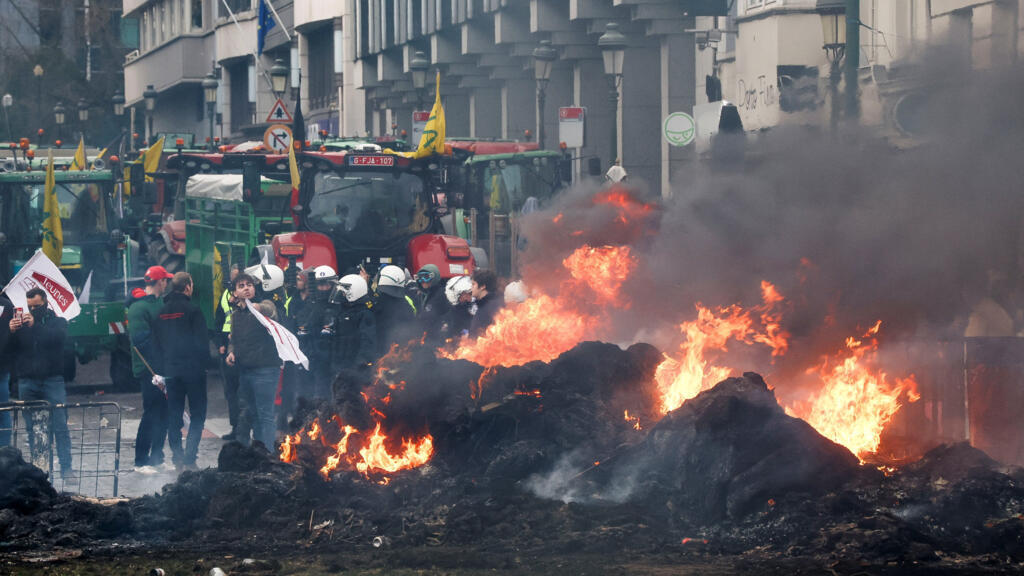
Thousands of farmers descended on Brussels on Thursday, driving around 1,000 tractors into the Belgian capital as the Mercosur deal loomed over the summit.
While the protest was largely peaceful, tensions flared near the European Parliament, where fires were lit and objects including potatoes and bottles were thrown at police, who responded with tear gas and water cannons.
Paris and Rome argue that the current text does not sufficiently protect European farmers from being undercut by cheaper imports from agricultural heavyweight Brazil and its neighbours.
Together, Italy, France, Hungary and Poland account for more than the 35 percent blocking minority required in the European Council – a threshold that was reached after Italy decided on Wednesday to push back against the deal.
French President Emmanuel Macron struck a cautious note at the summit, saying it was “too soon” to say whether Paris would back the deal next month and insisting that “fundamental changes” were needed.
Italy has called for tougher safeguard clauses, tighter import controls and stricter standards for Mercosur producers.
European Commission President Ursula von der Leyen sought to project confidence despite the setback.
“This evening, we have achieved a breakthrough to pave the way for a successful completion of the Mercosur agreement in January,” she said, after abandoning plans to travel to Brazil this weekend for a signing ceremony.
Germany, Spain and the Nordic countries remain strong supporters of the pact, seeing it as a way to bolster exports as Europe grapples with Chinese competition and an unpredictable White House.
Farmers clash with police in southwest France over mass cattle culls and trade fears
Disease outbreak deepens anger
The anger in Brussels reflects wider grievances among farmers – particularly in France, where the handling of a cattle disease outbreak has reignited protests and sharpened opposition to Mercosur.
In southern France, farmers have been blocking roads in protest at the government’s response to an outbreak of lumpy skin disease, a virus affecting cattle. This has fuelled resentment over what many see as a long-term decline in French agriculture caused by foreign competition and excessive regulation.
The government has responded by deploying the army to speed up vaccinations, flying in hundreds of thousands of doses and drafting in military veterinarians.
The aim is to vaccinate 750,000 cows within a month, as authorities seek to contain the outbreak ahead of the year-end holiday period.
The crux of the farmers' anger is a policy of slaughtering entire herds when the virus is detected – a measure the government says is necessary to prevent the disease spreading across France, home to the EU’s largest cattle herd.
Some farmers’ unions argue the policy is devastating livelihoods and compounding long-standing frustrations.
Macron has linked the domestic crisis directly to the broader trade debate, doubling down on his pledge not to endorse the Mercosur deal unless protections for European farmers are significantly strengthened.
French farmers were among those who travelled to Brussels this week to protest, as local grievances converged with fears over global trade.
(with newswires)