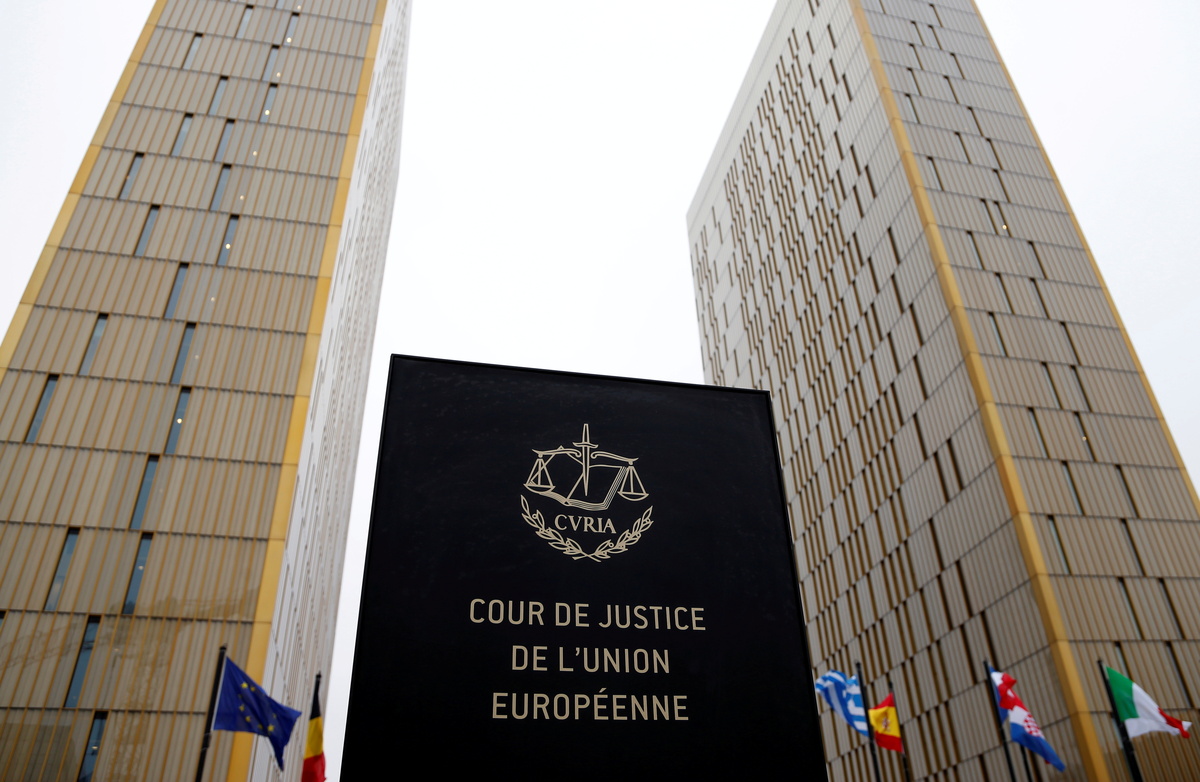
The European Union's top court should dismiss a challenge by Poland and Hungary to a new tool aimed at cutting cash for member states which break the bloc's democratic rules, an initial legal opinion said on Thursday.
While the advocate general's opinion is not binding, the Luxembourg-based European Court of Justice (ECJ) usually follows it when making a final ruling, which is expected early in 2022.

Contrary to arguments presented by Warsaw and Budapest, the opinion said the new policing mechanism does not overstep the competencies of the EU and its central institutions in Brussels as laid out in the bloc's treaties.
Polish and Hungarian officials criticised the opinion, with a deputy justice minister, Sebastian Kaleta, saying in Warsaw: "It was a naivety to trust EU institutions would be capable of self-restraint."
Hungarian Justice Minister Judit Varga said the advocate general disregarded "obvious legal mistakes" in the cash-for-democracy conditionality mechanism. "We say no to rule of law blackmail!," she added.
Hungary's self-styled "illiberal" Prime Minister Viktor Orban and his allied eurosceptic Law and Justice (PiS) party in Warsaw have battled liberal EU countries and the bloc's executive in Brussels over the rights of women, LGBT people and migrants, as well as the freedom of media, courts and academia.
While rights activists have sounded the alarm over damaging the rule of law, Orban and the PiS enjoy steady support on the back of broad public spending, nationalist rhetoric and conservative policies.
The EU has all but failed to force the two formerly communist member countries on its eastern flank to change tack, but last year agreed the new mechanism to withhold financing from the bloc's shared budget to those violating joint laws, including on human and citizen rights.
The tool is yet to be used and the eventual ECJ ruling will determine if it has any more teeth than democratic safeguards previously in place.
Since joining the EU in 2004, Poland has been a leading beneficiary of development funds, which are meant to help poorer members catch up with the better-off.
As the country gets richer, it would become a net contributor rather than a beneficiary of EU funds.
A lawmaker with a junior coalition party known for its hard line rhetoric said last month that Poland could hold a referendum on leaving the EU in 2027 when the long-term budget ends, but Poland's premier dismissed any talk of a "Polexit".
(Additional reporting by Anita Komuves, Writing by Gabriela Baczynska; Editing by Alexander Smith)