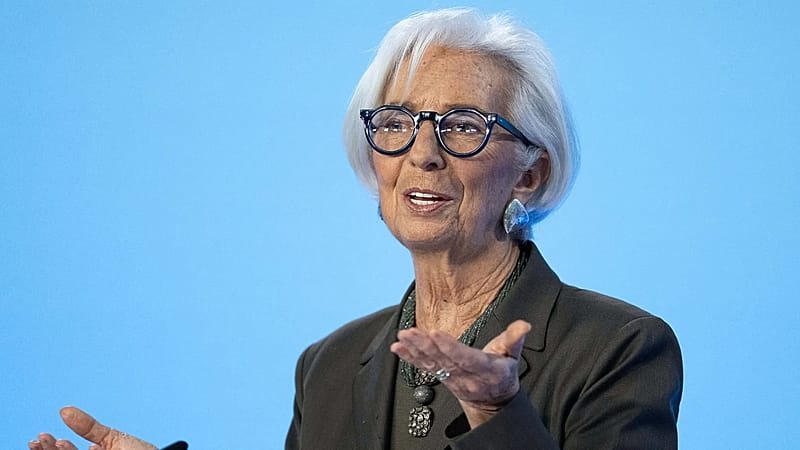
Frankfurt and Brussels are abuzz with speculation over the future leadership of the European Central Bank, after indications that ECB President Christine Lagarde may be weighing an early departure.
Lagarde is said to be considering an earlier-than-planned exit to ensure a successor is in place ahead of France’s next elections, where the far right is polling strongly and could reshape the political landscape in the eurozone’s second-largest economy.
An ECB spokesperson told Euronews on Wednesday that no decision has been made and that Lagarde remains focused on her mission, but the response stops short of an explicit denial of a possible early exit — unlike last year.
On Thursday, Lagarde echoed the original response from the ECB, stating that her "baseline" is to finish the mandate, in an interview with the Wall Street Journal. The language was again carefully different from completely rejecting the reports.
The French central banker also entertained the rumours that her next job might be chairman of the World Economic Forum, stating that it is "one of the many options".
Despite the ECB’s official dismissal of the claims and Lagarde's ambivalent assertion, conjectures over the central bank’s future are mounting and have already prompted a reaction from Spain.
Mere hours after Lagarde's story was first reported by the Financial Times, Spain's Economy Minister Carlos Cuerpo stated that the country wants “a leadership role within Europe’s main economic institutions”.
Cuerpo also added that Spain is “actively working to ensure it holds an influential and meaningful position”.
Spanish economist, Pablo Hernández de Cos, former Governor of the Bank of Spain and current chief of the Bank for International Settlements, is a top-tier contender to lead the ECB next.
Moreover, Spain’s Luis de Guindos is ending his eight-year mandate as the ECB Vice-President in May, with Croatia’s Boris Vujčić already nominated as the successor. The country is therefore likely to try to enhance its channel of influence at the ECB.
Since the central bank's inception, almost 30 years ago, Spain has never held the top executive position.
The ECB race
The threshold for joining the ECB's executive tier is notably high, requiring any prospective member to win the backing of at least 16 of the 21 eurozone countries, collectively representing 65% or more of the bloc's population.
The former Dutch central bank chief, Klaas Knot, is also widely perceived as one of the most probable successors to Christine Lagarde.
He has previously been described by analysts as a seasoned veteran who transitioned from a strict inflation hawk to a more moderate, consensus-building figure.
In a notable public gesture last year, Lagarde tipped Knot as a formidable contender for the ECB’s top job when she was a guest on College — Leaders in Finance, a Dutch podcast.
The ECB President praised Knot, highlighting a "rare and very necessary" ability to foster inclusivity among colleagues.
Although Lagarde was careful and noted that he was "not the only one" with the requisite skills for the role, her endorsement provided a significant boost to the potential Dutch candidate.
Speaking to Euronews, the Head of Global Macro for ING Research, Carsten Brzeski, acknowledged that "Knot changed to a pragmatic central banker under Lagarde after being one of the biggest opposers to quantitative easing in the Draghi era".
Brzeski added that "if indeed we have an earlier succession than expected, that favours Knot because de Cos was nominated to lead the Bank for International Settlements less than 2 years ago".
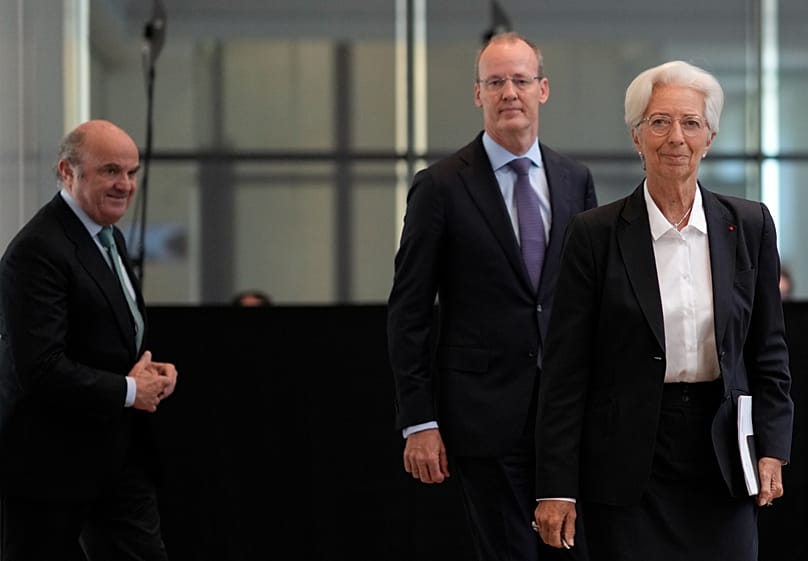
In the potential case of Lagarde's early departure from the ECB, outgoing French President Emmanuel Macron and German Chancellor Friedrich Merz, leaders of Europe's top two economies, would likely play a key role in the appointment of her successor.
However, with Christine Lagarde being a French national, the next ECB President is highly unlikely to come from France, leaving President Emmanuel Macron to back a like-minded candidate from elsewhere in Europe.
Carsten Brzeski, who is also the chief eurozone economist for ING, explained to Euronews that "France knows how to play the game so they are very likely not going to try for a third French ECB President".
Instead, Brzeski pointed out that "France is expected to focus on the ECB chief economist position" which will also become vacant in 2027.
As for Germany, Joachim Nagel, the current chief of the German central bank since 2022, is also potentially going to be put forward as a candidate.
Like Spain, Germany has never held the ECB’s top post, despite the central bank being based in Frankfurt.
Although Merz might attempt to throw Nagel's hat in the ring, the current president of the European Commission, Ursula von der Leyen, is German, which means it would be politically complex to convince other eurozone members that Germany should simultaneously lead the ECB.
An Italian contender?
Italy could also play a key role in the ECB's succession process, as the third-largest economy in Europe after Germany and France.
Fabio Panetta, the current Governor of the Bank of Italy since 2023 and a former member of the ECB Executive Board, is a prominent figure in European monetary policy.
Despite that, ING's Head of Global Macro told Euronews that Panetta will "probably be perceived as too dovish by other eurozone members".
Additionally, Mario Draghi, the Italian economist who served as the ECB President between 2011 and 2019, continues to be highly influential in the European Union, actively shaping its economic and political trajectory beyond his official roles — most notably through the release of the Draghi report on EU competitiveness in 2024.
Even if Italy does not put forward a candidate, it is likely to scrutinise the options closely — particularly after a recent dispute with the ECB over the legal ownership and control of Italy’s gold reserves, which was resolved last December.
EU policy questions
The ECB's succession race is unfolding against a highly polarised policy backdrop in Brussels, where the future of the bloc’s economic integration remains a point of contention.
The discussion is now focused on the Savings and Investment Union (SIU) — the Commission’s 2025 rebranding of the long-stalled Capital Markets Union. The initiative aims to harmonise financial rules across all 27 EU member states.
Spurred by warnings from Mario Draghi about Europe’s "existential risk", Commission President Ursula von der Leyen has set a firm deadline for the end of 2026 to deliver the initiative.
Then there is the debate over Eurobonds, revived by calls from French President Emmanuel Macron for jointly issued debt to help fund the €800bn annual investment gap in defence and renewable technologies.
Berlin remains a staunch opponent of the proposal. Merz recently dismissed the case for more common debt as a distraction, saying he would rather focus on deregulation.
Finally, tensions have peaked after the European Commission warned it could pivot towards a "two-speed Europe".
If EU member states fail to reach consensus on the SIU by late 2026, Brussels intends to use what is being called "enhanced cooperation", specifically allowing a smaller group of countries to forge ahead.
Any ECB candidate will now face rigorous scrutiny along these fault lines. Nominees will be pressed on whether they support debt mutualisation — a red line for the ‘frugal’ north — and on how they would manage a fragmented monetary union in which only part of the bloc may be fully integrated.