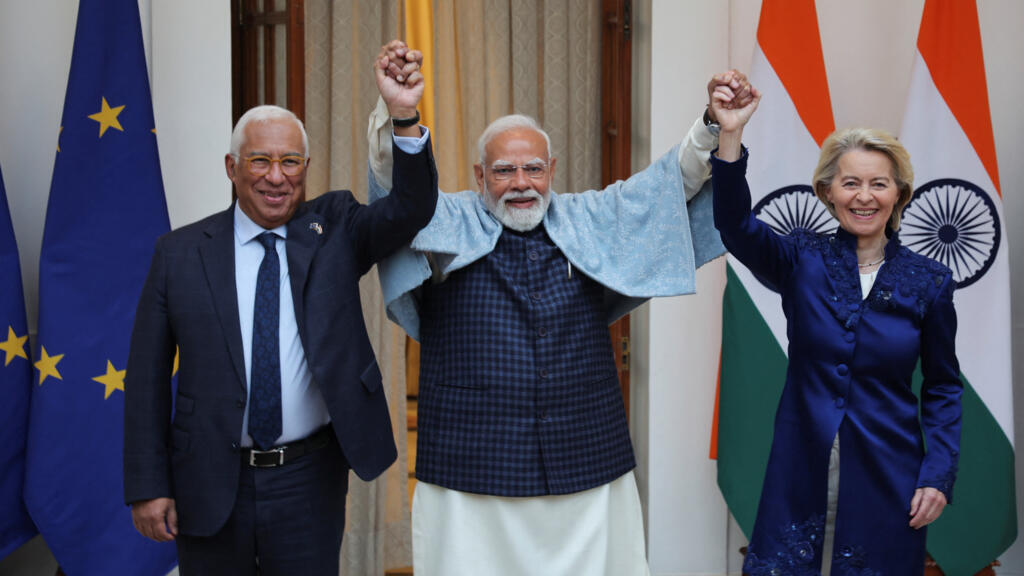
European Union leaders have signed a landmark free trade deal and security partnership with India during a summit on Tuesday, wrapping up nearly two decades of negotiations.
European Council president Antonio Costa and European Commission president Ursula von der Leyen arrived on Sunday to take part in Republic Day celebrations in New Delhi on Monday.
On Tuesday, the delegations put the finishing touches to the arrangement during an EU-India summit, before signing the accord.
The EU had been working on a trade agreement with New Delhi for over a decade before US President Donald Trump's trade tariffs pushed India and the 27-nation EU to expedite their efforts last year.
Posting on social media, Von der Leyen dubbed the partnership "the mother of all deals".
As the world's most populous nation, India is on track to become its fourth-largest economy this year, according to International Monetary Fund projections.
The EU regards India as a key market, while New Delhi sees the European bloc as an important source of much-needed technology and investment to rapidly upscale its infrastructure and create millions of jobs.
"The EU stands to gain the highest level of access ever granted to a trade partner in the traditionally protected Indian market," von der Leyen said.
"We will gain a significant competitive advantage in key industrial and agri-good sectors." she added.
EU competes with Russia and China to court closer ties with India
Bilateral trade in goods reached €120 billion in 2024, an increase of nearly 90 percent over the past decade, according to EU figures, with a further €60 billion in trade in services.
The pact is seen as a significant win for Brussels and India as both attempt to open up new markets in the face of US tariffs and Chinese export controls.
In September, during a meeting in Brussels to highlight a new strategy to bolster EU-India ties, EU trade chief Maros Sefcovic stressed that it was important for the bloc to strengthen its links with different countries. "Otherwise this void will be filled by China and other actors," he added.
Last Wednesday, in the wake of statements made during the World Economic Forum in the Swiss resort of Davos, Kaja Kallas, the EU's top diplomat, said: "The EU and India are moving closer together at the time when the rules-based international order is under unprecedented pressure through wars, coercion and economic fragmentation."
India, which has relied on Moscow for key military hardware for decades, has tried to cut its dependence on Russia in recent years by diversifying imports and pushing its own domestic manufacturing base.
Europe is trying to do the same with regard to the United States.
(with newswires)