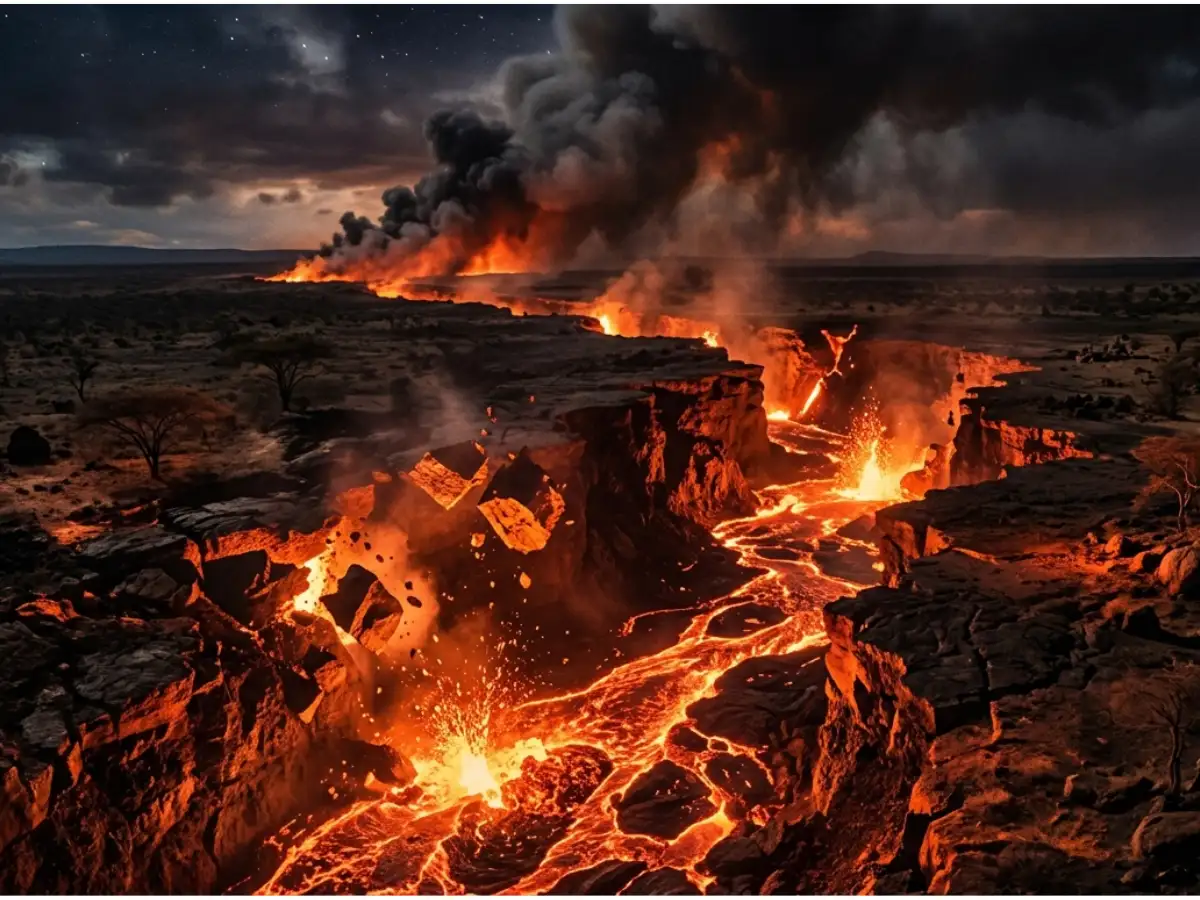
Parts of Africa are slowly ripping themselves apart from the ground up. Deep beneath the surface, something ancient and powerful is at work, and new research suggests the process is further along than most of us ever imagined. What is more surprising? The same forces that are ripping the continent apart may have had a direct role in shaping the story of our own species.
According to a study published in Nature Geoscience by researchers at the University of Southampton, a huge plume of molten rock beneath Ethiopia's Afar region is pulsing rhythmically up from deep within the Earth like a geological heartbeat. Over millions of years, these pulses are slowly creating a brand-new ocean by stretching and thinning the crust of the African continent.
It sounds like something out of a sci-fi film, but it is very real, and it has been going on for tens of millions of years right under our feet.
What is happening beneath Africa?
This is the Afar region of northeastern Ethiopia, one of the most geologically unusual places on the planet. This is the place where three major tectonic rifts meet: the Main Ethiopian Rift, the Red Sea Rift and the Gulf of Aden Rift. Scientists have long suspected a hot mantle plume beneath this area, but the 2025 research gives the clearest picture to date of how it behaves.
The team collected more than 130 samples of volcanic rock from the region and used advanced statistical modeling to map what is going on beneath the surface. What they found was striking: the mantle plume is not a steady uniform flow. Instead, it surges upwards in discrete bursts, each with its own chemical fingerprint, like geological barcodes repeated across the rift system.
“We found that the mantle beneath Afar is not uniform or stationary; it pulses, and these pulses carry distinct chemical signatures,” said lead author Dr. Emma Watts in a University of Southampton press release. “These ascending pulses of partially molten mantle are channeled by the rifting plates above.”