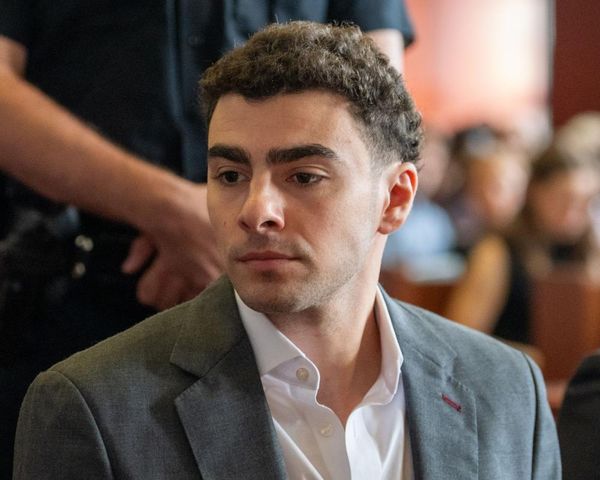
Members of a House Ethics subcommittee ruled against Rep. Sheila Cherfilus-McCormick, D-Fla., after a marathon hearing Thursday that stretched into the night, finding that she violated ethics rules.
It was a rare moment for the typically secretive Ethics panel, as a public “trial” unfolded for the first time since 2010.
In a packed room that started to empty out over several hours, Cherfilus-McCormick sat next to her attorney, William Barzee, who is also representing her in her separate criminal case. She listened silently as committee lawyers accused her of campaign finance offenses and using a “straw donor scheme” as she ran for Congress.
Behind her in the audience sat Elijah Manley, who is challenging her in the Democratic primary for Florida’s 20th district.
Some friendlier faces showed up in the crowd, too, including a few members of the Congressional Black Caucus, like Reps. Steven Horsford, D-Nev., Joyce Beatty, D-Ohio, and Jasmine Crockett, D-Texas. At one point Rep. Shomari Figures, D-Ala., hugged Cherfilus-McCormick as she exited the room for a recess.
“I want to reiterate that the process is not adversarial in the traditional sense,” said Ethics ranking member Mark DeSaulnier, D-Calif., as the hearing began. “It is not a criminal trial. It is an inquiry to determine whether Rep. Cherfilus-McCormick’s conduct violated House rules and ethical standards.”
Members of the adjudicatory subcommittee retreated behind closed doors to deliberate “well past midnight,” according to a statement released Friday morning. They found that 25 of 27 counts were “proven by clear and convincing evidence.”
But the subcommittee was not convinced by count 16, finding insufficient proof that her conduct was improper around money laundering allegations tied to Florida-based company Petrogaz-Haiti. It also rejected count 27, which accused her of a lack of candor and diligence during the investigation.
Now the full Ethics Committee will meet to recommend a punishment, which it will do “shortly after the House returns from the April recess,” according to the release. While the panel can’t expel her from Congress on its own, it can suggest that action to the House, which would then require a two-thirds vote on the floor.
Cherfilus-McCormick also faces a federal criminal trial set to begin next month. She was indicted in November on charges of conspiring to steal $5 million in federal disaster funds that were mistakenly overpaid to her family’s health care company during the pandemic, with prosecutors saying she funneled money to her 2021 run for office and bought a diamond ring. She has pleaded not guilty.
The prospect of expulsion puts some Democrats in a tough spot. While they want to appear tough on corruption, some believe the ethics process was rushed and will interfere with Cherfilus-McCormick’s coming day in court. And with tight margins in the House, losing a Democrat would give Speaker Mike Johnson and his GOP majority more breathing room.
The House Ethics Committee has been probing Cherfilus-McCormick since 2023. It formed an investigative subcommittee that in December accused her of the 27 violations, ranging from improper receipt of funds to disregarding limitations on volunteer work.
The last time the Ethics panel held a “trial” was in 2010 for the late Rep. Charlie Rangel, D-N.Y., who was ultimately censured for tax evasion. Rangel slammed the committee, saying he wasn’t provided due process and boycotted his own hearing.
No witnesses were called Thursday, and Cherfilus-McCormick didn’t speak herself. Instead, lawmakers questioned lawyers on both sides as they considered a motion for summary judgment.
“Fundamentally, the allegations before you involve a member of Congress misleading constituents, the FEC and the House of Representatives in order to obtain and keep the congressional seat,” said Brittney Pescatore, the Ethics Committee’s director of investigations, arguing she won her special election in 2022 using a murky web of money tied to her family’s business.
Cherfilus-McCormick’s lawyer pushed back and denied wrongdoing, saying the money she loaned to her own campaign came from an informal profit-sharing agreement, not from an elaborate money laundering scheme.
“In the Haitian American community, family members don’t put things in writing like that. They shake hands and they trust each other,” he said.
‘You can’t unring the bell’
The hearing should have been delayed until after her criminal trial, or at least moved behind closed doors, Cherfilus-McCormick’s lawyer argued.
“You can’t unring the bell. Once you ring the bell, it’s going to reverberate,” Barzee told the subcommittee, arguing Thursday’s news coverage could sway jurors.
The subcommittee rejected both requests.
Holding a public ethics hearing is not unprecedented — but what’s unusual is for the committee’s investigations to make it this far at all, said Kedric Payne of the Campaign Legal Center, who once worked for the Office of Congressional Ethics.
“To get to the point that it reaches the point of a hearing, it’s extremely rare,” Payne said.
The House Ethics Committee follows a time-consuming process and loses jurisdiction over members once they leave Congress. Since 1991, only four prior matters in front of the Ethics panel have progressed to the adjudicatory subcommittee stage, with only two completed adjudicatory hearings, according to a committee memo.
A House probe and a DOJ probe running concurrently is also unusual, Payne said.
“Usually, you would expect the committee on ethics to sort of delay and put the ethics matter on the back burner while they defer to the criminal prosecution — but that doesn’t always provide the public confidence that the members of Congress care about the integrity of their own body,” he said.
The Ethics panel began its investigation well before the criminal indictment, committee counsel said, citing a “truckload” of evidence it amassed and noting the Justice Department did not request a full deferral of the proceedings.
Democrats tread carefully
House Democrats largely avoided weighing in prior to Thursday’s trial.
“Next question,” House Minority Leader Hakeem Jeffries told reporters who asked him about the matter earlier in the week.
“We’ll see what happens in the Ethics Committee. I’m not going to prejudge the outcome,” House Democratic Caucus Chair Pete Aguilar said Wednesday.
On Thursday morning, Aguilar was similarly brief after the subcommittee released its findings: “It doesn’t sound good.”
Rep. Marie Gluesenkamp Pérez, a moderate Democrat from Washington state, signaled she would support any expulsion push given the ethics outcome. “She should resign or be removed,” she posted Thursday on X.
Florida Republican Rep. Greg Steube had threatened to force a vote on expelling Cherfilus-McCormick last year, but ultimately said he would hold off while the committee worked.
Expulsion in the House is exceedingly rare and requires two-thirds of lawmakers to vote in support, which means if it were to come up for a vote, a significant chunk of Democrats would have to join with Republicans for it to succeed.
The last member to be expelled was former Rep. George Santos, R-N.Y., in 2023, though that case never reached a public hearing and followed a different track. The panel ultimately did not recommend disciplinary action for the New York Republican because it would have “taken several more months,” Ethics Chair Michael Guest, R-Miss., said at the time.
While the Ethics panel cannot impose legal punishments, members said the rare public hearing was important even so and could restore trust in Congress.
“Part of our charge is to protect the reputation of this institution, and it’s already been eroded by your client’s actions, at least in the public perception,” DeSaulnier told Barzee. “If we’re being honest and truthful — and we’re trying to give her the benefit of doubt — we’re already eroding that trust.”
Valerie Yurk contributed to this report.