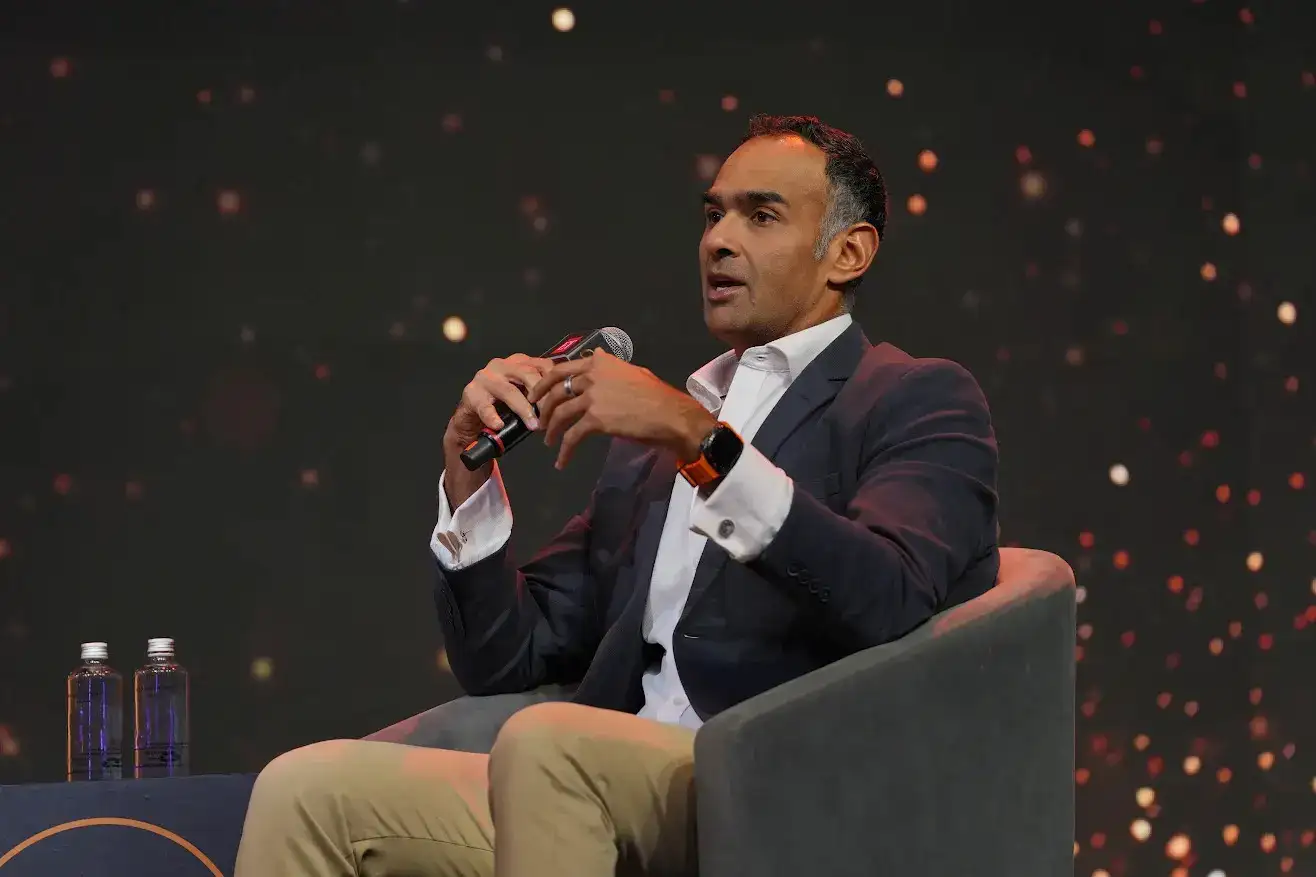
Sid Swaminathan, who moved to India from the UK two years ago, says the country is at a rare inflection point where first-time investors, seasoned equity holders, and a booming digital ecosystem are all transforming at once.
India's investment landscape is changing faster than anywhere else in the world, and passive funds are at the centre of that shift. That is the view of Sid Swaminathan, MD and CEO of JioBlackRock Asset Management, who made the case at the ET Alpha Wealth Summit that India has reached a genuine inflection point in how its citizens invest.
The panel discussion was on 'Global or Local? The New Allocation Reality'. Other than Swaminathan, Devina Mehra, Founder & CMD, First Global, Lakshmi Iyer, Group President, Investments, MD & CEO, Bajaj Alternate Investment Management Limited, and Rahul Jain, President & Head, Nuvama Wealth, took part in the discussion that was moderated by Kshitij Anand, Editor-Markets & Finance, ET Digital.
Swaminathan, who relocated from the UK two years ago, said the pace of behavioural change among Indian investors is striking even by global standards. "The pace with which investor behaviour is changing feels a lot faster than it has happened elsewhere in the world," he said, citing the rapid progression from basic saving to active investing, followed quickly by conversations about asset allocation, global exposure, and alternatives.
From 6% to 25% in a decade
The numbers back his claim. Passive funds, index funds and ETFs, have grown from roughly 6% of the overall mutual fund industry a decade ago to approximately 25% today. Notably, a comparable shift took 15 to 20 years in more mature markets. India is compressing that timeline dramatically.
"Passive funds as a function of the overall industry have gone from about 6% to now 25% in just 10 years, and even that took 15 to 20 years elsewhere. It is moving pretty quickly," said Swaminathan.
Three factors are driving this, according to Swaminathan. First, markets are maturing and becoming more efficient, making it harder for active managers to consistently beat benchmarks. Second, after roughly 18 months of flat equity returns, investors are beginning to question what they are paying active management fees for. Third, and most damning for the active fund industry, more than 70% of largecap funds are currently failing to deliver alpha over their benchmarks.
Not one market, but many
Swaminathan was careful to frame the passive surge not as a verdict against active management, but as a sign of investor sophistication. His view is that India does not have one investment market — it has several, operating simultaneously, each at a different stage of maturity.
At one end are first-time investors just beginning their journey, for whom SIPs and basic mutual fund access remain the priority. At the other are seasoned equity investors, already fully allocated to Indian stocks, now asking about debt, global diversification, and alternatives. Both cohorts need entirely different conversations.
"What is really fascinating about India right now is that all of this is happening at the same time," Swaminathan said. "There is not one single solution. Education has to be very specific to the segment."
He pointed to India's rapidly expanding digital ecosystem as a third, uniquely Indian accelerant, one that is enabling financial access and investor education at a scale and speed that has no real parallel globally. Together, these forces make India, in his view, one of the most exciting asset management markets in the world right now, not despite its complexity, but because of it.