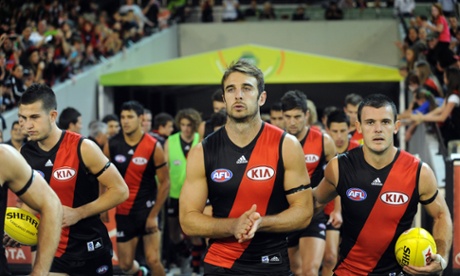
It’s the first weekend of the AFL season. The Herald Sun’s front page is dominated by the return of football. The paper’s motto is printed at the top of the page – “We’re for footy” – as though anybody would doubt it. Its chief football writer Mark Robinson takes a stroll around the stadium – “Centre of the universe” is the unironic headline – and writes of the sense of anticipation a new season brings. “The chips are hot, crunchy and cheap, the cost of a beer is worth the plastic cup and Round 1 is a cracker.”
The Age, meanwhile, publishes a poem to mark the occasion. “We seldom know what lurks and waits/Revealed to us sometimes too late/And worries weight too great to bear/’Cause there be Tigers lurking there.”
But then they had to go and spoil it. “Query over Dons’ Records” is the story, about the head of the Australian Sports Anti-Doping Authority (Asada) suggesting that the Essendon Football Club’s records of its supplement program in 2012 may have been “either destroyed or removed”. “No end to saga,” it says.
Melbourne’s silliness at the beginning of the AFL season is one of the city’s most endearing qualities. This year, there is a strong sense that most people want to be silly again, giddy about their team’s chances and their own tipping genius. They’ve had enough of the Essendon “saga”.
It has gone on for 26 months, has been intensely emotional, has destroyed careers and reputations, and has seen the politics of the game – the men in suits, the lawyers, the journalists – take too much attention from the game itself.
Everyone in this is protecting their own position now, but my guess is that most people would agree with AFL chief executive Gillon McLachlan’s hope that this is the end of it. He’d prefer that Asada decides not to appeal against an AFL tribunal’s verdict that the anti-doping body had not proven that 34 past and present Essendon players were injected with the banned substance thymosin beta-4.
The players are free to play this weekend, with Essendon lining up against Sydney. Few would argue that the footballers – let down by their club and the league – have not suffered enough.
“I’ve almost forgotten what it’s like to be an AFL player without having this hanging over our heads,” an emotional Essendon captain Jobe Watson said after the anti-doping tribunal’s verdict this week. “We want to go to bed at night and not have it be the last thing we think of and the first thing we think of when we wake up.”
The pity is, we still don’t know the truth about what happened at Essendon in 2012, and we will probably never know. We do know that the whole thing started badly and never recovered.
The “blackest day in sport” press conference in February 2013, with then justice minister Jason Clare, sports minister Kate Lundy, the Australian Crime Commission and the heads of the major sporting codes was no such thing, given what we know now. There was too much hyperbole about organised crime and widespread performance enhancing drug use in various codes before investigations had properly started. Too much noise, too few facts – a pattern that has been repeated for more than two years.
We do know, too, that the three-person tribunal, headed by retired Victorian county court judge David Jones, found that Asada – after two years of investigating – had not proved that the players had received thymosin beta-4. Biochemist Shane Charter intended to buy and import the substance, chemist Nima Alavi thought he was compounding the peptide and sports scientist Steven Dank, who then ran the supplements program at Essendon, took possession of vials he believed contained the drug.
But the tribunal could not be “comfortably satisfied” that the substance was in fact thymosin beta-4 because of limited testing and poor records and because of the low credibility of the three men. Basically, no one knows what was in those vials.
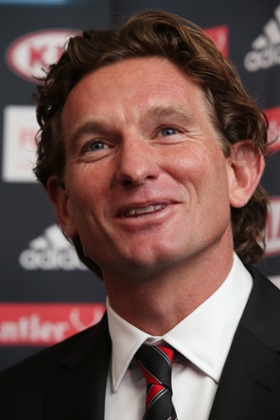
The ruling was a relief for Essendon, but it was hardly a vindication of the club. “There was a deplorable failure to keep comprehensive records of the supplement program and its administration,” the tribunal reportedly found. Essendon’s coach James Hird has proved stubborn and tough, if not entirely plausible as someone ignorant of the discredited supplements regime. For its own governance failures, the club was thrown out of the 2013 finals and fined $2m. Hird was banned from coaching for 12 months. He may be angry and unrepentant, but he is lucky to have survived.
Equally, the tribunal’s verdict is a humiliating defeat for Asada. It was hamstrung, sure. Dank, who is accused of multiple counts of breaching anti-doping rules but maintains his innocence, refused to cooperate. And Asada lost its bid to subpoena Charter and Alavi to give evidence before the tribunal.
As former Asada chairman Richard Ings told the ABC’s 7.30 this week: “It is completely unprecedented in international anti-doping for an anti-doping organisation like an Asada to publicly charge 34 players and to lose 34 cases. I have never seen that anywhere in the world.” He urged the body to give it up.
No wonder Asada’s current chief executive, Ben McDevitt, is so bitter. Despite the unanimous ruling, he still believes Essendon players were given banned drugs. What happened at Essendon was “absolutely and utterly disgraceful”, he said.
“I’m very confident [of Asada’s case]. It’s whether or not you can prove it.”
Asada didn’t prove it. At some point, someone somewhere will need to let this go. No one is “comfortably satisfied”, to use the wording of the moment, about any of it. But there would be serious dissatisfaction if this was allowed to hang over another AFL season. Football may be more than a game, but it’s still a game.