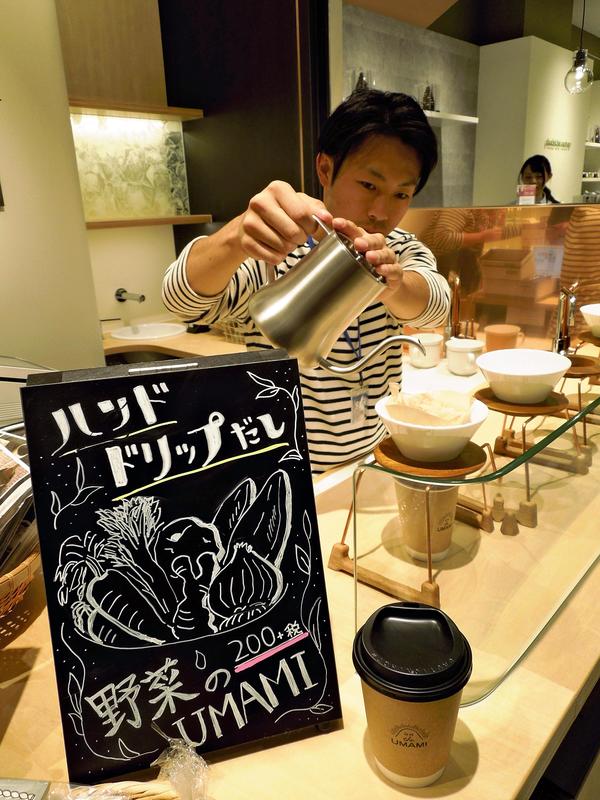
Located in the Shinjuku Marui shopping complex in Tokyo, the shop looks like a cafe. A staff member sets a cone-shaped paper filter on a stand and pours hot water into it. A pleasant aroma fills the air, but the filter contains fluffy dried tuna flakes instead of coffee.
This shop is named On the Umami, and it offers just "hand drip" dashi stock at 200 yen per cup, before tax. The regular flavor comes from dried tuna flakes combined with dried vegetables, and a seasonal flavor using chicken and kombu seaweed is scheduled to be available through mid-April.
"It's delicious," said a Tokyo woman, 32, as she sipped the "fresh-brewed" dashi. "I'm curious to learn about the types of dashi and how to use it."
On the Umami is one of a growing number of establishments specializing in dashi stock, usually prepared from dried bonito flakes or kombu, or from both. As washoku Japanese cuisine is enjoying global popularity, makers are opening these places in a bid to interest young consumers in this key element of the cuisine, because many of them even don't know how to prepare it.
The shop was established by Akira Eguchi, who runs a company in Niigata Prefecture that makes and markets dashi products for professional use. For On the Umami, the 35-year-old Eguchi chose a building that houses many clothing and fashion shops for young people. His shop also sells bonito flakes and other ingredients for dashi that are wrapped neatly in packages like those for sweets, which look perfect for gifts.
Glu Glu Kombu Cafe opened in Kobe in November, serving vegetable potage that uses dashi made from seaweed. The cafe was launched by Naniwa Kombu, a Kobe-based manufacturer and wholesaler of kombu products, to show that Japanese stock can go well with Western-style dishes.
The company initially planned to run the cafe until December but decided to keep it open longer, as the place has proved popular among families with children and young people.
Nihonbashi Dashi Bar in Chuo Ward, Tokyo, offers cups of dashi made from bonito flakes as its main menu item. The place has been popular since it opened in 2010, selling up to 500 cups of dashi a day. That prompted Ninben Co., the bar's operator specializing in bonito flake products, to release "dashi bags" -- tea bag-like products designed to make preparing dashi easier -- while also posting recipes using dashi on its website.
According to a survey conducted in October last year by Nippon Shuppan Hanbai Inc. on 1,274 people, from teenagers to people in their 60s, 40.6 percent of respondents in their 20s and 33.3 percent of respondents aged 10 to 19 said they "don't know" how to prepare dashi. Among respondents in their 30s or younger, 41.2 percent said they had never prepared it on their own, except for trying their hand during classes at school.
About 10 percent of those in their 20s said they didn't know dashi is necessary to make miso soup.
In January, the publishing company inaugurated a "dashi test" in the hope of providing members of the public with an opportunity to learn about the stock. About 1,000 people sat for the exam.
"Dashi can be made simply by leaving kombu and/or bonito flakes in water overnight [without having to heat that water]," said Maki Ukai, who supervised questions on the test as the head of an association that issues certifications for so-called "dashi sommeliers." "Or it can be extracted from meat, fish and vegetables in the process of cooking. I hope people don't consider dashi something complicated and enjoy food much more."
Ryukoku University Prof. Toru Fushiki, an expert on washoku, said if you do not take advantage of dashi, you "miss a lot because it can make your dishes more delicious."
"However, many families are busy today, and there is a great need for 'fast recipes,'" he said. "So it'll be good to offer various information on tips for easily preparing dashi."
Read more from The Japan News at https://japannews.yomiuri.co.jp/