The European Space Agency is designing a new robot to explore caves on the moon.
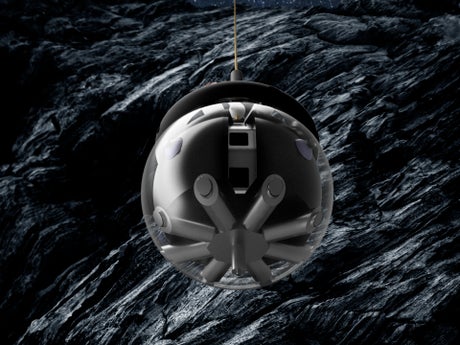
Daedalus, named after the mythological Greek craftsman and father of Icarus, is 46 centimetres in diameter – approximately twice as large as a football.
The robot’s impressive feature set includes an immersive stereoscopic camera, a ‘laser radar’ lidar system for creating three-dimensional maps of cave interiors, temperature sensors and a radiation dosimeter. In order to get around obstacles and test rocks, the robot also has extendible arms.
When on the moon, Daedalus would be lowered into a cave via a tether, before disconnecting and rolling away autonomously with an in-built battery pack. The wire would then act as a Wi-Fi receiver, allowing the robot to send back data to the astronauts.
“The design is driven by the requirement to observe the surroundings in full 360 degrees and the necessity to protect the interior from the harsh lunar environment,"explains Dorit Borrmann of the Daedalus team.
Read more:
- Scientists reveal new image of first ever black hole to be pictured
- Tesla warns customers they could lose a car’s worth of bitcoin with one mistake
- Nasa announces details of first ever controlled flight on another planet
- Next bitcoin crash will wipe 90% from price and cause ‘crypto winter’, expert warns
“With the cameras acting as a stereo vision system and the laser distance measurements, the sphere detects obstacles during descent and navigates autonomously upon reaching the pit floor.”
The robot, which the space agency describes as a ‘dangling hamster ball’, could be used to map caves for potential astronauts, who might have to live in the caves while establishing camps on the moon.
One cave on the moon has already been identified by the Japanese space agency as a potential shelter for astronauts, with long-dead lava tubes that stretch for miles; similar theories have been suggested for future settlers on Mars.
Daedalus is not the only concept that the ESA is exploring for future Moon missions. The agency also invited designs for other studies, including a rover that would scout and map lava tubes by hopping around, and another with a crane attachment.