In 2012, I had this gut feeling that we were living in a kind of interbellum, a period between two wars. It felt as if a huge thundercloud was heading our way. I sensed it in art and in the young and wanted to capture it.
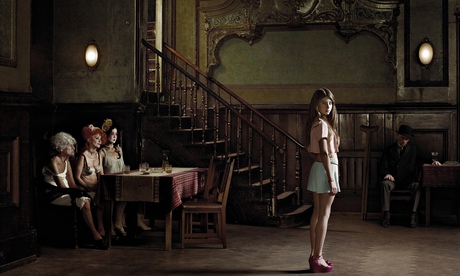
I had wanted to photograph in Berlin for a long time and managed to find a ballroom that officers had danced in during the second world war. It’s dilapidated but still in use. It made me think of a painting by Otto Dix called Salon, 1927, showing three elderly women and a younger one at a table. That became one aspect of the photograph, but I didn’t have anything for my idea of the interbellum. Then, later, I was at an airport and saw children screaming and running around. It was a eureka moment. That’s how to add the power of youth, I thought, while the battle element would come from a struggle between youth and maturity.
I spent a lot of time looking for models. I was after open-minded older women to echo the characters in Dix’s work. The one on the left was fantastic: 89 and really liberal. The worse she looked, the more she liked it. The woman in the middle had a sad smile. I didn’t ask for it, though. I just said, “Think about your youth” and she started to smile. I’ve always been interested in women who wear too much makeup, so I made the woman on the right a down-at-heel geisha figure. Three is a magical number in photography. Two never works. With three, you have conflict and good composition.
The girl was adorable, really beautiful, on the edge of becoming a woman. The way she is standing, looking towards the camera, shows her innocence. But, if you look to the table, you see a chair pushed away – as if she had been sitting there. So there is a kind of maturity and arrogance, as if she’s saying: “I don’t want to mix with those people any more.” She becomes a symbol of youth, strong and aware of their power.
I lit the scene from the right, too, so it looks as if the girl is moving in that direction. Perhaps the light is coming from a door, a way out from the old world.
I looked at a lot of newspaper photographs when I was researching the interwar period in Berlin. What I saw was a lot of disabled men returning home from the first world war – and a lot of alcoholism. The man at the back of the picture is based on one of these images. Every picture from the series has stairs in the background, too, because for me that’s what Berlin is: a city of stairs. Whenever I heard about some interesting new location, I would be told that it was up, say, three flights of stairs. I suffer from emphysema so climbing up them is a nightmare. But stairs can be interpreted as hopeful – a way out – or they might be going down to hell.
I have lots of ideas in my mind when I’m making photographs, but they’re not set in stone. There is no single way the picture should be interpreted. I like how you can suggest things through minor adjustments – to the lighting, the position of the chair, whether the girl’s shoulders are up or down, or if she’s looking into the camera.
I used to want to conquer the world with strong images, but nowadays I want to say to the viewer: I’ll give you the ingredients, you make the story.