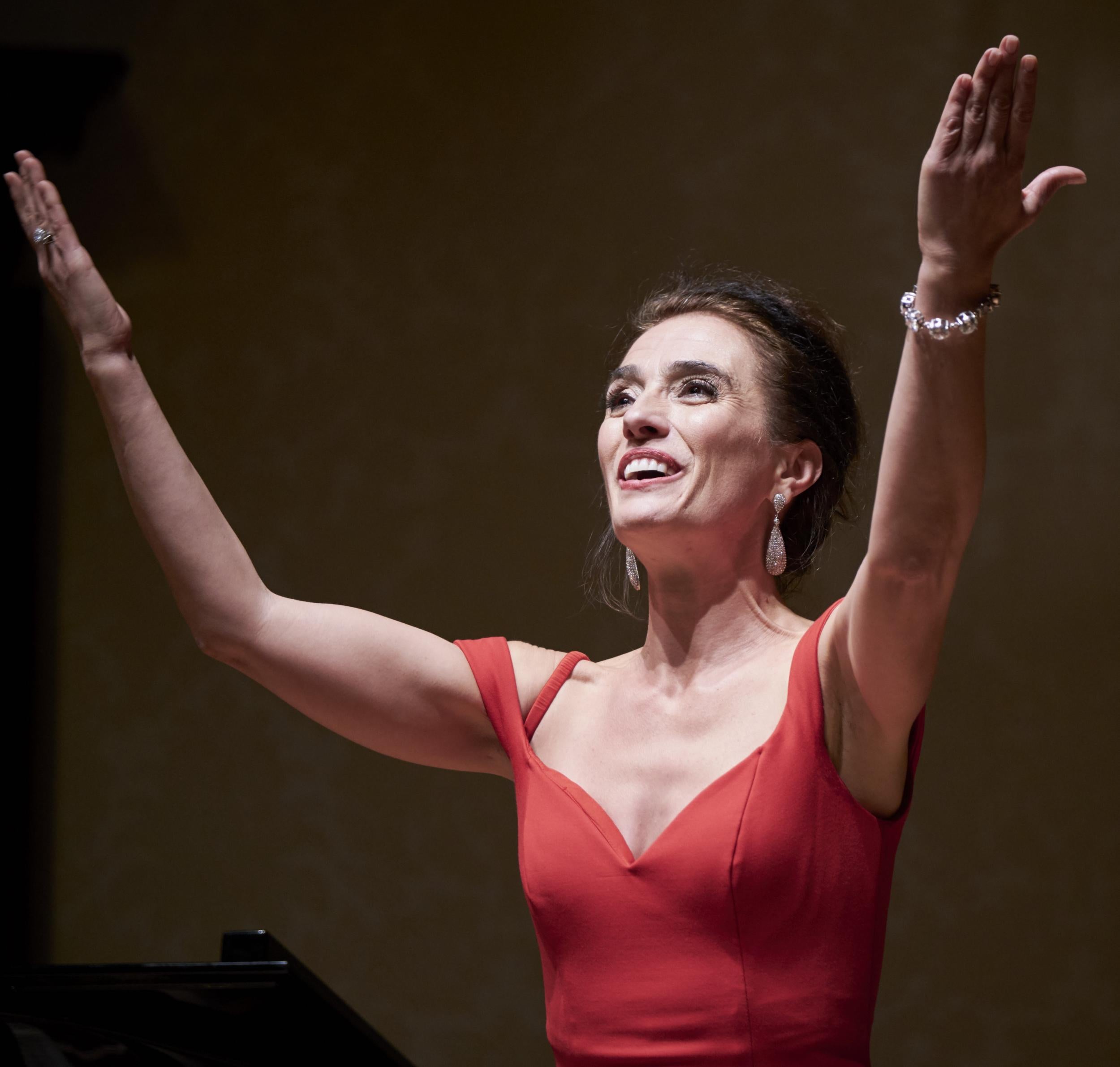
Trust Ermonela Jaho to make a splash with her Wigmore debut. By tying it to her campaign to revive the memory of an unjustly forgotten singer, she’s ensured that the world pays maximum attention both to her chosen cause and to herself.
It was the Italian soprano Rosina Storchio whom Puccini chose to take the lead in the premiere of his Madama Butterfly in 1904. Noted for the lyrical refinement of her singing, Storchio was the soprano of choice for the premieres of many works; she was an acclaimed Mimi, Manon, Violetta, and Norina. “She didn’t have a big voice,” says Jaho, ‘but she was a wonderful actor.”
The same has been said of Jaho herself, though not of her voice. This diminutive Albanian, whose fame was slow in coming but tumultuous when it did, had the house in tears when she first sang the lead in Puccini’s Suor Angelica at Covent Garden, and she electrified the audience again with her recent Desdemona. Few other singers have her ability to concentrate the entire focus of a scene and to compel our attention to every nuance of her phrasing.
Here at the Wigmore Hall, we get a feast of the arias Storchio sang, and with the exception of three (from Puccini, Bizet, and Massenet) all prove refreshingly unfamiliar: rarities from Verdi and Donizetti, Leoncavallo and Cilea, a world of verismo and late bel canto. Jaho eases herself in at first, letting Leoncavallo’s Mimi flirt and two Bellini songs spread their smooth lustre, but it’s soon apparent that, ably accompanied on the piano by Steven Maughan, she’s going to fully become each of her 19 characters in turn.
Some are good-time girls, others burn with passion, or are desperately deranged, but there’s nothing diva-ish about her finely judged theatricality: her goal is emotional truth. Her sound is by turns light and transparent, or luxuriously full, and it builds to huge climaxes when the music demands. What she does with a 13-minute mad scene from Mascagni’s rarely-performed Lodoletta has shattering force. An astonishing debut: later this year Opera Rara – now celebrating its 50th anniversary – will release the record.