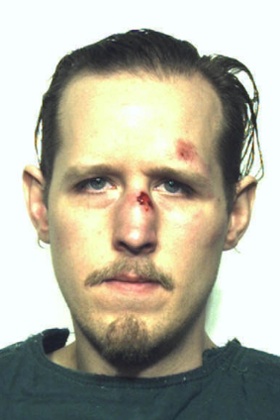
The survivalist accused of killing a Pennsylvania state trooper made his first court appearance on Friday morning, facing jeering crowds as police escorted him into the Milford, Pennsylvania courthouse.
Eric Frein, 31, evaded police for nearly seven weeks, but was captured by US marshals on Thursday night outside an airport hangar at Pocono Mountain airport.
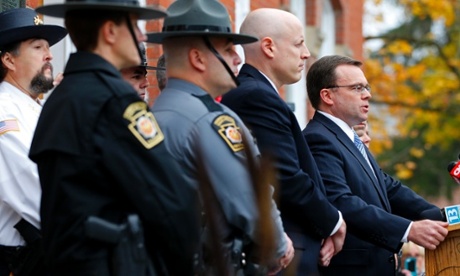
“Today we find some comfort, as a community, that we are taking these next steps toward justice,” said Pike county district attorney Raymond Tonkin, addressing reporters outside the county courthouse on Friday.
More than 1,000 law enforcement officials had searched for Frein in the densely-wooded Poconos mountains, just outside the Pennsylvania-New Jersey border. Frein, who had studied survivalist tactics and is said to be an expert marksman, is accused of killing Cpl Bryon Dickson and wounding another trooper in an ambush on 12 September at the Blooming Grove barracks.
Frein has been charged with 11 counts including first-degree murder, attempted first-degree murder and possession of weapons of mass destruction. A preliminary hearing is scheduled for 12 November at the Pike county courthouse.
Prosecutors said they will seek the death penalty for Frein. Pennsylvania has the fourth-most inmates on death row of any state, but has only executed three people since it reinstated the death penalty in 1976.
“I have characterised his actions in the past as pure evil and I would standby that,” said Lt Col George Bivens at a news conference after the arraignment.
He said officials surprised Frein during a sweep of the area. Frein kneeled and put his hands up after being approached by US marshals. He had scratches on his face at the time of his arrest, but police said those were acquired before he was caught.
Bivens said Frein had spoken to police but would not comment on what he said.
“He did not just give up because he was tired,” state police commissioner Frank Noonan said at a Thursday night press conference. “He gave up because he was caught.”
Noonan said that Frein was held in Dickson’s handcuffs and placed in his police car. Dickson had joined state police in 2007 and was the father of two sons. Hundreds of police from around the US gathered for his funeral, where he was remembered as “no ordinary trooper”. Trooper Alex Douglass, who was wounded in the attack, was discharged from the hospital on 16 October to a rehabilitation facility.
Frein was linked to the ambush after a man walking his dog discovered a partially submerged SUV in a pond a few miles from the barracks. Frein’s driver license was in the vehicle, along with items including military gear, camouflage face paint and “various information concerning foreign embassies”, according to the criminal complaint.
Later, police say they discovered his journal at one of his campsites, which had a “cold-blooded and absolutely chilling account”, of the ambush. Police said a review of the notes did not give any indication that he knew the identities of the troopers he shot.
Frein was put on the FBI’s 10 most wanted list, where he was described as “armed and extremely dangerous”. The manhunt stilted life in the rural mountain region he was raised in, with schools shutting down and outdoor activities being cancelled during the search. Residents were blocked from returning to their homes or ordered to stay inside during particularly intense periods of the search.
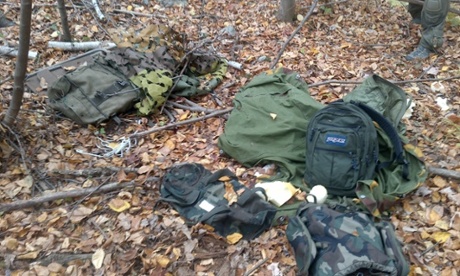
Investigators said officers and civilians had spotted Frein multiple times in the 48-day search period. They had also found materials in the woods believed to be Frein’s, including soiled diapers, an assault rifle, two functional pipe bombs and his checkbook.
The checkbook and other items were found after police surveilled Frein’s cellphone, which showed he was about three miles from his parents’ residence. Police were stationed in that area since in an attempt to find Frein.
Officials said he had anti-law enforcement views and that a computer search showed that he had been preparing for the shooting and hideout for years. He had run online searches for things including “can police track cellphone”, “tips on placing caches” and “swat raid tactics”, according to the criminal complaint.
He was also tied to war re-enactment groups and officers had found a book titled Sniper Training and Employment in his bedroom. His father E Michael Frein, a retired major in the US army, told police in Septemberthat his son “doesn’t miss”.
His sister, Tiffany Frein, told NBC News last month that her brother is “not a psycho” and that the last time her mother had spoken with him he had seemed happy.
“We’re not trying to protect him. He has to suffer the consequences. But he’s still our family,” she said. “I don’t know where he is or what he’s doing. I hope it’s a big misunderstanding.”