Church authorities will take the help of epigraphists to decipher the inscriptions on stone slabs unearthed on the premises of the church where the historic Udayamperoor synod was held in June 1599. The stone slabs were recently spotted during the works to shift the granite cross in front of the church closer to the church building.
The writings on the stone slabs are confirmed to be in Vattezhuthu, a script used between the 9th and the 18th centuries and is considered to have evolved out of Brahmi. The AD 832 Vazhappilly edict is the oldest inscription in Vattezhuthu that has been discovered, according to researcher Gibson Louis who is pursuing a doctoral degree on the significance of the historic Udayamperoor synod.
Documents written between AD 1600 and 1701 can be viewed inside the synod church, 16 km to the south of Ernakulam, he said. Earlier discoveries of inscribed stone slabs from the premises were tombstones, which included one of King Thoma of Villwarvattam, he pointed out.
Though there is widespread belief of the reign of a Christian king in the vicinity of Kochi, having migrated from Chendamangalam, the discovery of the tombstone established its historicity, tracing back the king’s death to AD 1701, said the researcher.
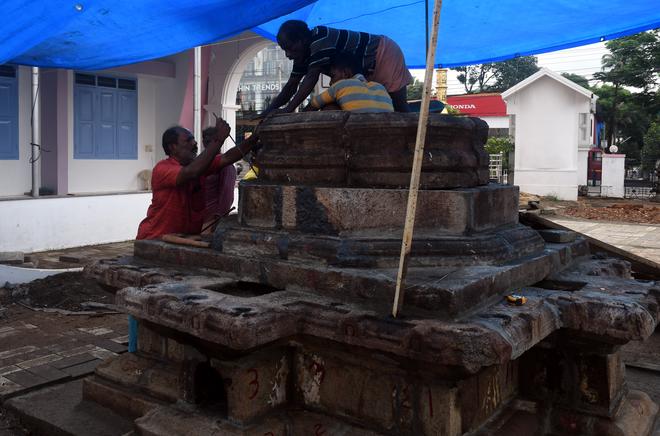
Fr. Ignatius Payyappilly, chief archivist, Archdiocese of Ernakulam-Angamaly, said the contents of the stone slabs will be deciphered with the help of the experts once the ongoing works on the church premises are complete.
The iconic cross in front of the church could be older than the synod itself because there are no records of activities of considerable significance at the Udayamperoor church after the synod, said Varghese Angamaly, a history enthusiast.
Discoveries around the Council of Udayamperoor (known as Diamper in its westernised name) are keenly watched because of their significance in the history of the Malabar (Saint Thomas) Christians in particular and the Kerala social history as a whole. The synod, convoked by Aleixo de Meneses, Archbishop of Goa, formally united the ancient Saint Thomas Christians of the Malabar coat with the Catholic Church by severing their ecclesiastical ties with the East Syrian (Chaldean) Church.
The synod, with the backing of the Portuguese authorities, suppressed local practices within the Church, Latinised rituals, ordered burning of books found not adhering to the Catholic faith and established the supremacy of the Latin Church vis-a-vis Portuguese power. Rebellion against the synodal decisions led to the Oath of Koonan Kurishu (Oath of the Leaning Cross) in 1653 and a schism.