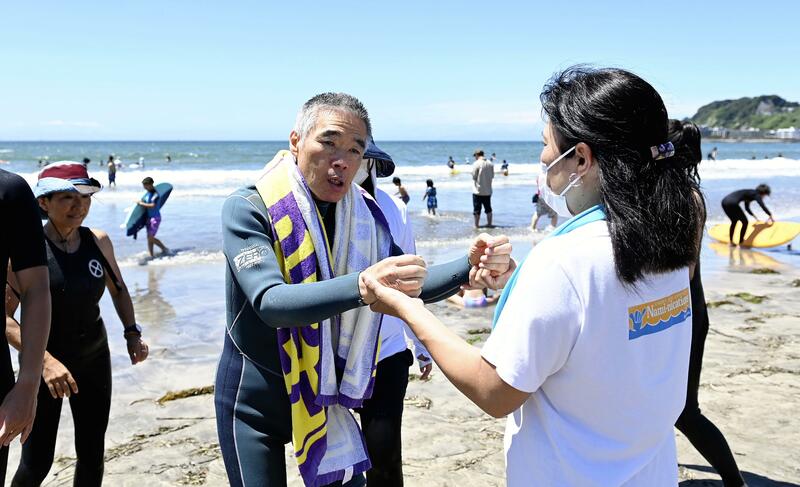
As Kenji Kawana lies on the surfboard, the voice urges him, "Let's do one more."
It is mid-July at Yuigahama Beach in Kamakura, Kanagawa Prefecture. Kawana, 64, suffers from early onset dementia, and a volunteer from a group dedicated to helping the physically and mentally disadvantaged to enjoy sports is encouraging him as he tries surfing, an activity of his youth.
The "Nami-nications" is a private group of surfing enthusiasts comprised of local professionals from the medical and nursing fields who are trained in sports instruction for the disabled. Nami means wave in Japanese.
With the Tokyo Paralympics as an impetus, the group and others like it are hoping to provide people from a more diverse range of backgrounds with additional opportunities to participate in a wider variety of sports.
Kawana was a local surfer who had competed around the country. He stopped surfing after he was diagnosed with dementia at the age of 52, but returned in 2016 after being invited by Yasuhiro Shibata, who runs a local daycare service and is the head of the Nami-nications.
Since then, Kawana has been riding the waves about once a month. On the day they surf, the group chooses the length of the surfboard for Kawana by looking at the waves as well as his physical condition. The team members surround him when he enters the water.
When he comes out of the water, Kawana always has a smile on his face .
"It has become difficult for me to talk with my husband, but I know that he enjoys just being at the beach," said Kawana's wife Yumi, 58. "It is also refreshing for me as a caregiver."
The group's activities spread by word of mouth, and they now accept others with various disabilities in addition to Kawana. "It is difficult for me to do alone, but I can do it with peace of mind when there are people who support me," said a 50-year-old man who suffers from retinitis pigmentosa, an intractable disease that causes gradual loss of vision.
Although the group's activities are currently on hold due to the declaration of a state of emergency in Kanagawa Prefecture, Shibata said: "There are many people with disabilities who want to participate. I hope that with the Paralympics, more people will become interested."
-- Adapted sports
Sports with rules and equipment designed to make it easier for the disabled and the elderly are called adapted sports. Some can be done from a sitting position, such as "ping-pong volleyball," in which players with various disabilities sit around a ping-pong table and volley a ball back and forth.
Once a month at Tokai University's Shonan campus in Hiratsuka, Kanagawa Prefecture, former lecturer Katsusaburo Kondo leads a group that includes people with various visual and mental disabilities in scuba diving in the pool. The group has about 50 members, including 20 who are disabled.
Kondo, 76, with more than 50 years of diving experience himself, carefully assesses the symptoms of each individual and adjusts the attachment and position of diving weights, and then goes under water with them.
"Even people with serious disabilities can try different things with proper assistance," Kondo said. "I am happy to see the smiles on their faces when they are able to do something they thought was impossible."
Tomoyasu Yasui, a professor at Hokkaido University of Education and president of an academic society on adapted sports, said: "If we can create an environment where people with disabilities can play sports, it will help people from all walks of life, including the elderly and parents with young children, to enjoy an active life. It is necessary to increase the number of place where able-bodied people and people with disabilities can take part in sports together."
Read more from The Japan News at https://japannews.yomiuri.co.jp/