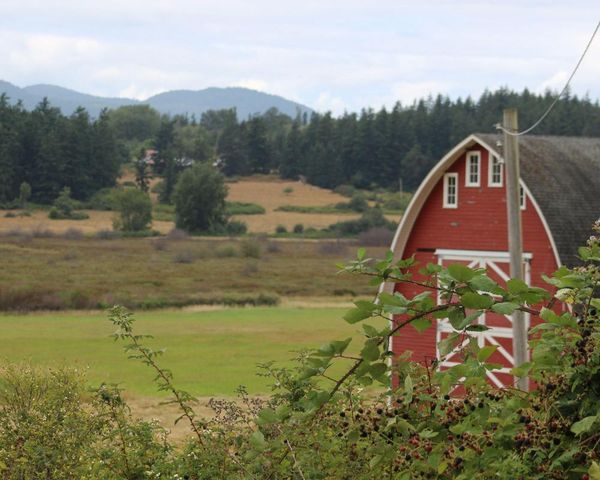
Located near the University of Tokyo's Hongo campus, Homeikan Morikawa Bekkan is a wooden Japanese-style inn built in the 1950s. On the first Sunday of every month, the inn is "visited" by yokai monsters.
I can't resist scary things, so I had to check out this establishment in Bunkyo Ward, Tokyo.
In these modern times, there are an increasing number of opportunities to encounter old-fashioned yokai monsters, their modern variations and other supernatural beings, not only in video games and anime, but also during various events aimed at vitalizing local communities.
When exchanging my shoes for slippers in the dim entryway of the Tokyo inn, I was greeted by zashiki warashi, a kind of house fairy in the form of a child. At a table in its banquet room were a group of hanafuda playing cards that transformed into yokai. These hanafuda-based creatures are classified as tsukumogami, or monsters believed to transform from old tools.
Of course, the monsters I encountered there were actually participants in a cosplay event, disguising themselves as yokai. The event was launched in July by Tomoko Kaizu, 35, who has organized programs to boost Tokyo's traditional shitamachi residential and commercial neighborhoods.
"Yokai monsters are the brainchild of Japanese people's imagination. They're interesting for their great diversity," she said. "I hope this event will draw in [not just Japanese people] but also people from overseas as the 2020 Tokyo Olympics and Paralympics approach."
The premise of the event is that yokai monsters still live in today's society in the guise of human beings, encouraging participants to "go back to your true form and relax once in a while."
When I asked one of the hanafuda-based "creatures" about what he usually does as a human being, he said hesitantly, "I'm a yokai, so I won't describe my background in detail."
"I enjoy sharing a great time with others. When I'm dressed up as a yokai, I can do even things that would be embarrassing as a human being," he said.
People who do not take yokai forms can also attend the event as long as they wear a "talisman" sticker.
"Here I can enjoy spending time with yokai, which are not supposed to exist in today's society," a 26-year-old female company employee said as she took many photos. "A world with many yokai monsters in it is attractive to me."
Over the course of the Heisei era, which started in 1989, there have been a growing number of opportunities for grown-ups to get away from their daily lives and enjoy themselves in other worlds.
Dressing up as characters in anime, manga and video games is now called cosplaying, which is becoming more and more popular. Celebrating Halloween has also taken root in Japan as a fun event for adults as well as children.
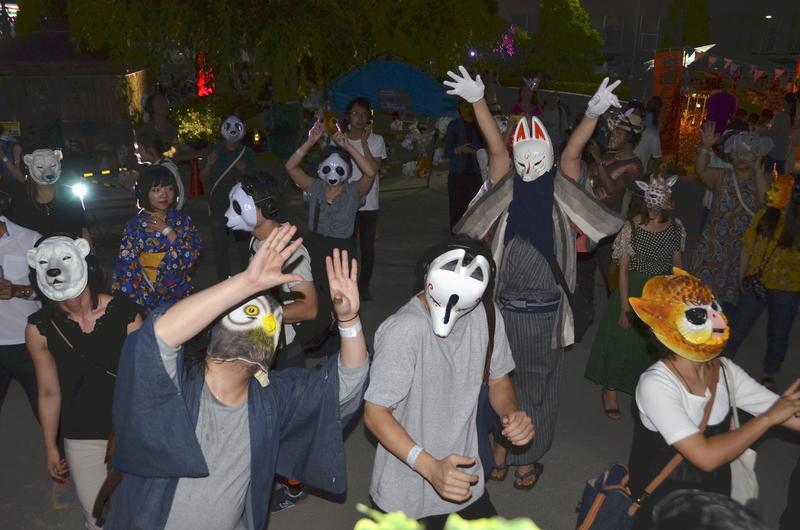
A masquerade was incorporated into a Bon Festival traditional summertime dance event held in late July at a park in Ota Ward, Tokyo. In the Neo Bon Odori event, young participants put on animal face masks and danced to the music provided by a disc jockey through the headphones they put on. Masks of monkeys, owls, foxes and other animals were rhythmically moving in silence, and the scene looked so surreal.
Yu Amemiya, 26, who organized the event, said the dance event was meant to encourage participants to extend their thoughts to extinct animals.
"I'm excited when I watch something other than human beings dance, because it makes me feel like I'm in another world," said Hitomi Komaki, 24, one of the participants in the event. "I have a somewhat strange feeling of unity with others."
Hiroya Ichikawa, a lecturer at Tohoku University of Art and Design who studies relationships between yokai and regional cultures, pointed out a major change in people's attitudes toward such creatures over the course of the Heisei era.
"During this period, it seems that a generation who experienced yokai and other supernatural beings through anime and manga have started to play them on their own," he said. "I believe immersing yourself in certain thematic worlds will become more popular in the future, just like trends in which fans 'make a pilgrimage to sacred places' where their favorite movies and other works take place."
Anxiety over society and the future helps fuel yokai boom in Heisei era
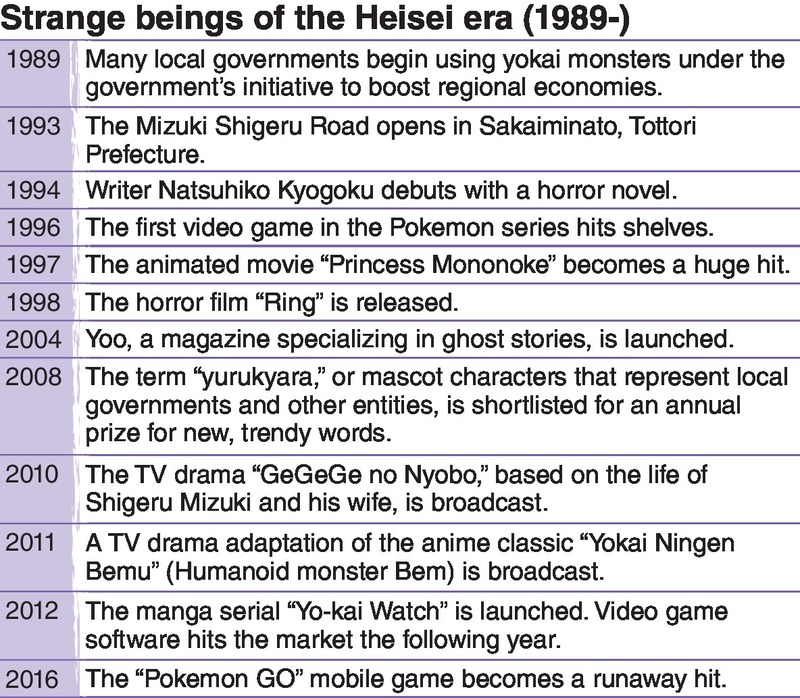
The current Heisei era, which started in 1989, has seen numerous fads for strange or mysterious presences and phenomena.
They were partly spurred by the central government's efforts to boost the economies of regional areas, measures that were implemented from fiscal 1988 to fiscal 1989. Under the initiative, some local governments used local folk legends featuring yokai monsters and mysterious phenomena to boost their communities.
For example, the town government of Tanushimaru, Fukuoka Prefecture -- which has now been merged into Kurume -- erected a station building modeled on a kappa, a child-like creature living in rivers or ponds with a signature plate on top of its head. Many other local governments built facilities or organized events based on demons, unidentified flying objects and other unworldly things said to have been witnessed by locals.
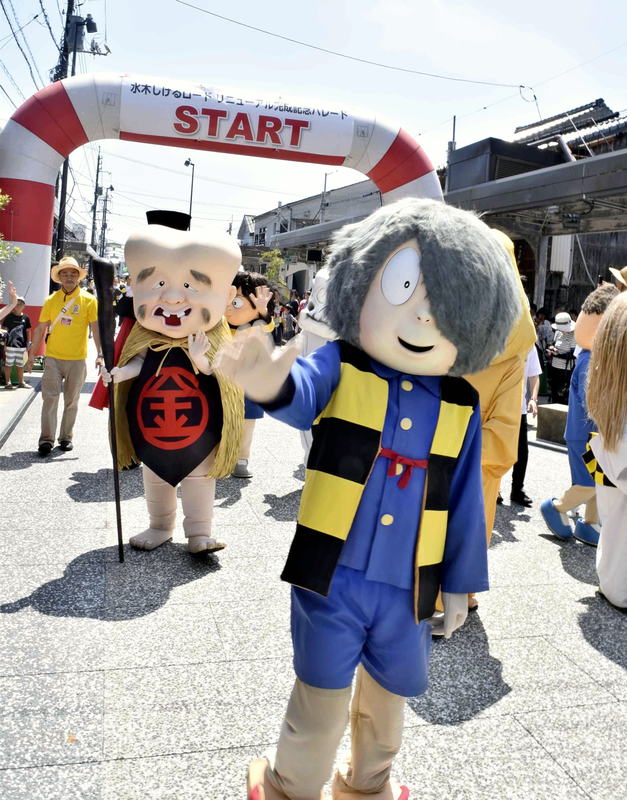
The Mizuki Shigeru Road was created in Sakaiminato, Tottori Prefecture, named after renowned manga author Shigeru Mizuki. Featuring statues of popular characters from his "GeGeGe no Kitaro" comic series depicting Japanese yokai monsters, the street has become a popular tourist spot, boosting public recognition of yokai.
Mysterious creatures have also raised their profile through anime and video games. For example, the role-playing game series featuring characters from "Pokemon," each of which has special powers, became so popular it got an anime adaptation. The "Pokemon GO" online game has even captured the hearts of adults.
"Yo-kai Watch" entertains players with a variety of mysterious characters that solve problems with the protagonist.
So why are all these monsters and other strange beings thriving to this extent in the Heisei era?
"In the history of Japan, yokai monsters often become popular when people's anxiety increased [about their society and future]," said Kazuhiko Komatsu, director general of the International Research Center for Japanese Studies.
Komatsu believes today's people face even greater anxiety because their lifestyle is undergoing great changes amid the development of information technology and expanded use of the internet.
Komatsu also pointed to a positive aspect of yokai monsters -- because they are created through the imaginations of human beings, people can use them as a means to put new ideas into shape or create something innovative.
This protean aspect may encourage more and more new yokai to be created, thus expanding the world of these mysterious creatures.
"I believe yokai monsters and other strange beings that started during the Heisei era will further develop in the future," Komatsu said.
Read more from The Japan News at https://japannews.yomiuri.co.jp/