The are few design concepts more likely to inspire rage and frustration among gamers than the escort mission. These inexplicably common tasks involve ensuring the safety of a vulnerable computer-controlled character, while traversing a dangerous environment filled with enemies. In some ways, the concept is sound: protecting another character adds an extra dimension of jeopardy to the situation, requires a new sub-set of combat skills, and brings in human traits such as empathy and altruism, which strengthen our emotional connections to the experience.
That's the theory. In practise it can be a maddening chore, as poorly implemented AI will often mean the character lacks the path-finding skills to effectively follow the player, and may be overly willing to engage enemies, despite being poorly equipped to do so. Some gamers found the otherwise brilliant Resident Evil 4 to be almost fatally scuppered by walking Ganados-magnet Ashley Graham, the whimpering president's daughter who Leon Kennedy is assigned to rescue and protect. Others equally despised the section in which Raiden must escort Emma Emmerich to safety.
It was a risky decision then, for Ninja Theory to base its sci-fi action adventure Enslaved entirely around a protective relationship...
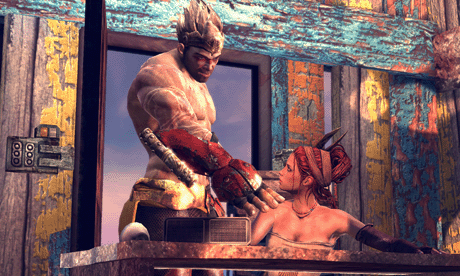
In this interesting re-telling of Wu Cheng'en's 16th century novel, Journey to the West, the player takes on the role of Monkey, a sort of tribal warrior who, alongside a mysterious young woman named Tripitaka, escapes a slave space craft only to crash land in a post-apocalyptic New York teeming with robot killers. When Monkey awakens, he finds that Trip has fitted him with an electronic headband that will instantly kill him if her heart stops - he must now protect her on the long journey back to her homeland.
And here's the really interestingly thing: this relationship actually works. Very early in the game, there's a palpable emotional connection between the two, and by extension between the player and Trip. The reason why it's successful is that the designers have effectively combined the two best AI escort characters ever devised: Yorda from Ico and Alyx Vance from Half-Life 2.
To begin with, Trip's vulnerability is cleverly physicalised from the earliest moments in the game. We constantly see her in a state of shock and fear, her wide eyes conveying more desperation than 2000 words of scripted dialogue ever could (a key problem with AI characters – they often talk way too much). When the figure is static, her idling animations convey the body language of fear – looking around, hugging herself – it all acts on the player unconsciously.
This often wordless, empathetic approach to AI characterisation closely resembles Team Ico's rendering of Yorda, the ghostly princess who must be protected from shadowy spirits intent on stealing her away. There, the two lead characters establish a physical connection when they hold hands and this acts as a powerful protective signal to the player. And intriguingly, Monkey and Trip form a similar connection via the slave headset, which allows Trip to project instructions to her protector telepathically. It's another subtle message that this is a symbiotic relationship, that something deeper is going on.
But like Vance, Trip is also resourceful, intelligent and useful. She's able to hack security doors, create flying recon vehicles out of electronic dragonflys and upgrade Monkey's skills and weaponry. In Resident Evil 4, Ashley could lob the odd flaming lantern but that was about it – most of the time, she got in the way, or got killed. Furthermore, Trip's skills contrast with Monkey's and that's doubly attractive. True selflessness is, after all, rare and human behaviour is probably much closer to Robert Trivers' concept of reciprocal altruism – the idea that we'll help others as long as there's something in it for us. The fact that Trip's not an entirely parasitic presence helps to build the player/AI relationship.
The key factor though is that, at least in opening chapters of the game, Trip never willingly exposes herself to harm. If there are areas to be cleared of mech killers, Monkey goes ahead and fights while Trip takes cover. This removes the agonisingly annoying element of many escort missions: failing through no fault of your own because another character has got themselves stuck on a piece of screen furniture and is now being set upon by the end-of-level boss and 30 zombies. Again, this is just human nature – we want to help people who want to help themselves; human altruism is more often than not a considered investment.
I wonder if any thought went into the fundaments of human relationships when Capcom designed Ashley? Possibly not. It's likely the team just saw the mechanical possibilities of the escort concept. Protection should, after all, be a failsafe game mechanic because it splits the player's attention which adds to the challenge. And in fact, the function has often worked best when it is dehumanised in this way. Lemmings offers one of the most compelling protection systems in the history of game development, largely because, when you're dealing with teeny cartoon lemmings rather than people, the concept can be appreciated as design component. Elsewhere, Dead Rising cleverly side-steps the whole issue by making the protection missions optional and clearly present for the player's material gain. But in this sense, altruism becomes entirely transactional and therefore meaningless.
Perhaps there is an emotional version of the uncanny valley at play here. As video game relationships attempt to ever more closely mimic those of our real lives, the stark differences between the actual and the virtual become monstrous. But then that doesn't explain why I'm finding the interplay between Trip and Monkey so endearing. Maybe, it's all down to the writing, the voice acting, the burgeoning romance; there is certainly a touch of the rom-com about this relationship – the gruff alpha male and the thoughtful woman, forced together in adverse circumstances only to form a grudging mutual admiration. Perhaps game designers can ease us into caring about escort quests through the narrative methodology of Hollywood.
That's no bad thing, and it partly explains the appeal. Enslaved might not be about protection at all. Like Ico, it might sort of be about love.