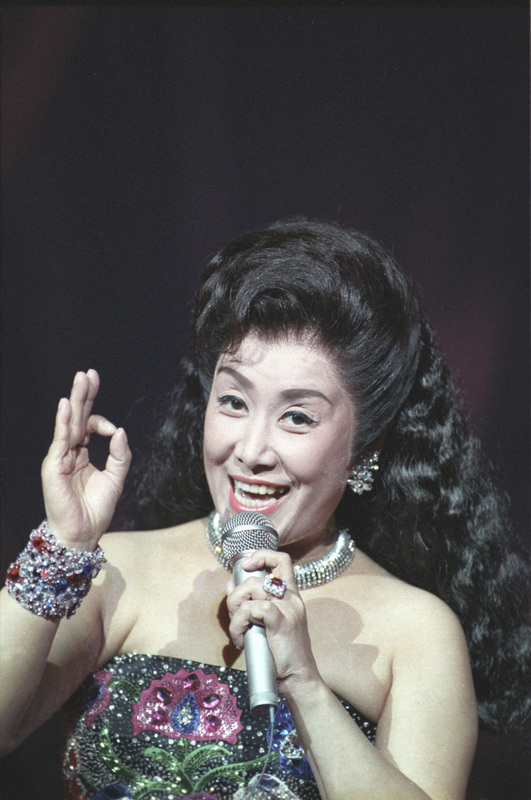
The Tokyo Olympics and Paralympic Games were supposed to be held this year, and the plan was for tourists, who were visiting Japan, to take home Hibari Misora's CD as a souvenir from Tokyo. The album, "Hibari-chan no Tokyo Uta Sampo" (Wandering around Tokyo through Hibari's songs), is a collection of songs that mention locations in Tokyo and are sung by Misora (1937-1989). The album, released by Nippon Columbia Co., is filled with elements in which Japanese today should listen to again.
The album was curated by Michito Goda, a singer who has also authored many books on Japanese popular songs.
"I imagined a stage play of 'The Hibari Misora Story,' and selected songs from the perspective of Tokyo," Goda said.
The songs have been arranged to take into account scene and costume changes during an imaginary stage performance. The opening song is the high-spirited "Omatsuri Mambo" (Festival Mambo), originally released in 1952, featuring the streets of Kanda and Asakusa.
The following song is "Tokyo Rhapsody" -- released in 1936, featuring Ginza, Kanda, Asakusa and Shinjuku -- that was originally performed by Ichiro Fujiyama that was then covered by Misora. This selection seems a bit of a surprise for many, but this song would be considered essential if you looked back at her life. "Tokyo Rhapsody" was the No. 1 hit song the year she was born, but the selection was also significant because it was written by Masao Koga, who would later become the songwriting partner to Misora.
"Kudan no Haha" (Mothers at Kudan) was a song -- released in 1939, featuring the Yasukuni Shrine -- that Misora sang in 1943, when she was 6 years old, at a send-off party for her father, who had joined the marine corps.
"Tokyo Boogie Woogie" -- released in 1948 and featured Tokyo -- was written by songwriter Ryoichi Hattori and performed by singer Shizuko Kasagi, and became a big hit because it cheered people up in the early postwar years in Japan. Misora performed the song just like Kasagi and became a famous idol. It is well-known that Hattori and Kasagi felt a sense of impending crisis because Misora's voice had a sweetness to it that put adult singers to shame.
The next song is "Ginbura Musume" (Young Woman Strolling in Ginza), which was released in 1951 and featured Ginza. This is the one and only song that Hattori had written for Misora.
Needless to say, "Tokyo Kid" from 1950 is also included in the album, a song that many people would readily associate with Misora and Tokyo.
"Yakuza Wakashu Matsuri Uta" (Seedy Blades' Festival Song), released in 1956 and featuring Kanda, was one of the songs sung by the then-popular trio of young female singers -- Misora, Chiemi Eri, and Izumi Yukimura -- in the movie "Romansu Musume" (Romantic Daughters).
There are also those songs you can enjoy, and see a play within the play of the "Hibari Story." Both "Meiji Ichidai Onna" (The Life of an Amorous Woman in the Meiji Era), a song released in 1935, featuring Hamacho-gashi, and "Oume Jamisen" (Oume's Shamisen -- a three-stringed musical instrument), a song released in 1961 and featuring the same area, are songs based on true stories and is still being performed today as part of the program for a modern play. When the geisha Oume Hanai killed her shamisen carrier Minekichi in 1887, it was constantly being covered by the news.
"Onna Keizu no Uta" (The White Plum of Yushima), a song released in 1942, was based on the novel "Onna Keizu" (The Romance of Yushima) written by Kyoka Izumi. This story is so famous that Otsuta, a heroine of the story, was referenced in a song released in 1959 titled "Beranme-e Geisha" (The Prickly-mouthed Geisha), which was also set in Yushima. It is important to know that these incidents, as well as these types of novels regarding Tokyo, exist.
The album contains 44 songs in two CDs, with both her original songs and cover songs mixed together, with a broad range of melodies.
"No matter what kind of songs or what type of genre she sings, such as boogie, enka (traditional Japanese-style ballad) or mambo, she had mastered the skills to sing any song. The foreigners who listen to the songs on this album may think that all of them are originals," Goda, who curated this album, said.
Hidemi Sasaki, who is good at singing chanson and popular songs, and also an ardent fan of Misora, recommends listening to "Fukagawa," in particular, one of "hauta" or short love songs that are accompanied by a shamisen.
"Hibari-san's rhythmical singing and her magnificent vocals are showcased in the song. She can sing jazz and foreign music because she had a solid foundation. Hauta was a popular song during the Edo period, the Meiji and Taisho eras, but no one can sing well unless one is well-grounded in nagauta (ballads that are sung along to shamisen), and kiyomoto, a type of joruri recitation (in which the singing voices are more high-pitched than usual)," Sasaki said.
You can also enjoy listening to Misora's songs from the NHK serial TV drama "Yell." Two songs, "Kimi no Na wa?" (What's Your Name?) and "Kimi, Itoshiki Hitoyo" (My Dear One), both of which were released in 1953, featuring the streets of Ginza and Sukiyabashi, are on the album. The protagonist of this TV drama is modeled after Yuji Koseki, a music composer who wrote these two songs.
"Tokyo Tower," a song released in 1959 and whose lyrics were written by Toshio Nomura, who is another main character that appears in the TV drama as Tetsuo Murano.
The most important work of Nomura is "Tokyo dayo, Okkasan" (Mother, It's Tokyo), which was performed by Chiyoko Shimakura.
"Nomura, who wrote the lyrics for the song in which a son takes his mother to Tokyo, which was a normal tourist destination for those from rural areas back then. Two years later, he describes the Tokyo Tower, a new sightseeing spot, like 'seeing a fairy tale land of little people.' This contrast is very interesting," Goda said.
Read more from The Japan News at https://japannews.yomiuri.co.jp/