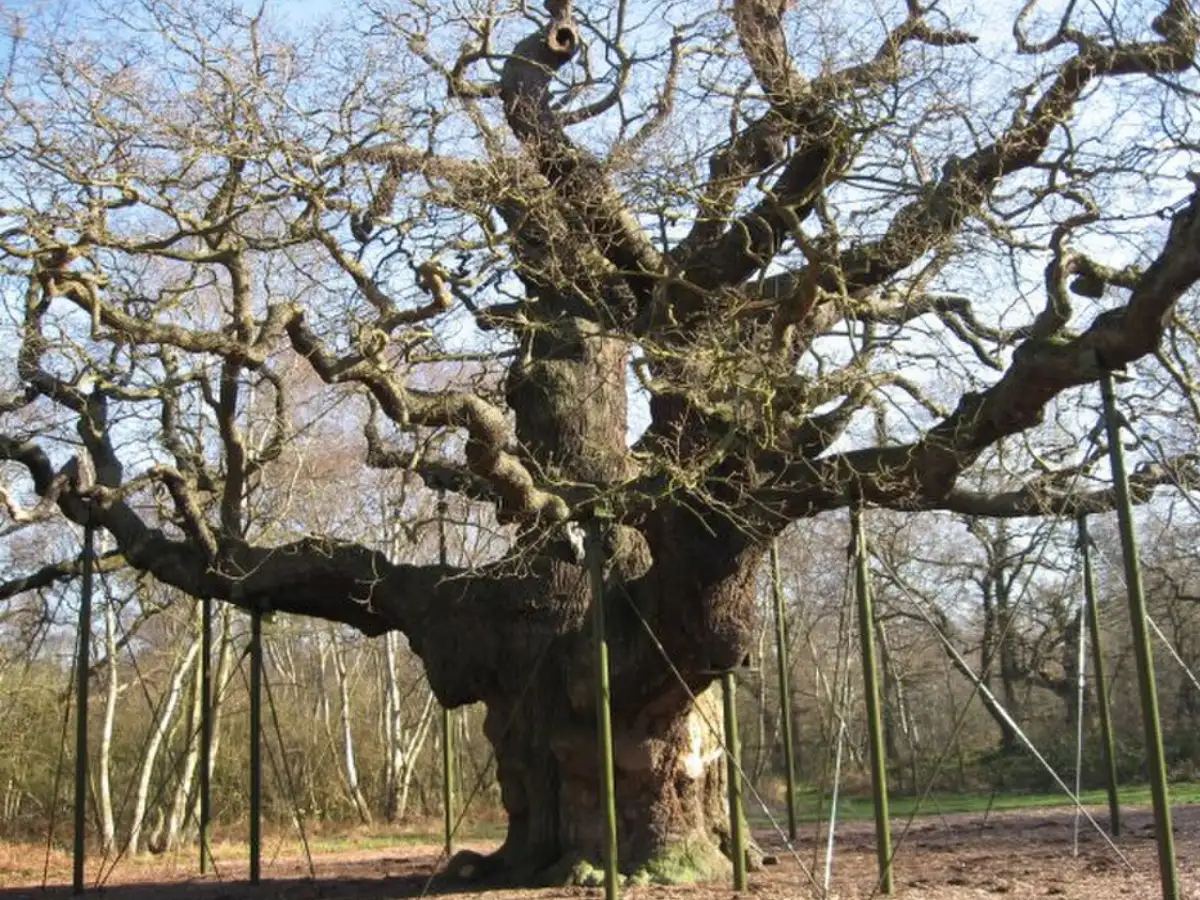
Britain's most famous oak, a roughly 1,000-year-old giant standing in Sherwood Forest, England, has died, Natural England confirmed in a blog post this month, after the news was first reported by the Royal Society for the Protection of Birds. This is probably the tree you have in mind if you’ve ever pictured Robin Hood ducking into a hollow tree trunk.
According to a widely cited 2012 study, ‘Global Decline in Large Old Trees,’ published in the journal Science, large, old trees like this one are vanishing from landscapes around the world, and their absence tends to ripple well beyond the tree. The death of the Major Oak fits that pattern exactly. But conservationists say this is not actually an ending. It is the beginning of something new.
A tree that lived longer than kings
The Major Oak has stood in the same patch of Nottinghamshire since around the 10th century, which is way before the Battle of Hastings, the printing press, and the United States. It grew at the center of what was once a royal hunting ground, walked by English monarchs for centuries, and now sits within the Birklands and Bilhaugh Site of Special Scientific Interest, a zone also protected as a Special Area of Conservation under European conservation rules.
For generations, it has had enormous cultural weight as the legendary hideout of Robin Hood and his outlaws, making it one of the best-known trees in Britain. That fame, it turns out, likely contributed to its decline.
Why one of the planet's oldest oaks finally gave out
Popularity is rarely kind. From the Victorian era onwards, for over a century, waves of visitors, arriving first by horse-drawn carriage and later by car and on foot, packed down the soil around the Major Oak’s roots. Compacted soil contains less air and water, which denies roots the ability to function. Add climate change to the mix, and the damage multiplies.