England have advanced to ninth place among 174 countries in the global chess body Fide’s June 2015 ratings, which are headed by Russia, China, Ukraine and the United States. A decade ago England struggled to stay in the top 20, yet there is a paradox. In this same period England have often underperformed at the two top team events, the Olympiad and the European championship.
England’s strength at world level is largely based on just six grandmasters who have ratings above 2650, the level of the world top 100 players: Michael Adams, David Howell, Luke McShane, Nigel Short, Gawain Jones and Matthew Sadler.
The rankings rise is owing less to real improvement than to Sadler’s comeback and to John Nunn, who has a historic 2600 rating, returning to compete in over-50 senior tournaments. Below 2600 there is a big gap to GMs in the middle to low 2500s, while England’s juniors have not produced a potential 2600 player since Jones and Howell emerged in the late 1990s. The result is lack of strength in depth. The No100 ranked player in England is rated around 2240, while No100s in our West European rivals Germany, the Netherlands and Spain are all rated much higher.
England’s ageing team struggles in the hurly-burly of Olympiads where more than a thousand players compete and where young GMs flourish. Even Russia has suffered, whereas China, whose squad has an average age in the low 20s, won both the 2014 Olympiad and the 2015 world team crown.
The area where England is clearly No1 is in senior over-50 chess, where the former world top 10 GMs Nunn and Jon Speelman plus the 2014 European champion, Keith Arkell, have been joined by the legendary Short, who turned 50 this week and is already the firm favourite for the 2015 world senior at Acqui Terme, Italy, in November.
So it is strange, to say the least, that the English Chess Federation directs almost its entire international budget to the underperforming Olympiad and European teams and gives little to senior chess, where it can expect gold and silver medals. Funding for England’s senior teams owes much to a single individual. Terry Chapman was a leading junior 40 years ago, gave up the game for a successful City career, and now bankrolls and plays in the senior side, where he has already won several team and individual medals.
At the other end of the age scale, the juniors who will be the grandmasters of the 2020s, England’s situation is worse. In the 1970s England juniors were feared in Europe, and even in the 1990s our players won gold in world and European junior competition. Now the England squads are large, but their results are often disappointing, and even those scoring 50% are praised. It would be better to return to much more rigorous selection standards.
However, there is hope. Some of our best talents now eschew junior events and follow a more testing route. They compete at Hastings, in the London Classic and the British Championship, and they travel to tough continental opens. England’s national league, the 4NCL, also plays a key role as team captains give norm seekers suitable opponents or even extra games with the white pieces.
At the 4NCL season’s final rounds last month Guildford duly took first and second places, pressed only by Cheddleton in third. The focus was rather on two impressive individual performances. James Adair, 22, of York University, scored his second (of three required) GM result with a 9/11 total, while the 17-year-old Highgate School sixth-former Isaac Sanders achieved his first international master score.
Adair was only a 2100 expert five years ago, while Sanders has developed his skills at strong events, including high-class opens in Eastern Europe. He won a fine attacking game against a former British champion and showed a mature style against other highly rated opponents. If his target now is the IM title by 18 and GM by 21, he is on course for it.
Adair showed his defensive powers in this win against a Dutch GM, whose rare 6 Qd3 and 7 Bg5 has had good results. Adair countered with a surprise of his own, as his Be7 rather than Bg7 plans a fast counter on White’s long castled king. The critical test would be 10 f3 with g4, but van Kampen misplaced his bishops, then made a dubious double pawn sacrifice. Adair took the material, found an unlikely king hideout at d6 and e6, and won with an extra piece.
Robin van Kampen v James Adair
1 e4 c5 2 Nf3 d6 3 d4 cxd4 4 Nxd4 Nf6 5 Nc3 a6 6 Qd3 g6 7 Bg5 Nbd7 8 0-0-0 e5 9 Nb3 Be7 10 Be2 b5 11 Kb1 Qc7 12 h4 h6 13 Bd2 Nb6 14 a3 Nc4 15 Bc1 Be6 16 g4 Nxg4 17 Nd5 Bxd5 18 Bxg4 h5 19 Bh3 Bb7 20 f4 Bxh4 21 f5 g5 22 f6 g4 23 Bxg4 hxg4 24 Bg5 Bxg5 25 Rxh8+ Kd7 26 Rh7 Ke6 27 Rg1 Ne3 28 Nd2 Rc8 29 c3 Bf4 30 Rxg4 Nxg4 31 Qh3 d5 32 Qg4+ Kd6 0-1
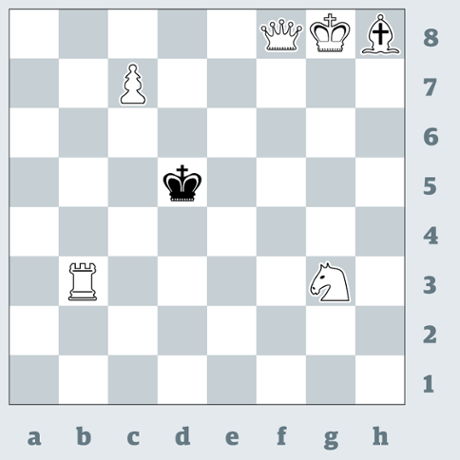
3393 (by F Abdurahmanovic): 1 Ne4! and if Kxe4 2 Qf3, or Kc4/e6 2 Qf7, or Kc6 2 Qd6. White’s promoting pawn is a decoy: 1 c8Q? stalemates, while 1 c8R? Ke6 1 c8B? Kc6 and 1 c8N? Kc4 also fail.