Before kick-off England were bound tight in a huddle, as always. This time, though, they seemed to be pulling each other just a little closer than they typically do, and every pair of eyes was looking in, fixed on the group. Twenty-three men, alone together, and beset on all sides by lights, fireworks, flamethrowers, and tens of thousands of roaring, singing, screaming, Welsh fans. No matter how many loudspeakers Stuart Lancaster installed at the Pennyhill Park training ground, no matter how loud he turned up the volume, nothing could have prepared his team for this: an occasion, and an atmosphere, unlike any they are likely to experience outside of the knock-out stages of the World Cup.
There had been a stand-off in the tunnel and despite the promises of the referee Jérôme Garcès, England were made to wait an inordinately long time until Sam Warburton eventually emerged, and the floodlights came up.
England reeled through the opening minutes, battered back towards their try-line by the flood of Welsh runners. The Welsh made a wonderful start, from Dan Biggar’s kick and on. Jonny May gave away a penalty in the very first minute. Leigh Halfpenny kicked it. Three-nil down. Toby Faletau broke off a scrum, having plucked the ball out from the depths like a man pulling a prize from a lucky dip. He spat a pass to Rhys Webb, who slid past May and scored. Three missed tackles and 8-0 down. Halfpenny converted. Ten minutes gone, 10-0 down and England all but out. It was shaping up to be a long, hard night.
The comeback began with a deft and skilful piece of play. Luther Burrell gathered a wayward, scuttling pass from down by his knees, and flicked the ball on to Mike Brown. He looked up, dropped the ball down as he did so, and kicked it on inside Halfpenny. Anthony Watson, alert to the chance, shot around the other way, passing Halfpenny on the outside, stooped to gather and scored. George Ford missed the conversion and a canny drop-goal from Dan Biggar made it 13-5 but England had a foothold, one won through Brown’s wit and Watson’s speed. They had a clear advantage in the set pieces, too, especially the scrum, though Faletau’s skill had masked it when Wales scored their first try.
Still, at half-time England were eight points down. If there’s one statistic that puts their excellence in the second half in context, it’s this: only once in their history have England ever won a game after trailing by eight points or more at the interval. They have been in that exact situation 65 times and they lost 64 of them. The only exception was a Test against Argentina in Buenos Aires in 2002, when they won 26-18 after trailing 12-3.
On the flip side of that, Wales have led by eight points or more at half-time in 101 Tests, and they had only lost two of them. No wonder Lancaster was beaming afterwards. He said this was one of his best days in charge of the team. Andy Farrell, always understated, described it as “a proper win”. High praise that, from him.
Lancaster said that he particularly enjoyed listening to the English fans sing Swing Low. When Watson scored his try, one little pocket of the 70,000 strong crowd broke out in a chorus of the old song but were soon drowned out by derisory hoots and jeers. However, they were able to sing it almost uninterrupted towards the end of the match. In the final five minutes it rang out loud and clear around the ground while the home fans made for the exit. They were shaking their heads, and seemed to be every bit as stunned as their team were by the ferocity of England’s play in that period, when they dominated control of territory, and better yet made more runs, more clean breaks, and beat more men than Wales did too. There was a measure of flair about the way England played, which had been all too lacking in the autumn.
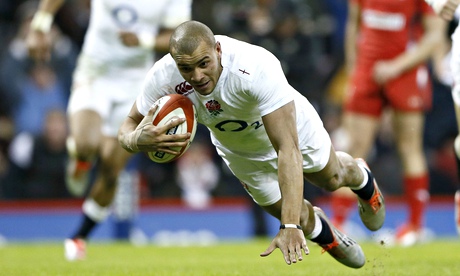
Jonathan Joseph scored a glittering try. “Special,” said Lancaster. “Soft,” thought Warren Gatland. He curved around Biggar, then fooled George North with a neat dummy.
England adapted to the demands of the game and then overcame them. Wales, in contrast, seemed at a loss, unable to claw back control of a match they had been bossing only a few minutes earlier.
This iteration of Stuart Lancaster’s England, the product of happenstance insomuch as he was unable to select a dozen injured players who could feasibly have been in contention for the squad, emerged as perhaps the best the coach has put together yet. The combinations, many of them untried and untested, came together. The same XV will surely start against Italy. The spirit the coach has so often spoken of, and that had seemed to be faltering and elusive through 2014, emerged and hardened. By the whistle England, while far from flawless, looked as if they have the makings of a formidable side.