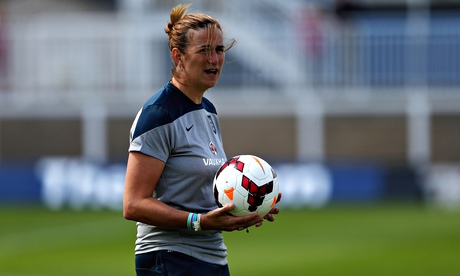
A year ago Jazz Hervin attended Kick It Out’s estimable Raise Your Game conference looking to those within football for advice on how to progress her coaching career. Twelve months later, aged 20 and now coach of the development team at the Women’s Super League side Yeovil Town Ladies, she was back to deliver a workshop to peers who had collectively racked up centuries of experience in the game. Like most things, it did not seem to faze her.
In years to come, Hervin plans to return as the coach of the national side and could even become one of the first female managers to break through the glass ceiling and succeed in the men’s game.
If the launch of the WSL has not quite proved the big bang moment for women’s football in this country that some thought it might be, it has elevated it to a new level of professionalism, organisation and visibility. More importantly, behind the scenes it has facilitated the creation of the sort of coaching pathway the men’s game has long taken for granted.
Hervin, in the vanguard of a breed of young female coaches who have grown up with the game from a very young age, is combining her role at Yeovil with a sports management degree.
“Since last year, it has been very much about improving what I’m already doing. I’m at Yeovil now and that was probably the biggest change as well as starting my Uefa B licence,” she says, paying tribute to the contacts she made a year ago at the Kick It Out event, designed to offer routes into the game for those who may have traditionally been excluded.
“It was about improving what I already had and building on that to move forward. Yeovil is a great club to be at – great club, great people.”
Marieanne Spacey, the former Arsenal player who won 91 England caps before retiring in 2004, is the assistant coach to Mark Sampson with the national side as well as taking charge of the Under-23s and having a role at the Football Association in developing female coaches.
“We want to really encourage more girls into coaching,” Spacey says, recalling how she was the only female among a cohort of 40 when she took her Uefa badges. “The perception is that everyone wants to be a player but there are opportunities for coaching and we want to encourage that.
“There’s a much better pathway now for females to get involved in coaching and coach education than there has ever been. It’s like anything – you put the time in and you work hard and the rewards will come because the game is growing. There are so many good, young female coaches out there at the moment.”
Hervin played herself but on realising she was not going to make the grade at elite level turned her attention to coaching. Given her youth and her ambition, she is not gender-specific when it comes to her ultimate goals.
“I love working within the women’s game, purely because that’s what I know best because I’ve played,” she says. “But before I was at Yeovil I was head coach of a senior men’s team in a regional league. I loved that as well and that changed my whole perception in terms of what I want to do when I’m older. I’m not saying it has to be in the women’s game.”
For Spacey, the immediate priority is to develop more female coaches at all levels, with a particular focus on the WSL. Emma Hayes, the manager of the league leaders Chelsea Ladies, is the only female manager in the top flight of the WSL.
“Where we stand at the moment we’re certainly better off than we were 10 or even five years ago,” Spacey says. “We have the people within the development unit and the senior unit, we’re working with the coaches in the WSL clubs, we’re looking at how we can succession plan for players moving out of playing and into coach education.
“We want to continue to develop that and get better. But we’re doing everything we can to ensure we have a big influence of women’s coaches in the WSL. We want to grow that, Emma Hayes is there at the moment. We’d like to see more and it’s something we will aim to achieve in the next couple of years.”
Few would bet against Hervin being among them, whatever the obstacles that still exist for female coaches. “Like Marieanne said, it’s about the opportunities,” she says. “For Yeovil to give me the chance to work within a WSL setup at the age of 20 is something I think that young coaches need,” she says. “If we’re ready to do that and take that step then the opportunity needs to be there for us to do it.”
Spacey talks persuasively about her “cradle to grave” ambitions for women’s football. As with the men’s game, that means everything from increased opportunities for female coaches teaching girls in primary schools, to better career development for those working in centres of excellence and more chances at elite level. Back in the here and now, Spacey is preparing to head to Canada for an expanded World Cup that has proved controversial because it will be played on artificial surfaces but offers the women’s game the opportunity to make another decisive leap in popularity and profile.
“We’re really excited about the group of players we’ve got, the potential within the squad,” Spacey says. “We’ve got a group that will challenge us but that we have a great chance of getting out of. Then you’re into the last 16 and the quarter-finals and all the old cliches apply.
“This is a great gauge of where we’re at as an international squad but also where the game is and where it can go to next. It’s not a ‘wow’ moment. But it is part of the development and the progression of us becoming a real strong, positive, aspirational field for people to want to come into and work in, watch, play, whatever.”
In the short term, Hervin is targeting success at Yeovil and possible promotion to the top division but does not hide her ambition to one day coach the national side.
“Looking at this year, the main aim for me is to do a good job at Yeovil,” she says. “We’re aiming for the top three and, personally, to pass my Uefa B at the end of October. Long term, I want to work with the national side. You just need people to believe in you. I believe in myself.”