Barney Ronay
In recent years Twenty20 international cricket in England has had the air of something rather grudgingly undertaken, the sporting equivalent of a lukewarm limoncello liqueur handed out with the bill at the end of a five-course Italian meal. As thoughts turn naturally towards the first Ashes Test in three weeks, it would be easy for England’s one-off Twenty20 against New Zealand at Old Trafford to fade into a state of spectral semi-invisibility, a game to be forgotten before it has even begun.
Except, of course, things are supposed to be a little different these days. The appointment of Andrew Strauss as the director of cricket may not have been everybody’s idea of a break from the more constipated recent past but the early talk about making white-ball formats the focus, the strong top hand leading English cricket into the near future, was reflected gloriously in the one-day series against New Zealand. With this in mind even a one-off, mid-season Twenty20 looks like an opportunity to emphasise the shift in focus from sullen five-day specialists to the new “brand” of England cricket, with its talk of engagement, aggression, polyvalent self-expression and all the rest of it.
This represents a significant shift in priorities. In the buildup to this match two notable recent retirees have criticised the way red-ball cricket has tended to drive every decision around the England team. First, Graeme Swann suggested that Test match players have often dominated the one-day team for reasons other than pure playing merit. Separately Craig Kieswetter has mentioned the split between cliques of Test and one-day players, with no points for guessing which group ranked higher up the scale of human worth.
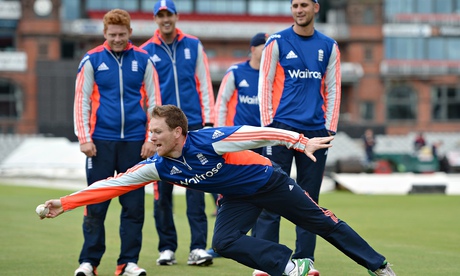
But this has changed now. The idea that white-ball cricket – in other words, the cricket most of the world plays and watches – must be allowed to drive the way England prepare and select their teams was reiterated this week by the interim head coach, Paul Farbrace. And with this in mind it seemed apposite that Sam Billings, one of the more invigoratingly unconventional England debutants of recent years, should address the media before a match that is likely to bring his own Twenty20 international debut.
“Hopefully playing New Zealand has generated a bit of interest around the country and got people behind the England cricket team going into the Ashes,” Billings said of the recent one-day international series. “Hopefully the vibe around the team can be taken forward into the Ashes and the one-day series against Australia. It is a start but that is how we mean to go on.
“The gulf between Test and one-day cricket has probably narrowed in the last few years. The guys who are not in that Ashes squad have got to go back to our counties and play like England players. The great thing about this one-day team is there is competition for every place which is a good thing going forward.”
Having played as a specialist No7 in the one-day series, Billings is expected to retain his place there behind Jonny Bairstow, who will keep wicket at Old Trafford. In the course of a wide-ranging press conference that touched on Billings’ skill at rackets (his cousin is the world No1) and the fact that he once scored a hat-trick for his under-14 football team against Tottenham Hotspur’s academy, it was tempting to reflect on the importance for any England Twenty20 cricketer of keeping a full range of alternative career options open.
The sheer churn in personnel is evidence enough of how England have struggled with the shortest form. Of 13 international debutants in the last four years, only one, James Tredwell, has 10 or more caps. Harry Gurney, Tredwell, Jos Buttler, Chris Woakes, Ravi Bopara and Moeen Ali will all be missing in Manchester, from England’s last game in this format against India last summer. The game before that had seen Michael Carberry, for reasons that remain obscure, make his England Twenty20 debut, face seven balls and then never play again, while the game before that England were bowled out for 88 by the Netherlands in Chittagong, the medium pacer Logan van Beek taking three for nine in 12 balls.
Tuesday’s team will show nine changes from that ignominious end to last year’s World Twenty20. For once the abundance of untried talent looks like something other than a curiosity. Billings was keen to talk about “momentum”, as sports people so often are, but he might just be on to something.
If England really are serious about allowing talent in the shorter game to pollinate across every format, then Alex Hales, Eoin Morgan, James Vince, Bairstow and, according to some wise judges, Jason Roy all have a chance to press their case.
Another sound performance from Adil Rashid would confirm his status as England’s current best attacking option in white-ball cricket and an intriguing choice as a possible second spinner in the longer game. With the weather set fair there is at least a sense of something more at stake than simply a glorified farewell to some very popular tourists.