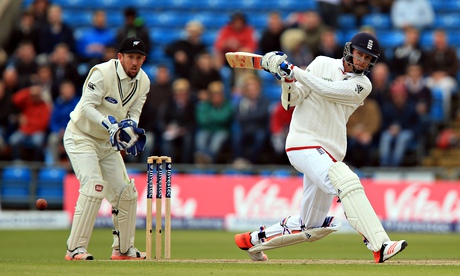
It was said, after his first innings at Lord’s, that Stuart Broad’s batting had hit rock-bottom; that the nightmares the left-hander honestly admitted to following the broken nose suffered against India last summer meant he was no longer up to it at No9 and a demotion to tail-gunner was inevitable.
Leading the calls during that first Test was Shane Warne on commentary, who suggested that, were he England captain – a notion to similarly leave one waking up during the night in a cold sweat – he would insist that Broad be relegated to No11 until he was no longer scared of the ball.
Harsh words, even if few observers since that bouncer from Varun Aaron penetrated the grille of his helmet to bloody effect at Old Trafford can claim not to have privately pondered the same at some stage. The bowlers know he has a problem against the short ball. Broad knows the bowlers know he has a problem against the short ball. And they know he knows they know.
Alastair Cook has not exactly been inclined to take on Warne’s advice of late and held his nerve here to keep the 28-year-old in his usual spot. And on the morning of day three, this game of bluff and counter-bluff that now comes with every post-Aaron Broad innings proved, as it happens, to be exactly what the situation required. Ian Bell, Jos Buttler and Moeen Ali had all succumbed to the charms of Tim Southee under overcast skies by playing tentatively. New Zealand talk about aggressive cricket and deliver it. England, still adjusting themselves to cricket’s in-vogue philosophy, remain prone to spells where thoughts of the worst-case scenario can become a self‑fulfilling prophecy.
But Broad, in his current funk, knows only one way and his response to coming in with England seven down and still 84 in arrears was simply to attack, smearing 46 from 39 balls for his highest score in any cricket since Aaron’s Exocet, during which time he has averaged 10 runs fewer than his career mean of 23. While still exhibiting some of that instinctive flinching – something he tries to disguise by getting in line after the ball has passed – and surviving a drop at deep square-leg with just nine to his name, the left-hander showed guts of a different kind. Flaying seven boundaries – including one mighty six off Matt Henry that was pulled in front of his face and over square – the left-hander was able to do what his senior colleagues should have done before him: throw New Zealand off their lines.
A stand of 51 in eight overs with Mark Wood, whose 19 from 33 balls demonstrated maturity and a more correct technique, was followed by 32 runs in tandem with James Anderson. England’s No11 is happy where he is, thank you very much, seemingly underlining the point with consecutive fours off the spinner Mark Craig. The net result was first-innings parity with the tourists’ 350 all out and a reminder that even those captains at the funkier end of the spectrum, such as Brendon McCullum, can be driven to distraction by some good old tail-end biff.
Provided we end comparisons with the Broad who, six years ago, was deemed authentic enough to occupy the No7 position on this ground against Australia before going on to record a career-best 169 against Pakistan the following summer, this new 2.0 version – one that comes with a yahoo approach to batting as its default – can still do damage in the lower order. While his technique may never again stand up to the scrutiny of a protracted Test innings, his eye remains excellent.