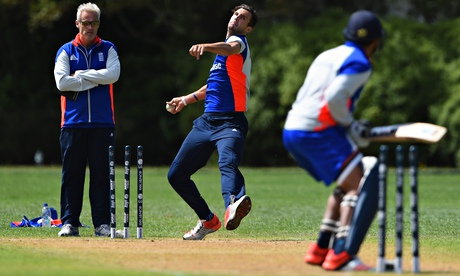
For a pace bowler there is no finer feeling when everything clicks into place and he can enter the zone. The run-up is precise and urgent, the action grooved and the intent full. Everything that happens at his end is a given and all energy – physical and mental – can be focused on the batsman at the other end. It is sublime.
In Christchurch’s Hagley Park last Monday, probably for the first time since he was in New Zealand almost two years ago, Steven Finn found himself in that nirvana. Forget for now Moeen Ali’s century, or the fact that it helped England to their first win of this World Cup, because the manner in which Finn bowled to take three for 26 against Scotland carried more significance than anything else this winter.
The bones of the fall and rise again of one of the most promising fast bowlers in the world is well-documented, if not often accurately. On that New Zealand tour, he bowled with great rapidity and aggression, his run cut down just sufficiently to ensure he hit the crease to maximum effect – with input on this from Sir Richard Hadlee, who understands more about the subject than anyone –where once he decelerated.
A year later and he had returned to his original run, and had received advice – certainly not from England and ill-advised if well meant – that rather than bowl straight and bring the ball into the right-hander, which he did naturally, he needed to be able to shape the ball away from the bat if he was to be successful at international level. Life was further complicated by the South Africa captain Graeme Smith’s opportunistic use of the fact that Finn occasionally knocked the bowlers stumps with his knee, complaining that he had been distracted when he edged a catch to slip.
It resulted in a change to the laws of cricket – and another issue for Finn to deal with. He developed a kink in his bowling arm that shortened its extension as he cocked his action and his pace dropped. There was a speed wobble in his last few strides that threw him off-balance in delivery. Confidence drained away and he became, infamously, “unselectable” during the last Ashes tour.
The remedial work has been long and collaborative rather than Finn being the rope in a tug-of-war between various interests within England and Middlesex. The process has been a little like climbing a greasy pole.
Even as late as the World Cup defeat by Australia in Melbourne, when he actually took a hat-trick – albeit one that will require embellishment when he comes to tell of it in his dotage – there were technical things that were awry: he was still, at best, only cruising to the crease and, at worse, decelerating, and the kink in the arm was still apparent. His pace was down by 10% as if he was struggling first and foremost to ensure at least he could hit a line and length. He resembled a bowler still nervous about the issues at his end of the pitch.
Now put to one side the mauling at the hands of the New Zealand captain, Brendon McCullum, in Wellington’s Cake Tin. Two overs for 49 runs, including four successive sixes to finish: it told nothing as far as Finn’s progress was concerned, dejected as he undoubtedly was in the aftermath. It was an embarrassment of a kind that no one would want to go through but that is all it was. Two days before that match, in practice at the Basin Reserve, he had been put through an intensive 50-minute session and suddenly it all began to fall into place.
When England next trained, in Christchurch, it was apparent to those who looked closely that he was hitting the crease hard – coincidentally, the net area was too short to accommodate his normal run – and that there was a full extension of his bowling arm, so he was getting maximum leverage once more. It was genuinely heartening to see the pace he was generating and the reactions of the batsmen.
The match against Scotland finally put him back into a position where he could begin to think about how to dismiss a batsman rather than just bowl and hope it was right. He looked terrific.
The greater tests lie ahead. He will be challenged more than Scotland were able to but he seems to be better prepared for that now.
Finn has the knack of taking wickets, even during the bad times when they came at a price too heavy to pay in the end. Currently he is England’s leading wicket-taker after three matches and, with eight, he stands behind only Tim Southee of New Zealand, who has 11, and Scotland’s Josh Davey and Jerome Taylor of West Indies, with nine apiece.
This World Cup will be won by a team who can take wickets to keep the opposition at bay and Finn is an essential part of England’s plan for that. It is good to have him back.