The crowds rather than the rain poured on to the grassy banks of Supersport Park and it wasn't for another one-day international. It was a public holiday in Gauteng but even so here was evidence that Test cricket still lives beyond England and maybe evidence that less can mean more. This was South Africa's first Test for nine months and there were plenty who wanted to watch.
Even in the thin air of the high veld there was just a solitary six but no one seemed to mind. Sixes have become 10-a-penny anyway. The regular disappearance of the white ball into the stands at the Wanderers or distant streets of Rajkot has meant that the maximum hit has lost some of its glamour. The six has become a mundane occurrence, barely worth a raising of the eyelid.
But maidens? Now they are really quite interesting. There were nine in the morning session at Centurion, which was an intriguing throwback to Test cricket from another era – with the odd addition. The strains of "It's been a Hard Day's Night" were not belted out on the PA system when John Edrich hit another four. But here there was a brief musical interlude after every boundary.
Nor did batsmen decline to head for the pavilion after the finger was raised in the 60s and 70s. This was Ashwell Prince's perfectly legitimate reaction after umpire Davis had given him out lbw to Graham Onions as the Review system made a first, uncontroversial intrusion into the series. (Leg before wicket will rarely be an issue. It is the caught behind review that will cause the angst).
Otherwise this was the sort of Test cricket that was commonplace a few decades ago, but which is a novelty today: probing pace bowling against watchful batsmen determined to see off the new ball. Prince batted a bit like Edrich in dour mode. There was the nudge to long leg, the edge to third man and the occasional solid thump down the ground.
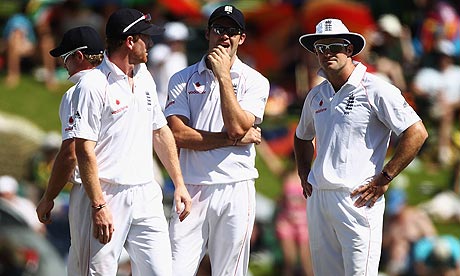
And there was a hint of Ken Higgs in fellow Lancastrian, Jimmy Anderson, not so much in his style of bowling as his demeanour. A smile never threatened to flicker across Anderson's lips. That troublesome knee may be gnawing away at his mind. He looked more than grumpy. No one likes operating when the body is less than 100% and he looked the least likely wicket-taker among England's trio of pacemen and the least cheerful.
For a moment Jacques Kallis changed the tempo. South Africa's senior batsman is the most classical of players, whose MCC manual technique might have been honed in the 60s. Surely Tom Graveney was no more graceful? But for 10 minutes Kallis functioned like a 21st century, "new world" batsman.
Graeme Swann had just taken the wicket of Ashwell Prince with his second delivery. Kallis, mindful that England were only fielding four proper bowlers, now took a step down the pitch and heaved the ball over the mid-wicket boundary for the day's six. Swann kept his field up. So Kallis heaved again for four more runs. This was as close as Kallis gets to agricultural.
Swann accepted the situation. A boundary fielder or two had to be stationed on the leg-side and Kallis, moral victory established, resumed his decorous progress. No matter the era, Kallis is a prince among batsmen. In this one he remains the most coveted wicket in a South African strong line-up. His half-century was cheered as vigorously as any one-day six.