England’s bid to scale rugby’s Everest begins in earnest on Saturday evening. Base camp has long since been established but the first warmup against France at Twickenham represents the next, slightly apprehensive step. For some players this is as high as they will get; for others the real push for the summit starts now.
If past Rugby World Cups have taught us anything it is to prepare for all eventualities. The 2003 tournament ended blissfully for England but not before they had to cope with the lengthy injury absence of Richard Hill, fitness alarms at scrum-half, Will Greenwood’s temporary return to the UK and much off-field stress. In 2007 the squad were hammered 36-0 by South Africa in the pool stages; four years ago they bowed out in the quarter-finals.
It explains why World Cups, generally speaking, are less about poetry in motion than scrambling to victory by the most prosaic means available. Just as mountaineers shun unnecessary risks on rock faces, so most rugby coaches preach the gospel of simplicity at tournaments. Stay tight, get your basics right, kick your goals and, with any luck, the scoreboard will look after itself.
In England’s case a give-em-nowt mindset is even more tempting given the opposition in Pool A. Ashes to ashes, dust to dust, if the Welsh don’t have ya, the Aussies must. Which begs the question that continues to preoccupy Stuart Lancaster: if I want to keep Wales and Australia at arm’s length how best do I go about it?
In both cases the answer is not to throw the ball around unnecessarily, concede avoidable turnovers or overplay inside their own half, while seeking to entertain an expectant Twickenham crowd. A more expansive game may have borne fruit against France on a mad final Six Nations weekend earlier this year but that 55-35 try-fest will bear little relation to the tense, tight contests in prospect next month. “If it’s as slack as that defensively there will be a lot to iron out before that first game against Fiji,” said Andy Farrell, England’s backs coach.
When push comes to shove next month, then, it is hard to believe England will take undue risks, instead the priority will be taking a firm grip up front, having a steely curtain in midfield and daring their opponents to attempt the frilly stuff. It is not necessary to spool back years for a pertinent case study.
When Saracens played Bath in the Premiership final in May all the pre-match talk revolved around Bath’s quicksilver backs, marshalled by George Ford, against Saracens’ suffocating defence. In the event it was virtually all over inside the first half-hour: the electric Anthony Watson was flattened by Owen Farrell and Bath were harried into a series of costly errors. Jonathan Joseph barely got a look-in.
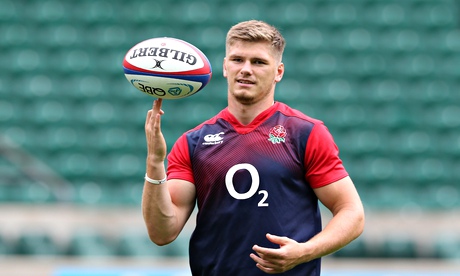
Farrell Jr, moreover, contributed 18 points as Saracens won 28-16. During the latter’s injury-enforced absence from the national side during the Six Nations Ford established himself as an international threat, helping England score 18 tries in the championship, a figure exceeded by no other country in Six Nations history. Five months on, however, the 23-year-old Farrell is not just fit again but visibly determined not to spend his World Cup holding tackle bags.
Interestingly, whispers from within the camp suggest the same individual will not start at No10 for all of England’s first three games against Fiji, Wales and Australia. It would, accordingly, be no surprise if Farrell, who starts at 10 on Saturday, ends up playing a more prominent role than some currently expect. At the very least he is the squad’s coolest pressure kicker; that qualifies him as a veritable coach’s dream in a World Cup context. Even Farrell cannot resist dropping a quiet hint. “In tight games kicking’s massive and we’ve got a few big games in our pool,” he murmured last week, not sounding like a man resigned to watching the tournament from the replacements’ bench.
It makes Saturday’s Test against France, the 100th match between the two sides, all the more intriguing. If Farrell kicks everything from all angles – and Henry Slade lands a howitzer or two from long range – it will certainly cause some disquiet in Australia where goalkicking has lately been of the curate’s oeuf variety.
If Wales have one ominous point of difference it is the golden boot of Leigh Halfpenny; England need to find not simply an antidote but a similar threat of their own. Farrell would dearly love to supply that weapon, as well as disprove the theory that his friend Ford is the team’s primary attacking catalyst: “If selected, it’ll be the biggest thing I’ve done in my career, the Lions included,” Farrell said. “Everyone’s dying to be involved, especially with it being at home. No one’s going to get this opportunity again. But what you don’t want to become is desperate. If you do, you start doing things you wouldn’t normally do.”
Keeping that tide of selfish desperation at bay will be England’s ultimate collective challenge on Saturday evening. As Farrell’s father, Andy, made clear on the eve of the game, they cannot afford to become too overexcited. “We have been away behind closed doors for quite some time and the hype is going to start building. It is our first showing at home at Twickenham, where the first game is going to be at against Fiji and we want to get the crowd behind us straight away.”
Most eyes, neutral or otherwise, will inevitably be on Sam Burgess at No12; if the home midfield displays all the cutting edge of a rolling pin the debate about Lancaster’s final 31-man selection will extend right down to the wire. In Burgess, Slade, Calum Clark and the reserve hooker Luke Cowan-Dickie, however, England have four debutants absolutely bursting to impress.
“Confidence comes from your preparation and we’ve been training hard,” Farrell Jr says. “I’ve no doubt that by the time the World Cup comes around whoever’s picked is going to feel unbelievably confident because of the way we have prepared. Everyone will be champing at the bit to show what they can do. We’ll all be ready.”
France, who have been sweating buckets in camp in the Pyrenees, will be seeking similar reassurance as Philippe Saint-André prepares to reduce his own squad from 36 to a final 31 for the World Cup. They will not be fielding their first-choice side – with Dimitri Szarzewski named as captain – and leaked seven tries at Twickenham on their last visit. If an unconvincing England contrive to stumble at this first warmup hurdle their autumn challenge will feel even steeper.