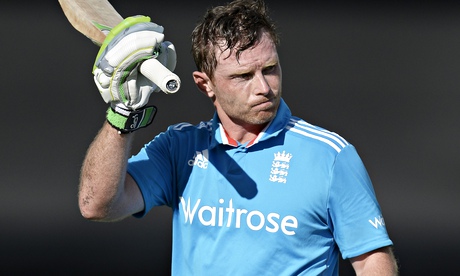
Step forward, then (finally) Ian Bell. Some England cricketers are born to lead. Some have leadership roles thrust upon them. Others are shuffled to the front of things out of circumstance. With a World Cup, Ashes series and tour of South Africa looming over the next 12 months, and with John, Paul and George finally shuffled off stage after assorted retirements, sackings and hissy-fits, the year 2015 already looks like the perfect moment for Ringo to step up and take the microphone.
This is, of course, a slightly unfair analogy. Eleven years into a stellar international career, Bell remains a wonderfully refined all-surface craftsman, as confirmed by his sublime 187 opening the innings in England’s Tri-Series warmup match against a Prime Minister’s XI in Canberra. And yet the fact remains that if England are to succeed across the diverse challenges of the next 12 months it is likely their most soft-pedalled star batsman, pigeonholed in the distant past as a beta-male, a high-class tag-along, is going to have to take centre stage once again, perhaps even to enjoy a definitive cross-format Year of the Bell.
Either way these are intriguing times for England’s longest serving batsman. Through the various dramas of the past decade Bell has been a uniquely frictionless presence, the only member of the Sky-generation galácticos to have only ever offered runs and nothing else, and a player who still seems more or less unaffected by the business of being a career England cricketer.
Indeed, almost by stealth, Bell is now just a concerted push away from a period of defining late-career achievement. To date he has 21 Test hundreds, four behind England’s all‑time leading centurion, Alastair Cook.
Both have stalled a little in the past year but of the two Bell looks the more likely to click into another purple patch, a man who has scored four hundreds in a year three times and who has a habit of rising to the occasion in big series at home. Perhaps for once the lure of individual laurels might add an additional spur. This would be the perfect moment to catch a glimpse of his captain in his sights.
Before that Bell is now certain to open for England at the World Cup, a last chance for the most effortless strokeplayer of his generation to convert a good record in ODIs into something more tangible. The wider sense of relief at Cook being euthanised from the 50-over team last month was dampened for some by the news this week that Bell would be his replacement at the top of the order. But it is a reshuffle that makes sense on several levels.
Bell was the opening batsman sacrificed so that first Alex Hales and then Moeen Ali could have a turn at defibrillating Cook’s own 50-over career – this despite the fact Bell’s form over the past two years was far superior to that of his former partner. A thousand runs in 30 innings at 37.10 is not the record of a player who deserves to be dropped. Not least when throughout Bell has been hampered to a degree by having to bat in tandem with Cook, his own sense of tempo disrupted by the relentlessly pachydermic rhythms at the other end.
Last year in Australia there was a slightly depressing pattern to Bell’s scores opening in ODIs, a series of promising run-a-ball efforts undone as the pressure to force the pace hit home. Batting with the more expansive Moeen, Bell has already produced an entirely different kind of innings.
In Canberra on Wednesday he was a familiar-looking 39 off 40 balls when Moeen was out for 71. With impetus coming from his partner – England were going at eight an over at the time – Bell was able to plough on serenely. He got to 50 off 55 balls and 100 off 102 before the ignition arrived, his last 87 runs coming off 43 balls, 64 of them in boundaries.
It is wrong to read too much into one innings against a scratch team, where the overs that really got Bell motoring were bowled by Chris Rogers and Glenn Maxwell. Against that, Bell’s basic talent, his ability both to bat through and to accelerate late on, has never really been in doubt. What has been wrong in the past is the balance of the top three.
It is not perfect now. Just as at the last World Cup, when a top three of Andrew Strauss, Kevin Pietersen and Jonathan Trott was a half-cocked show of aggression, so a top three of Moeen plus Bell and James Taylor is still only half a plan. One aggressive player in three isn’t a tactic. It’s a gamble, a punt that fails instantly if Moeen gets out third ball. But at least in Bell and Taylor England have two players with a more obvious range of gears. Similarly, if Bell’s success at the World Cup is likely to be tied to how consistently Moeen can provide that liberating aggression, England at least look to be giving their best all-round batsman a fair chance of shaping the innings.
When it comes to Tests, the challenge for Bell is more straightforward during a period in which England will play 17 matches from March to February. There are some technical issues to be resolved. In particular the Aussies have preyed on a weakness outside off stump that led to Bell being caught in the cordon off Ryan Harris or Peter Siddle in four of his last five innings last winter. His success this summer may depend on how effectively Harris can settle into that same merciless groove outside off stump.
Beyond this it is hard not to wish Bell well in a year that seems likely to provide either a clear signal that he can push on and play for another three years, or that the last man standing from the class of 2005 is entering his own international endgame.
In an era when England players have been packed off at regular intervals by physical and mental wear and tear, Bell has been an ever-willing stayer. His status as a delightfully elegant modern‑day demi-great seems secure. The next 12 months could yet provide a nudge upwards into something more.