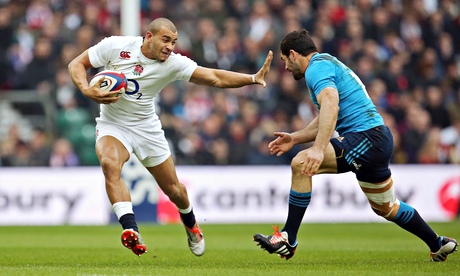
There’s much despair at the way rugby is going these days, not without reason, but to say that pace and flair are dead is to take the hand-wringing too far. England have not always gone in for it, have not always been blessed with it, but every now and then someone comes along to give us all hope. Jonathan Joseph is the latest embodiment.
Was it not always thus? As with life, rugby is for the most part dominated by the relentless and everyday, the back-row forwards and crash-ball centres of this world. What keeps us going is those flashes from a higher plane. Particularly so if you are English. In the early 90s it was usually Jeremy Guscott, then came Will Greenwood and Jason Robinson. Now Joseph emerges to give us a reason for carrying on.
It has taken him some time to convince the higher powers — not those dispensing talent to the chosen few, but certainly those of this earthly realm who decide how and when that talent should be used. Joseph was first capped on the England tour of South Africa in 2012, shortly after his 21st birthday, having burst onto the scene with London Irish.
His appearances since then, though, have been few and far between. Injury has played a part in that, as has the inevitable second- (and third-) season syndrome of the dazzling youngster, but he moved to Bath in 2013, following his old coaches at London Irish, and this season he has hit his stride at last. Good players recover from second-season syndrome to rediscover their old form; the really good ones take things on to another level. Joseph is in the latter class.
“We’ve always known he’s had it in him,” said Mike Catt, England’s backs coach. “He’s not done it on a consistent basis before, so all credit to him. He’s taken his chance, and he’s taken it well.”
He has been helped considerably by Bath, who are playing the kind of rugby to give heart to yearners for the sublime everywhere.
Joseph’s performance in Bath’s swaggering win in Toulouse last month was not just a victory for flair over power, but the kind of tour de force usually the preserve of back gardens and boyhood dreams. It was the final demand the selectors could not ignore.
“We assess every player’s performance throughout the season,” said Stuart Lancaster, “scoring them on a weekly basis. Of all our centres, JJ has been top-ranked. His case for inclusion has become overwhelming, really. We felt he needed to develop his defence, and he has put in a huge amount of work on that.
“His management of the breakdowns out wide has really come on, but also his confidence, his presence in the team — he’s a real leader, which is fantastic and has grown on the back of some good work at Bath.”
Insofar as selectors are suspicious of flair players, it is usually a result of perceived weaknesses elsewhere, a reluctance to partake in the mundane concerns of everybody else. Joseph is not of this sort, which bodes well for the longevity of any run in the national team. Flair and pace may be his defining characteristics, but power is not a weapon lacking in his armoury. His centre of gravity is low, and his hand-off ferocious.
The two tries he scored were questions of pace, but we saw the application of power and flair for his try against Wales in Cardiff. George North is the ultimate example of the power athlete that so concerns those nostalgic for rugby’s lighter past, but Joseph went clean through him.
Now he has three tries from his first two Six Nations games, thriving in tandem with a playmaker like George Ford in a manner reminiscent of Guscott outside Stuart Barnes in that great Bath team of the 80s and 90s.
Italy are no one’s idea of the Springboks as a defensive proposition, but Joseph’s first try here was every bit the gliding outside break we so cherished of Guscott. Leonarto Sarto, one of Italy’s most promising wings, was left floundering in his wake.
After an autumn campaign that found England seemingly bereft of the softer touches, the aptitude for a game beyond the thunder of close quarters, England suddenly seem to have developed more dimensions to their game, and Joseph is the figurehead of the new movement.
He played most of this game on the wing, but his favoured position happens to be that of the one man who had been considered assured of a place in England’s three-quarter line, Manu Tuilagi.
Now that certainty has been challenged, which must be the development that most pleases Lancaster as he builds for the World Cup. In reality, one of them may find himself on the wing, but the fact that Joseph has raised the possibility of an England without Tuilagi, England’s answer to the modern game’s obsession with power, is a tribute to the impact he has made. No, there is still more to rugby than the drudgery of power. Joseph is a new champion for those who would see that prevail.