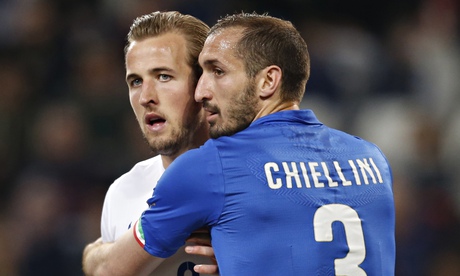
In hindsight, the writing had been on the wall from this game’s opening exchange. Only 16 seconds had elapsed when Jordan Henderson collected in midfield, spied Harry Kane apparently free of Giorgio Chiellini’s shackles and pinged a pass into the striker’s path. The Tottenham Hotspur forward had a yard of space in which to gather and weigh up his options but, instantly, Chiellini was on him. Illegally, as it happens, but the tone had still been set. A bodycheck to start, a reality check to follow.
Scoring within two minutes of his debut against a beaten and tiring Lithuania is one thing but this was Italy. Admittedly a much changed Azzurri from their own competitive fixture in Bulgaria last Saturday, from which they had made eight alterations, but a starting lineup offering steel and needle. A side who retain some of the streetwise qualities the other teams traipsing in behind the English in Group E of Euro 2016 qualifying clearly lack. Chiellini was winning his 76th cap and had been primed to leave an early impression on the upstart from White Hart Lane. Kane juddered and fell upon impact. By the time he had picked himself up he had a clearer idea what awaited in Turin.
Kane will be stronger for this experience, even if he had to cede the role of national saviour to his club-mate, Andros Townsend, once the hosts’ authority had been eroded by a blur of substitutions. The fairytale the forward has been living of late would have had his skimmed shot in stoppage time screaming beyond Gianluigi Buffon and in, but this script was to be more believable than his mind-boggling rise to prominence. When Chiellini, Leonardo Bonucci and Andrea Ranocchia were focused, Kane had run aground on a rugged backline. “They’re three very experienced, tough defenders,” said Roy Hodgson, whose juggling of personnel eventually struck on proper support for his forward. “ut it’s been a good 10 days for Harry. He’s scored on his debut and played 90 minutes of a tough game. He’ll benefit a lot from that.”
The flashes of promise offered by the Kane-Rooney partnership represented the one tactical experiment that paid off for Hodgson. It was at its most promising when the 21-year-old fizzed a tantalising centre across the six-yard box that his captain flicked narrowly wide of the far post, but there were glimpses of understanding and a proper partnership, give-and-goes which came off and inter-play which discomforted the Italians. Kane is learning on the hoof – rewind a year and he had only ever scored two goals for Spurs, with one of those being against Shamrock Rovers in the Europa League – and this game will have been an education from early buffeting to late shot at goal.
It was also a test of patience. The mishmash of a first half had been utterly underwhelming. England had flung down a stodgy midfield diamond devoid of all the pace in the pass that has propelled them on against lesser opposition since their toils in Brazil. Where were the “five-minute furies” Rooney had trumpeted as having become a tactic of choice? The initial sloppiness exposed Hodgson’s team as flat-track bullies, standards slipping in an atmosphere the manager likened to “a practice match”. It was as if the upbeat tempo had been sucked from England’s approach, the occasion’s rhythm imposed on them by a canny Italy who might have been stretched had the visitors torn at them at pace. The late cameos from Ross Barkley and Townsend confirmed as much and, without that direct running from wide, Kane went starved of service for long periods.
None of Hodgson’s early risks paid off. Phil Jones, beaten across the turf by Chiellini as the 30-year-old centre‑half set up Graziano Pellè’s opener, had offered none of the assurance in possession subsequently delivered by Michael Carrick in his natural position. Jones retreated into the backline with no little eagerness once Chris Smalling had retired feeling unwell.
The other pre-match strategy that had smacked of a gamble, Theo Walcott starting up front alongside Kane, had also been ditched before the interval, with the Arsenal winger appearing just as lost in an unfamiliar playmaker’s role.
These are trying times for Walcott. His first start for his country since September 2013 was curtailed before the hour mark, despite the fact he was arguably the one player in England’s ranks who could have benefited from a more prolonged run-out. His last full 90 minutes had come on New Year’s Day, 2014, a few days before he suffered the cruciate knee ligament injury that has so stalled his career. He has managed only 581 minutes of first-team football since, with only five starts this season, his return hampered by an untimely if not unsurprising muscular injury.
It was dispiriting to witness a player who had made his England debut nine years ago rendered so rusty. Walcott deserves better fortune than that.