
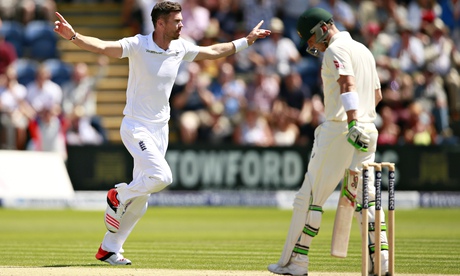
As England surged through the third afternoon of this first Test, initially with caution, later with some controlled and pointed aggression, it might have seemed a little odd to dwell too much on the dismissal in the first hour of the day of Australia’s 37-year-old wicketkeeper for a slightly streaky 22 off 38 balls.
As turning points in Test matches go, let alone five-match series, this looks in isolation like something of a non-starter. Albeit, only to those unfamiliar with the work of Brad Haddin, hammer of the English throughout the 5-0 whitewash in Australia two winters ago and a venerable, lurking bogeyman during the buildup to this series.
For all that, the suspicion of a slight dwindling away, of a congealing of that familiar menace was already out there. Haddin’s non-appearance on the second evening here at the fall of Adam Voges’ wicket had struck a slightly jarring note, Nathan Lyon’s appearance in the gloaming an abandonment of Waugh’s First Dictum, which states that night-watchmen are essentially un-manly, limp, craven, English, an admission – horror of all horrors – of some fatal tremor of self-doubt.
There was, though, good reason for protecting Australia’s No7. Most obviously to preserve just a little longer the unscabbed wounds of the last series when Haddin was Australia’s mid-innings executioner throughout, a glowering, cuffing, hoicking booby-trap lurking between the top six and lower orders. This was the pattern of Haddin’s Ashes last time out, when the wicketkeeper just kept on bailing them out from No7 right through to Sydney in January where a score of 97 for five was biffed and crashed up to a rollicking 326. It was, for all Mitchell Johnson’s fire and craft, a series-defining turn and Haddin might have retired after that. He is already the fourth most-capped Australia wicketkeeper after the modern giants Rod Marsh, Adam Gilchrist and Ian Healy. He wanted a World Cup, which he got. And he wanted another shot in England, where he has known only defeat.
Australia will still fancy their chances in this Test and beyond, but as far as Haddin’s own contributions to this powerful team go there is a palpable dwindling of influence since that last Ashes series. In 12 Tests since Sydney 2014, Haddin averages 15. Keeping wicket here he was late getting down to a nasty, dipping edge off Joe Root before England’s first-day centurion had scored. Chuck in numerous byes on a tough, up and down pitch and an unfavourable critic might conclude Haddin’s net contribution to the cause before he had batted here was minus 151. Here he came out to bat at 265 for six, Shane Watson having been dismissed lbw to give Stuart Broad his first wicket. As ever Watson looked devastated, crushed, genuinely shocked to be given out, as though unaware until now such a thing was actually possible.
It should perhaps comes as less of surprise these days. Watson has been described as not so much an lbw candidate as duly-elected life president of the international lbw association. Given the prominence here of that familiar broad front pad it is clearly a role he intends to see right through to his last available breath.
At which point: enter the gloveman. Haddin marched out with a familiar menacing jauntiness, a cricketer made for these kind of occasions, and bolstered by the muscle memory of all those bruising mid-innings counterattacks. He almost went second ball, jumping into line as Broad dropped short and seeing the ball bounce down not far from the stumps. Broad held his head in his hands. Haddin grinned a horrible grin. This is probably a tautology. Unless otherwise stated it is safe to assume Haddin will be grinning a horrible grin at all stages in this series. No doubt Haddin would grin a horrible grin just before you lowered him on a makeshift scaffold into a bubbling vat of magma. Before long, Mark Wood trapped Lyon lbw, hurtling in off his short somersaulting run and performing a gleeful little dance as the finger went up. At which point Haddin was joined by Johnson, twin hammers of the last Ashes series. Haddin, though, is the real heart of this team, as Australian wicketkeepers so often are, squatting behind the stumps and accumulating, oyster-like, all that free-floating bile and grizzle and Pommie-snarl.
Here he was scratchy early on. Still quite clearly the same Brad. But less so somehow, a Haddin tribute act without that same extra little breath to play his shots, hurried a little even in defence. It took 16 balls to get off the mark with an edged pull just past his leg stump off Ben Stokes, with whom there is a little history. Stokes had Haddin out off a no-ball in Australia. Haddin, diligent as ever, has never let him forget it. The next ball was driven with scalding power past short mid-off, followed by another slash to third man. And suddenly, gears still crunching, cam belt smoking , engine revving, Haddin was playing a little bit like Haddin again.
Not for long. Jimmy Anderson had taken the new ball with Broad and suddenly Haddin looked, if not all at sea, then certainly queasy. There was a horrible two-footed lash of a front-foot drive before Anderson got him with the score on 304, Haddin hanging his bat out at an away-swinger, feet only halfway there and nicking behind. Out prodding, not slashing or carting or heaving: it was a most un-Brad-like end, albeit to the bowler who has dismissed him more than any other in Tests.
For the rest of the day, Haddin was back in his familiar role as conductor of the cordon, troubled at times by the uneven bounce, but otherwise he stood behind the stumps in that attitude of distinctive, lounging menace, arms crossed, brain always ticking.
Nothing has been settled in this match, let alone the series. Haddin is too fine a player, too gnarly an opponent to go without a last flex of the muscles somewhere along the way. For now though England will cling to the first hint here of a familiar ghost perhaps in the process of being banished.


.png?w=600)









