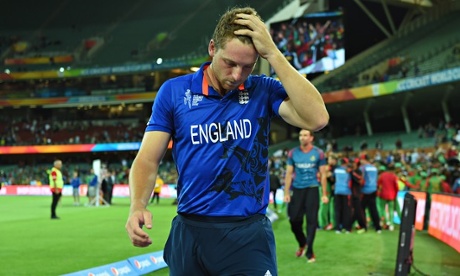
And so we’re out. Still in the group stages, and with one match left to play, England have already been eliminated from the 2015 Cricket World Cup, losing to Bangladesh by 15 runs. The nation that invented cricket is left trailing in the one-day version of the game.
The reasons for England’s abysmal showing are many. There was Kevin Pietersen’s very public falling out with the team. There was Alastair Cook’s failure to score more than a few runs and subsequent sacking as one-day captain just weeks before this tournament began. (He said this was our best chance of winning a World Cup but we didn’t believe him.) There is a lack of variety in our bowling attack. But is there a more underlying reason? Is there something rotten at the heart of the English game?
Of course, this isn’t the first time we have witnessed what might be described as English cricket’s “darkest hour”. The term “Ashes” is derived from a mock obituary published in the Sporting Times when England first lost to Australia on home soil in 1882. The obituary stated that English cricket had died, and “the body will be cremated and the ashes taken to Australia”. Piers Morgan’s Daily Mirror blasted the England team on the front page in 1999 for losing a home Test series to New Zealand. At the end of the series, England dropped below Zimbabwe in the ICC world rankings and in a moment of black humour England’s fans were heard to sing “We’ve got the worst team in the world” to the tune of the hymn “He’s got the whole world in his hands”.
Since then we have had the introduction of central contracts, and more money in the game, but still we struggle – in 2013-14 England were whitewashed 5-0 by Australia in Tests, blown away by the pace and hostility of Mitchell Johnson. Fans are good at taking such body blows in our stride. I toured Australia in 2002-03 when, despite England losing the series 4-1, the Barmy Army remained in good voice. We may have been thrashed by the Aussies on the pitch, but at least we outsang them in the stands.
Yet surely we can do better than be good losers? In Australia, one of this World Cup’s co-hosts, cricket is the national sport but in the UK it lags way behind football. Ireland, who only started playing One Day Internationals in 2006, have performed better in this World Cup than England.
So here’s my three-point plan to save English cricket:
Return cricket to terrestrial television
I remember during the school holidays being able to while away the hours watching cricket on the BBC, and then later on Channel 4, but England’s historic 2005 Ashes victory was the last to be shown on free-to-air TV. Now you need a bank-breaking Sky TV subscription to watch any more than the highlights of England matches. Cricket is a complicated game – it’s difficult to know your second slip from your long leg – but with a bit of time and some good commentary, you’re well on your way. Without this induction, I wonder whether many youngsters these days really know what cricket is. Falling participation at grassroots level can probably be partly explained by this absence of live cricket from TV screens. Some 844,000 people played cricket in 2014, compared with 908,000 in 2013.
Bring the game back into state schools
The writer and former cricketer Ed Smith has documented how the game is once again dominated by private schools. In 1987-88, of the 13 players who represented England on a tour of Pakistan, only one had attended a private school. By contrast, in 2011 more than two-thirds of the team were privately educated – a situation that has not improved in the last few years. We have now reached a point where we are in danger of never seeing a great state-educated player of the likes of Ian Botham or Andrew Flintoff. This player drought is partly because of the selling off of playing fields and partly because of the pressures of the national curriculum. To improve participation requires more investment in state schools and greater flexibility in education.
Ban innovation
The ECB should lobby the International Cricket Council to ban any sense of adventure from the game. Ramp shots, reverse hits and mystery balls should be eradicated and bonus points should be awarded for persevering with a bowling attack of right-arm, medium-pace trundlers. Likewise, leaving any ball outside off stump ought to be rewarded with five runs.
Actually forget that last bit. It was a silly point (if you’ll excuse the pun). Cricket ought to be about invention as much as it is about tradition. But to fulfil our potential on the world stage, we must tap talent from the whole population, not from the privileged few. Let’s hope we can do better in 2019.