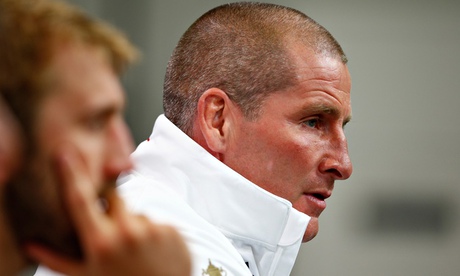
It is a little early for obituaries. And as for those who want to start the postmortem, they might stay their hand at least until the patient is dead. A three-point defeat, and a match against Australia to come, means there is life in England yet, for another week at least. One would not necessarily have known it from the look on Stuart Lancaster’s face during his post-match press conferences on Saturday night. He is typically pretty chipper, even in defeat, bullish at least. This defeat seemed to sap him, though, and he sat, sombre, sullen, stony-faced, his voice straining as he spoke. Alongside him Chris Robshaw held his hand across his face, the better to mask his own emotions.
Robshaw, to his credit, shouldered all the blame for the decision to kick that last penalty to the corner rather than let Owen Farrell take a shot at goal to try to secure the draw. Lancaster, perhaps a little too conspicuously, distanced himself from it in his own remarks. “On the field it’s the players making the decisions,” he said, “and it was a big call to go for the corner. It’s great if you score it. If you don’t, it’s a big moment. Obviously it was a huge moment in the game.”
That was his first take, given on TV. He was not any more supportive when he was talking to the press soon after.
Flash back three years to the last time England lost to Australia, 20-14 in the autumn of 2012. Robshaw was criticised again then, for deciding to kick several penalties to the corner to attempt to force a try, rather than let Toby Flood take shots at goal. “I thought it was the right decision,” Lancaster said then. “You back your players on the field. The momentum was with us and I thought from there we were going to score a try. If we are going to give players the confidence to go out and play, then we have to back them.”
The following week England lost again, 16-15 to South Africa. Then, Robshaw went the other way. England, trailing by four, won a penalty with two minutes to go. Robshaw let Farrell kick the three points, thinking there would be time enough for them to make up the extra one. He was wrong. Not that Lancaster was going to admit it. “A number of decisions are made in a game,” he said at the time, “and I am not going to talk about one of them. We will sit down with the players and review them all when the emotion has gone.”
Draw your own conclusions from the comparison between the three reactions, especially those then and the one now. To these ears it seems pretty stark. On Saturday night Lancaster did not seem as keen to back his captain. And the more cynical out there might even think it seemed a little as if the coach wanted to shift some of the responsibility on to the captain.
Because Lancaster knew full well the risk he was taking when he picked that team. He said himself that he was going to be judged by the selections he had made, especially the decision to drop George Ford, bring in Sam Burgess and shift over Brad Barritt. “This game was always going to be the one on which we were judged and clearly selection has heightened it. If we win this game, it will be judged a success.”
Be kind and put Lancaster’s reaction down to shock. It was a game one needed to watch twice even to begin to understand what happened in that last quarter, how England had lost a match they had led by 10, to a team so riven by injuries that they were there to be taken. Wales finished up fielding a back-line cobbled together out of two scrum-halves, two fly-halves, two wings and an inside centre. On second viewing two of Lancaster’s errors stand out.
The first is the decision to pick Barritt to play at outside centre. Wales exploited his sluggishness, drawing him in with a dummy runner, then attacking him on the outside, forcing him to switch targets and exposing his lack of speed. The second is the call to bring on George Ford for Burgess, who had been doing sterling work in defence throughout and led the tackle-count among the backs. It meant Wales were able to unleash Jamie Roberts, who switched back to attacking that inside channel. These were tactical errors.
But it still seems that Lancaster’s biggest problem is the one he has had throughout his tenure – his strategy. It is not a question of individuals, so much as it is one of collective identity. One week into the tournament he has been preparing for for the last four years Lancaster still seems unsure what his best team is and the way that he wants them to play.
Which was how it came to pass that England ended up fielding an untried centre combination, the 14th used in 44 matches, for the biggest match they have had in four years. And which was why, after spending the last 10 months fostering a more adventurous and attacking style of a play, he suddenly switched back to a conservative approach for this crunch match. He seems, like his team, to be still finding his way in international rugby. He has another week to figure it out.