By five o’clock the sun had disappeared back behind the clouds, so the last rites of another Australian defeat played out in fading light. Their openers, Chris Rogers and David Warner, had held the loss at bay through the sunlit afternoon until Ben Stokes broke their stand and the back of the innings in the first of two superb spells of swing bowling.
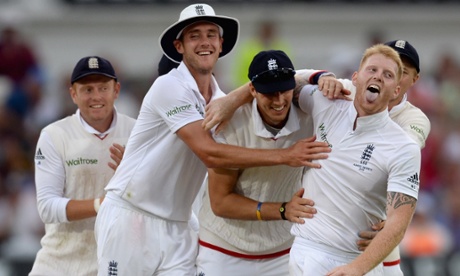
Stokes claimed the second day of the Test as his own, almost as surely as Stuart Broad had done the first. He finished it with figures of five for 35, his best bowling for England since the six for 99 he took at Sydney early last year. This is only his 15th Test but he is now one of a handful of English players, eight in all, who have scored two Test centuries and also taken two five-wicket hauls. The most recent of them was Andrew Flintoff and the one before that Ian Botham.
The superstitious say luck is a capital store, reduced by expenditure. And for this 24-over stretch it felt as if England had spent all theirs on the first morning of the match, when every edge seemed to fly to a fielder and every catch seemed to stick in someone’s hand. Now their supply was exhausted. Warner was beaten on the outside by Broad four times in an over and dropped by Alastair Cook when he had scored only 10. If England’s players and fans felt just a little uneasy, even though their lead was so large, it was only because the resistance seemed so unfamiliar. It was the first sound partnership Australia’s top six had managed since their second innings at Lord’s, back on 19 July. There are grizzly bears out there who understand teapots better than the Australians understand how to bat in these conditions.
Here, though, at last Rogers was batting well and he and Warner were eating into England’s lead. Broad shut down one end, with three maidens in his first six overs, but at the other England were struggling a touch. Wood seemed determined to bowl a different ball each time he ran in and, when he made way, Warner set about Steve Finn. He clobbered 15 off Finn’s first over, one four through fine-leg, another through long-off, capped by a magnificent six over deep square-leg. After his first three overs went for 30 runs Cook yanked Finn from the attack. It was then that he turned to Stokes, who made the ball swing from the start and immediately quietened down both batsmen.
A fourth fast bowler was a luxury Michael Clarke did not have during England’s innings, since the Australian selectors had dropped their all-rounder Mitchell Marsh and brought in his brother Shaun instead, the idea being that it would strengthen the batting. The upshot was that Shaun Marsh made two runs in the match and Warner ended up bowling three overs of his leg-spin to Joe Root and Jonny Bairstow on the first afternoon. It is easy to criticise the selection in hindsight, of course, but Clarke made it clear he had not been that sure about it beforehand either.
Before Friday Stokes had had an odd sort of series, firing in fits and starts without ever quite seizing hold of an innings. With the bat he has been erratic. A 52 and a 42 at Cardiff, 87 at Lord’s, along with a couple of ducks. Here he made five from 10 balls, before he was caught down the leg side off Josh Hazlewood, eighth man out. With the ball he had taken only two wickets in the first three Tests, Adam Voges at Cardiff and Hazlewood at Edgbaston. In between he went wicketless in the second innings at Cardiff and both innings at Lord’s. Altogether it added up to two for 199, though he would have had a few more if Ian Bell had held on to the chances he missed in the slips. When Bell dropped Warner in Stokes’s second over, it was the fourth catch he had missed off his team-mate’s bowling this summer.
Luckily the next edge flew a little wider, towards Root rather than Bell, and he held it, taking it one-handed while diving to his left, arm out full stretch. In his next over Stokes got Warner too. This time from a shorter ball, aimed in at the body. Warner tried to pull it but had too little room to work in. The ball looped high into the air, stayed up long enough for Warner to hammer his bat into the ground, before Broad took the catch at mid-on. Warner fell the very same way in the second innings at Edgbaston. In the over after that Stokes got Marsh, caught, by Root again, at slip. Three wickets in as many overs had Australia spiralling and England steaming.
After that Stokes took a superb catch, low down by his feet at point, as Steve Smith creamed a drive away off a wide delivery from Broad. As with Warner and Marsh, it was the very mistake England had been inviting Smith to make since he first came to the crease. Stokes’ rhythm was interrupted by the tea break, though it did allow him to regather himself and so stretch his spell to 11 overs. He was limping a little by the end, suffering a touch of cramp in his right leg. Revived by a banana and a quick massage from the physio, Stokes was soon back bowling again.
He duly dismissed Peter Nevill with an inswinger that hit him flush on his back knee roll, in front of middle stump and Mitchell Johnson, caught at first slip off a ball that went the other way. Let run, Stokes would probablyly have got the rest of the tail too, if only that fading light had not forced an end to the day’s play.