Was it only three and a half months ago that England dragged their backsides away from Wellington’s Cake Tin, after the greatest humiliation they have suffered in a one-day international? Twentieth February – not only bowled out for 123 but then utterly shredded in reply by Brendon McCullum, so there were still 226 balls of the match unused when the winning runs were scored. It saved a fortune on the electricity bill for the floodlights.
Much has happened in the interim, an upheaval in the England team and management. Paul Downton has gone and so too has Peter Moores. Andrew Strauss, Downton’s replacement, has demanded a new ethos in all cricket and the interim coach, Paul Farbrace, latterly in consultation with the incoming head coach, Trevor Bayliss, has delivered brilliantly. Seven of the team who played in Wellington have been replaced.
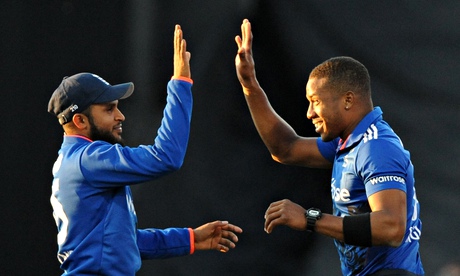
Steven Finn, who was torn apart by McCullum in a manner never before inflicted on any England bowler, has been retained and gained his retribution by bowling out his aggressor. The bowler’s reaction showed how cathartic that must have been.
Three months can be an age in cricket, but given that New Zealand were neither fielding Tim Southee, the bowler who took seven for 33 against them in the World Cup, nor their best ever spinner in Dan Vettori, nor Corey Anderson, the all-rounder who once completed an ODI hundred from 36 balls, has there ever been quite such a turnaround in fortune, from the worst defeat to the most comprehensive win?
The Test series against the Black Caps has led to records being broken and that has continued now, not only with England’s highest score in an ODI but an all-comers’ seventh-wicket record between Jos Buttler – who now has the second fastest ODI hundred for England to add to his own record at the top – and Adil Rashid.
Once England had posted that total of 408 for nine – the like of which has been chased successfully only once, and that on small boundaries at altitude in Johannesburg – New Zealand had little chance of matching it, which made the job of the bowlers easier. Finn’s dismissal of McCullum all but stopped the chase in its tracks even given the potential of Martin Guptill’s hitting prowess.
It certainly provided an ideal environment for Rashid with his leg-spin. He bowled very nicely, showing deceptive variations and some decent spin, and with his runs was a plausible candidate for man of the match. But the clamour that is already there for his instant inclusion in the Test side is heaping too much expectation on him and getting way ahead of the game.
It is four years since I found myself writing an optimistic piece about Scott Borthwick perhaps having the potential to become the first English wrist-spinner since Tommy Greenough, in 1959, to take five wickets in a Test innings. That prospect fizzled out and last season he managed only 13 wickets for Durham at more than 58 runs apiece: his batting has become his forte instead.
As an aside, the most prolific wrist-spinners for England since Doug Wright (108 wickets), the left-armer Johnny Wardle (102) and Eric Hollies (44), all in the decade after the second world war, have not been the obvious ones (Robin Hobbs, Ian Salisbury and Chris Schofield, all of whom were selected specifically as spinners) but the opening batsman Bob Barber, who took 42 wickets, and Ken Barrington, who managed 29.
In Ian Peebles (45), Len Braund (47), Walter Robins (64) and Tich Freeman (66) you have the only wrist-spinners to have taken more wickets for England than Barber. As a contrast there are 25 finger-spinners with more than him, of whom 15 have more wickets than Wright. A lack of quality wrist spin is scarcely a new phenomenon.
Even back in the Caribbean, where Rashid was selected for the Test tour but did not play, it was felt by some of the management that he could have a stronger part to play in England’s limited-overs cricket. For spinners, particularly those who can turn the ball either way, have tended to thrive in the format, largely because of the imperative for batsmen to attack and the preponderance of boundary fielders.
On the other hand Test cricket – as New Zealand and most recently England have shown – can be adventurous, but it still remains a world away from the white-ball game. Unless there was a pitch that was so obviously going to turn significantly (the UAE in October might be a case in point) then, particularly in this country, the bowling is always going to be dominated by seamers, with a spinner largely required to play a holding role until the latter stages of the match.
There is certainly a case for saying he could play a part in winkling out the tail, something that has eluded England for several years now, but technically, in terms of his default pace, he may allow Test match batsmen too much time. He really cannot play as a single spinner and in general, unless the seamers would be largely redundant once the new ball had gone, he would unbalance the team as a second spinner.
For now, best to enjoy what Rashid is doing in the happy environment in which he finds himself. Test cricket is no longer the only benchmark by which a cricketer should be judged.