Two hours before kick-off England’s bus started its slow and stately procession from the Whitton Road down the approach to the West Gate. As is the way now, it stopped short of the stadium walls to allow the players to walk through the crowd on their way into the ground. This week though, the scene was a little different. Aside from the little kids in the front rank, most of the fans had their backs turned to the team, the better to see the giant screen showing Wales’s match against Ireland in Cardiff. England’s players had their heads down and their earphones in, as they always do, but the screen was only 30 yards away, and one or two of them couldn’t help but sneak a quick peak up at it. Ireland were trailing. Shut it out and stroll on. That’s the way these days, as according to all the old cliches: “We have to play our own game … can only worry about the match in hand … just try and control what we can control.” You know how they go.
But England’s dressing room is only a short way from the spot where the thousands gathered to watch the other game, and so was still well within earshot. When the whistle went in Cardiff, no doubt England players could hear the rare sound of thousands of their fans roaring for a Welsh victory. The noise could only mean one thing. For England, the grand slam went in the last round, but the Championship was alive again. And this side have won so little in their time together they would settle for a prize won on points difference, one there to be taken by whoever can win their remaining games in the most emphatic fashion.
Extra incentive to turn it on against Scotland, then, not that they needed it. For the last fortnight all the talk from the camp has been about how the side are burning with desire to put right what went wrong in Dublin. They have told of training sessions cut short because they were so fierce the coaches were worried someone would get hurt. It showed. England made an electric start, and the crowd exploded into life at the sight. From the kick-off, an irresistible drive up the middle that sucked in the Scottish defenders, then a break from George Ford, straight through a yawning gap and away towards the goal-line. Startling stuff. Ford’s pass left Luther Burrell with only Stuart Hogg to beat. Burrell couldn’t do it. He tried to step when he should have passed to Anthony Watson outside him. That, it turned out, was the first of many points gone begging.
Not that anyone knew it then. Instead, England and their fans seemed to think “no matter”. They soon came again. Jack Nowell this time, taking a high ball, then setting off upfield. Then that man Jonathan Joseph, cutting inside Matt Scott, jinking around Hogg, sliding over the line to score. Four minutes gone, England seven, Scotland nil, and the question now not whether they’d win, but by how many. Or not.
England got sloppy, seemed to think they could afford to squander their opportunities. In the best of them, Nowell went through again, but he too tried to step when he should have made a simple pass to Ben Youngs. Too often England’s players seemed to come down with severe cases of white-line fever. Players decided to go for the line themselves when they should have given the ball, or they tried to find a shortcut to the line with a wildly ambitious pass when a simpler one to set up another phase would have done.
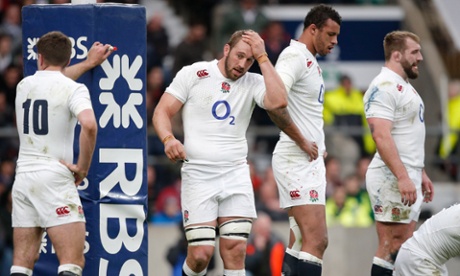
It wasn’t arrogance that made them so profligate, but ineptitude. Perhaps they were just too wound up. Their ferocity was wonderful to watch at some points, as when Courtney Lawes sacked Finn Russell, and Mike Brown made a 30-yard sprint for the line, seemingly heedless of the fact that he was wearing only one boot. In those first 20 minutes, England had 43 carries for 259m as opposed to the 14 for 35m made by the Scots. But those seven points were all they had to show for it. A better team than England, one blessed with older hands and calmer heads, would have been at least 14 points up. A better team than Scotland wouldn’t have let them get away with it. Stuart Lancaster’s team had their chances against Ireland, remember, and they let them slip then, too.
Scotland’s superb comeback did force England to sharpen up, enough at least to take control of a match they should have won more easily than they eventually did. But they were never clinical enough, were always too wasteful. Two tries were disallowed for forward passes. Ben Youngs, the man of the match, reckoned his team had left “four or five” out on the field. All this when they could least afford to, when every extra point would count not only in the score at the end of the game, but over again in the championship table next week. An afternoon that began with the Welsh victory, then, and which had seemed so rich in promise, ended with another blunt reminder about the nature of this English side: a good team, not a great one; a developing team, not a finished one; a willing team, not a ruthless one.