England’s Under-21s arrived in Olomouc on Sunday for their first training session at the Legionarska training ground, but it was curtailed with the arrival of murderous dark clouds and an unexpected lightning storm. In previous tournaments that might have been seen as typical of the Murphy’s law that seems to apply to England at international competitions or at least as an ominous portent of things to come. But there seems less reason for paranoia this time around.
Gareth Southgate and his side have genuine aspirations to win the European Championship and a quick glance at the team’s results since a dismal showing in Israel at the 2013 finals is enough to explain the optimism – 15 wins in 17 games and an undefeated qualifying campaign, Portugal and Germany beaten in friendlies. And, that unexpected thunderstorm apart, their preparation for the tournament in the Czech Republic has been smooth.
The buildup to previous tournaments has been dominated by rows about player availability, with the then manager Stuart Pearce at loggerheads with clubs and players prior to the 2011 and 2013 tournaments. This time around, though, the philosophy has been far clearer. “I think that if we’ve had any feeling that players were not desperate to be involved we haven’t picked them. Simple as that,” said Southgate last week. And the demarcation between senior squad and Under-21s has at last been properly defined.
Jack Wilshere, Alex Oxlade-Chamberlain, Phil Jones and Ross Barkley are all eligible but, with their places in Roy Hodgson’s squad established, they have been omitted for two understandable reasons – they did not play in the qualification campaign and the consideration is that they do not need further under-21 development. In short, they do not really need the Under-21s and the Under-21s do not really need them. As such there has been little friction. Only the absence of Luke Shaw has provoked problems.
It is not a policy followed by everyone. Sweden have named 12 full internationals in their 23, Denmark 11 (with six of their squad joining up with the Under-21s after the senior squad’s Euro 2016 qualifier against Serbia at the weekend). Italy’s squad, on the other hand, is entirely uncapped. But, because of injury and unavailability, self-imposed or not, few managers will be able to name what might be considered their country’s strongest under-21 XI.
They can all, though, take comfort in the fact that they are in the finals at all. This is not an easy tournament to reach. Even qualification group winners went into one of seven play-off games. England came through theirs, beating Croatia 4-2 on aggregate after 2-1 wins home and away but other big beasts did not fare so well. Spain, champions in 2011 and 2013, were stunned by Serbia after a 93rd-minute goal in the second leg of their play-off in Cádiz in October giving the visitors a 2-1 victory on the night and on aggregate.
France, Under-20 World Cup winners in 2013 and widely considered the best young international side in Europe, won the first leg of their play-off 2-0 against Sweden but then crumbled 4-1 in dramatic circumstances in the second leg. Holland, 2006 and 2007 winners, were beaten 7-4 by Portugal. It leaves Germany as the favourites and Southgate’s side very much among the contenders.
Portugal and the in-demand Sporting pair of João Mário and William Carvalho await again in their opening game on Thursday in Uherske Hradiste, close to the Slovakian border, before games against Italy and Sweden in Olomouc. The final is in Prague on 30 June.
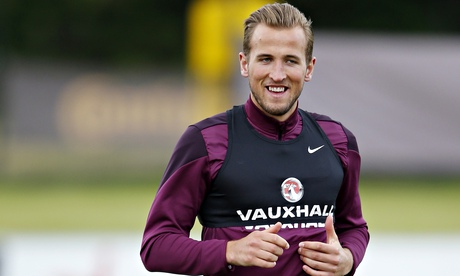
England last reached that point in 2009, when Pearce’s side were hammered 4-0 by Germany. Going one better this time around is the avowed aim. Harry Kane, who in contrast to some over the years has been keen to emphasise his eagerness to play in the tournament, is likely to spearhead the attack but Southgate’s other attacking options provide flexibility – Saido Berahino was the leading scorer in qualification while Danny Ings comes into the competition on the back of an impressive season with Burnley and a week after it ends will become a Liverpool player.
The goalkeeper and captain, Jack Butland, went through the chastening experience of 2013 but has also tasted success in the under-nder-17 version of this tournament in 2010. John Stones leads a back four that could feature three players with full caps and Southgate has looked to develop a midfield that can provide the control and penetration required by his possession game.
England sides have, of course, travelled to tournaments with high hopes before only for them to be dashed or shown to be overly optimistic in the space of a single group-stage game. And while there is genuine reason for expectations to be raised, there is plenty of quality elsewhere in the tournament.
Germany are favourites. Their coach, Horst Hrubesch, led them to their 2009 success and that side went on to provide the backbone to the country’s World Cup success in Brazil last year. Again their weakness is up front but the midfield looks intimidatingly strong, with Mainz’s Johannes Geis and Emre Can of Liverpool providing the control and the creativity coming from Max Meyer and Max Arnold of Schalke and Wolfsburg respectively. They could well be joined in qualification from Group A by Denmark, who feel they have something of a golden generation on their hands.
In Group B Portugal provide a tough test for England in their opener and Luigi Di Biagio’s Italy, even without Marco Verratti and Stephan El Shaarawy, will be dangerous and are led by the prolific Domenico Berardi. Sweden are the underdogs but that play-off win over the much-fancied French shows their potential.
The joy will be in seeing who can announce themselves on the international stage. Some fine players have done so over the years – Andrea Pirlo was player of the tournament in 2000, Petr Cech in 2002, while the Spain squads who dominated the last two editions were astonishing in their depth and quality. Southgate will hope it is one of his youngsters who emerges this time around.