So, no English team in the last eight of the Champions League. Despite the fact that the Premier League – what we are constantly told is the most formidable football competition the world – was recently paid £5bn for its TV rights. And with Everton out of the Europa League last night, English football is without a team at the quarter-final stage for the first time since 1993.
The zenith of football – the Champions League – was represented at today’s draw by three teams from Spain, two from France, one from Germany, one from Italy, and one from Portugal. Ergo, seven teams from countries with what we now like to call “dodgy economies”. And this in a year when Britain may hold a referendum enabling voters to take us out of the European Union: an offer they may very well take up.
The metaphor is irresistible: what a weird relationship we now have with the continent so close – but so far. English clubs rue being dumped out of Europe, while much of the country’s electorate prepares to gleefully exit “the continent”, and be Britannia alone again. How sure we are – in both cases – of a superiority as hubristic in its rhetoric as it is as unconvincing on the football field.
In 2008 England failed to qualify for the Euro championships held in Austria and Switzerland: a memorable contest won by an unforgettable Spanish team. To me the scene was allegorical of the political map to follow, and the rise of British separatism from Europe. Since then: the coming force of Ukip, and – perhaps more cogently – an infusion of generally Europhobic popular feeling across British culture.
And yet: take the Eurostar on a weekday morning, and there they all are in their suits and twin-sets: tapping away on iPads, off to business meetings in Europe. People in London, and others running businesses dependent on trade with Europe, will tell you: “Impossible – we’ll never leave!” But they do not listen to, or vote in, the housing estates of Shepton Mallet, Nuneaton and across the country, where the union jacks fly from satellite dishes.
On the weekend, take a plane from Bristol or East Midlands, and there they are too: lads dressed up as chickens or the Wurzels, off to waddle, piss and vomit across the cobblestones of Prague or Krakow. I was watching them once, in what was the lovely Krakow ghetto, with a Polish bookshop manager who asked: “Why is it the English who do this?”
Perhaps it’s something to do with what Stuart Jeffries in the Guardian called “an Empire state of mind”, morphed into what the sociologist Paul Gilroy calls “post-colonial melancholia”. Whatever the reason, Europe has never been so close for these people, many of whom will vote to leave. Soon, at the other end of the social ladder, those with a place in the sun will be preparing to spend a proper break there, or rent someone else’s, and play at the southern European way of life. Many will then return to work in financial industries preaching “fiscal prudence” bent on destroying that way of life. Let’s remember chancellor Osborne’s most passionate plea of all to Europe: contesting the EU cap on bankers’ bonuses. If Uefa applied a similar rule to footballers’ salaries, the Premier League would have to do the same as Osborne. Our economy still believes that the richer the rich get, the better for all. That principle has manifestly failed the football teams, and may fail us yet, alone across the Channel.
The fact is that the general feeling of “Britain is best” – and better off out of Europe – would make sense if it fitted the reality. If this myth that money can buy everything were not just that. On the morning of Arsenal’s defeat by Monaco, the Paris newspaper Libération wrote that Arsène Wenger now managed a team that “is not really interested in winning titles. But the shareholders are not unhappy …” – and it cited the club’s turnover, second only to Real Madrid’s as recently as 2007. The boasts of the Premier League would not sound so hollow if it had a team in the last eight. The performance of Chelsea’s fans on the Paris Métro speaks articulately for itself, but got its just retort when Paris Saint-Germain booted their team out of the Champions League.
In the real world, Europe is fraught with problems, and the EU even more so. But what if the same miscalculation of our football teams is true off the field too? Why are our trains so awful and most of Europe’s so good? Why do 400 million people travel around the continent without having to show a passport, until they come up crunch against the “UK border”? And if it is like that now, imagine …
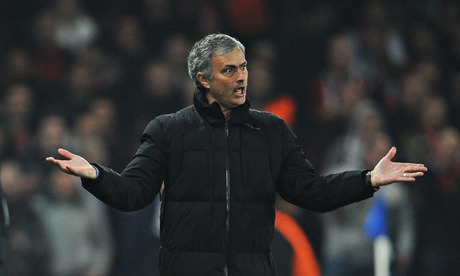
The journalist Roger Cohen – London-born, but working for the New York Times – wrote a book recently in which he describes the Britain of his childhood as viewing “the continent” as a distant place of “rabies and intellectuals”. Europe is no longer distant, but the mentality seems to be coming full circle. Ask Wenger the Frenchman or Mourinho the Portuguese, back to business this weekend, back on the island.