Look forward 10 months. It’s 18 September 2015 and England play Fiji at Twickenham. Eight days later it’s Wales, followed by Australia and finally Uruguay. The first three at Twickenham, Uruguay in Manchester. Four very different challenges that, in all probability, will require four differing answers.
Last week for England it was New Zealand, on Saturday it’s South Africa. Again different challenges, but with Samoa up next week and Australia after that you begin to understand there are parallels with what lies ahead in next season’s World Cup.
Unless England are totally dominant by then they will have to tailor their gameplan to meet the occasion. There is a better than even chance that mid-game adjustments will be needed and on the evidence so far, the ability to ditch Plan A and think on the hoof is a little way off.
With 11 games to go before Fiji, it’s possible that England can win the World Cup. The past couple of seasons have shown that on any given day, England can beat anyone, New Zealand included. Will they? That’s a different matter.
Not for nothing is it said that a side with a core of experience wins World Cups. That’s why New Zealand, littered with guys with more than 100 caps, come so easily to mind. If circumstances change then they have the experience to change with them. When it rained at Twickenham last Saturday they knew what to do and while the scoreline suggested England got close, the reality was otherwise.
It helps if you have a backline with close on 500 caps between them rather than a midfield playing together for the first time and one wing making his debut. When Ma’a Nonu returns from his broken arm, New Zealand will have close on another century’s worth of experience, whereas England, in part due to injury, are shuffling through the autumn without showing any compelling evidence that they know who will man their midfield come next September.
However, it’s not just the experience on the field that matters. It helps to have someone like Steve Hansen calling the shots. He was coaching Super Rugby at the turn of the century, was formed internationally by a few fiery seasons with Wales, when he was tested at every level from changing room to committee room, and had a World Cup in his back pocket before assuming total control of the All Blacks. Since 2011, Hansen has tasted defeat twice, but around him are guys who have been learning since they got beaten by France and showed a lack of nous in Cardiff in 2007.
England’s coaching team are new on the block. From where Stuart Lancaster found England after the 2011 World Cup they have come along way, but the evidence of last Saturday suggests they not only have a way to go, but old habits – discipline, breakdown in skills and the ability to think clearly under pressure – seem to die hard.
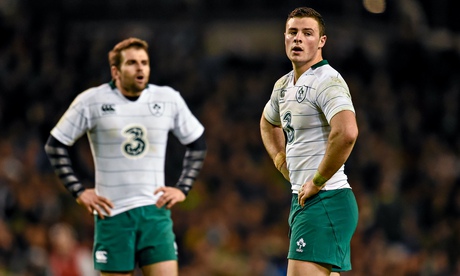
Contrast England with Ireland last week. Rain was the common denominator, but Ireland also had an embryonic midfield. Robbie Henshaw and Jared Payne, with three caps, were standing where Brian O’Driscoll and Gordon D’Arcy had finished the Six Nations with 212 between them.
After 15 years neither O’Driscoll nor D’Arcy were starting a Test in Dublin. D’Arcy probably could have been, but Joe Schmidt, another New Zealand coach with a wealth of experience – Bay of Plenty, Auckland Blues, two Heineken Cups with Leinster and a Six Nations championship in less than two seasons with Ireland – decided he’d go with the guys who had trained together during the week.
To understand why, it helps to understand how Schmidt’s teams work. The gameplan is simple, although there are always three or four moves which, when you see them, are trademark Schmidt. The Tommy Bowe try that finally did for South Africa was a classic example of an almost forensic approach to finding weaknesses and then offering his players ways in which to exploit them. Obviously it helps to have Jonny Sexton around and if Conor Murray appeared to be the architect of the move it was Sexton stepping inside the drifting cover who set it up. But the process started much earlier, probably three phases earlier. Now compare the sophistication of that try with the move that set up the victory.
A lot gets talked about “empowering” players. Fair enough. And yYou could argue that Jonny May’s remarkable try for England was the result of empowerment, but coaches also have to lead. If Schmidt was taking a gamble on Henshaw and Payne he lessened the odds by being quite proscriptive in the way they played. Told to keep things simple – I can’t recall a 50-50 offload – they stuck to the basics, so that when Henshaw kicked, both chased and harried Willie le Roux into the sliced clearance that set up the lineout and Rhys Ruddock’s score.
Simple and effective, but how often did England chase and retrieve their kicks in the second half at Twickenham?
South Africa responded to defeat and even if Heyneke Meyer says the five changes were always planned, then so be it. Lancaster has decided otherwise. He’s decided not to use selection as a method of changing things around, clearly believing his coaching team or the players themselves have the wherewithal to freshen up their game. It will be fascinating to see if he’s right.