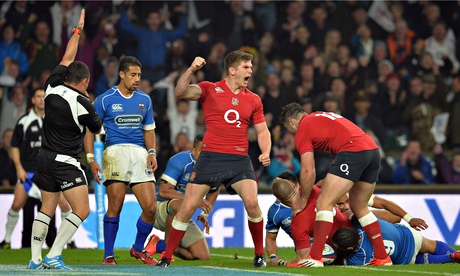
This is the week when Stuart Lancaster’s England have to be tactically smart. If they are to end the autumn with something approaching a pass mark – by no means a distinction when you look around at how other sides are developing – they have to look at what they do best and what will beat Australia.
The evidence of Dublin on Saturday only underlines what we already knew about Australian strengths and weaknesses, so if England invite them into the game as they did the Samoans, they’ll be asking for trouble.
The formula has to be forward power – and England have the set piece to do that, otherwise you don’t bundle a Springbok pack back over its own line twice – plus territory and defence.
Give Australia the ball in the wrong half of the field and it means trouble. Discipline is everything, which means being sharper than in the first rudderless minutes at Twickenham on Saturday when Samoa and their fly-half Tusi Pisi were first to put anything like a pattern on the game.
That said, you stick with George Ford. Of course you do. He took some pretty big hits – some fair, some not – but looked the part, confident to challenge the gain line and pull a few rabbits from the hat rather than go through the motions 10 paces away from examining the opposition, as England had previously been doing in Tests against the All Blacks and South Africa.
At last England’s forwards and backs were singing from the same songsheet, the fly-half pulling big men on to short passes as well as going wide, Ford, in turn, feeding off a Brodie Retallick-like link using Chris Robshaw as his first receiver.
Of course, it is the curse of selection that once Lancaster got the right fly-half the inevitable question arises – why did it take him so long? And then we come to the week’s biggest question: does he keep Owen Farrell at inside centre? He inevitably will, but should he? The answer is probably yes.
Not even Farrell would claim to be the best No12 in the country, and nor is he in the form of his life. There are issues about whether he should have been selected in the first game against the All Blacks when injury had denied him decent game time. But Farrell has time on the clock with England and there are signs that some of the rust is beginning to fall off.
He looked far from comfortable early on against Samoa and throughout the game there was an inclination to drift and squeeze the space outside. Billy Twelvetrees also looked lively when he came on. But other qualities come into the equation and England and Lancaster clearly rate the person and the warrior that is Farrell – the spark, the aggression, the man that clearly adds to the team environment.
Whether we can be that charitable with others is a matter of concern. If England are to beat Australia they clearly have to score points and Brad Barritt, for all his defensive qualities, is a bit of an anchor – in the sense that it slows things down rather than keeping things safe – in attack.
Outside him are two wings worth sticking with – Jonny May if only for his exceptional pace, Anthony Watson because he looks increasing comfortable and getting there as a Test player – but it might be time to turn to Alex Goode, a more complete footballer than Mike Brown at full-back.
This isn’t the same Brown who soared to the top of the world rankings for full-backs last season. Teams have worked out his limitations – that he doesn’t pass and if he kicks it’s largely for himself – so they aren’t giving him that kind of ball in the kind of space that was food and drink during the last Six Nations. Add the troublesome hands which fumbled another chance against Samoa and you’ve made the case for Goode, who is probably quicker this season.
Lancaster picked Goode when he wanted help spicing up a dull midfield, but the awareness of a man who once was a fly-half might also add to the Ford/Farrell playbook. And there is also the matter of Goode’s back-field cover, something at which Saracens are brilliant, Goode excelling and which a fly-half like the Waratahs’ No10, Bernard Foley, is sure to examine.
Otherwise I’m not sure that Saturday’s back-row changes worked and I can see Lancaster reverting to Tom Wood and Billy Vunipola for James Haskell and Ben Morgan. Wood is another with time on his England clock and adds to the lineout options which England will need against Australia. Haskell needed to nail it against Samoa and he was pretty sharp in getting to David Lemi, who didn’t have a big game.
Morgan’s problem is that he is such a good impact player. His arrival worked wonders against the Springboks but he loses out on balance with Vunipola, probably a better ball carrier for 50 minutes, before making way for the Gloucester No8.